Pomegra
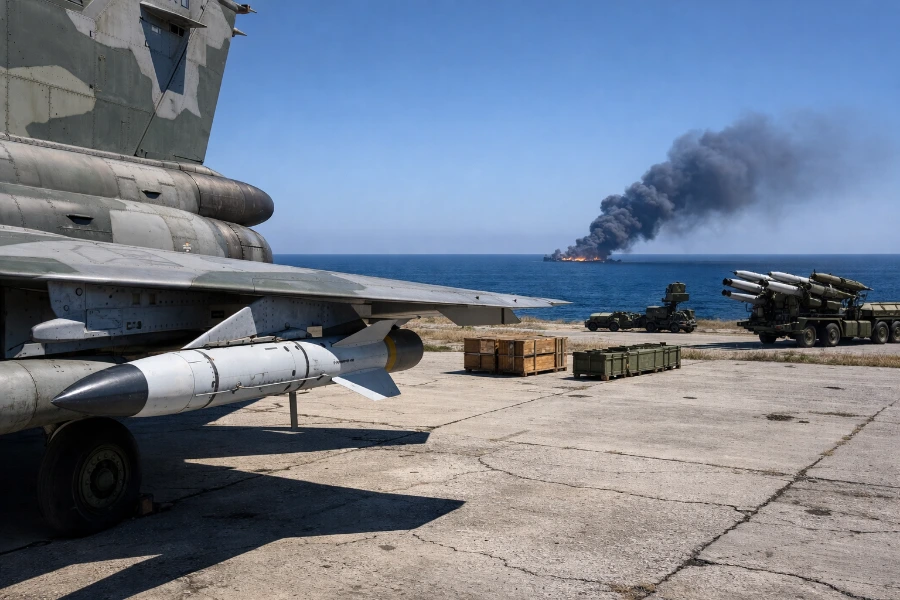
Ukraine says seven naval drones sank the Russian corvette Merkury at Benghazi, Libya, and a Russian cargo ship was hit in the Gulf of Finland a day earlier.
- Ukraine's SBU says seven naval drones sank the corvette Merkury at Benghazi on Sunday, Nov. 22, 2026.
- The sanctioned cargo ship Angara was damaged and a Ka-27 helicopter destroyed. Sparta II was hit in the Gulf of Finland on Nov. 21.
- Brent crude fell 1.75% to $90.95 on Monday, so the strikes did not move the oil price.
Lead
Ukraine's Security Service (SBU) said on Monday, Nov. 23, that seven explosive-laden naval drones sank the Russian corvette Merkury in the harbor at Benghazi, eastern Libya, in the early hours of Sunday. The strike took place roughly 1,500 miles from the front line in Ukraine. It is one of Kyiv's longest-range maritime operations of the war.
The attack also damaged the sanctioned dry-cargo ship Angara and destroyed a Ka-27 naval helicopter aboard the corvette. Satellite imagery taken Sunday showed the vessel mostly underwater after it capsized. Two Libyan officials confirmed the corvette was "severely damaged" at the Benghazi naval base, and civil defense crews put out the resulting fires.
What Happened at Benghazi?
Ukraine says it hit the Merkury at its moorings with seven naval drones, and the ship sank with the helicopter on board. The Merkury is a Project 20380 Steregushchiy-class corvette that entered Russian service in 2023 and joined Moscow's Mediterranean squadron in 2024. It was docked at Benghazi for refueling and resupply.
The Angara is listed under U.S. Treasury sanctions for transporting weapons. It has been linked to Russian naval logistics to Syria and Libya. The SBU said the Russian fleet and its supply networks "have no safe routes."
President Volodymyr Zelenskyy called the operation "exemplary." Ukraine has not said how the drones reached Benghazi, though some Ukrainian-linked accounts point to a mothership launch. Libyan authorities have confirmed the damage but have not attributed it to a specific party.
What Happened in the Gulf of Finland?
The Russian-flagged cargo ship Sparta II was struck by drones on Saturday, Nov. 21, in international waters west of Gogland Island. It had left St. Petersburg for Kaliningrad. The 121-meter vessel belongs to Oboronlogistika, a company that handles logistics for Russia's Ministry of Defence. It is under U.S. sanctions for transporting military hardware.
All 16 crew members were evacuated to a nearby Russian ship. The fire burned overnight, and the vessel later drifted into Finnish territorial waters before leaving them under Russian tow. Finland's military assessed that Ukraine was probably responsible. Prime Minister Petteri Orpo said the war was "spilling over" into Finland's immediate vicinity. Estonia's navy commander said further attacks in the Gulf could not be ruled out. Ukraine had not formally claimed the Sparta II strike by Monday.
Why Does Libya Matter to Russia's Navy?
Libya matters because it became the main fallback for Russian naval logistics in the Mediterranean after Moscow lost Tartus. Syria's transitional government revoked Russia's access to the Tartus port on Jan. 20, 2025. That access had been Russia's only Mediterranean naval base since 1971.
Since then Russia has leaned on ties with Khalifa Haftar, the commander who controls eastern Libya, to use ports such as Benghazi and Tobruk. The Merkury strike shows that this arrangement no longer shields Russian ships. Ukrainian forces have also carried out operations from bases in Misrata, Tripoli and Zawiya in western Libya, according to Kyiv-linked accounts. These are areas that Moscow has not traditionally treated as contested.
How Did Moscow and Markets React?
Russia called the strikes "a very dangerous trend" and "terrorist activity." The Kremlin asked the Baltic states to use their influence to warn Kyiv against further attacks. That request signals Moscow wants Baltic governments to treat the Gulf of Finland incident as their problem to manage.
Energy markets looked past the strikes. Brent crude fell 1.75%, or $1.62, to $90.95 a barrel on Monday. WTI fell 1.49% to $82.17. Brent has posted three straight weekly losses. The main driver was the return of Libya's Sharara pipeline, which lifted Middle Eastern supply and outweighed concern over attacks on shipping near the Strait of Hormuz. Brent had traded around $110 in October.
Geopolitical Dimension
The two operations extend Ukraine's maritime campaign from the Black Sea to the Baltic and the Mediterranean. The Baltic strike falls on the sea lanes that carry Russian military cargo and energy exports out of ports such as St. Petersburg and Primorsk. The Mediterranean strike targets the supply line that connects Russia's forces in Africa and the Middle East with its home ports.
For shipping, the near-term effect is higher risk on routes that touch sanctioned Russian vessels. Insurers and port operators in the Baltic and eastern Mediterranean now face an exposure they did not price a year ago. A burning, sanctioned ship drifting into Finnish waters also raises environmental and legal questions for coastal states that are not parties to the war.
What Comes Next?
Expect more Ukrainian pressure on Russian logistics, and growing pressure on NATO members in the Baltic to decide how far they will tolerate it. Finland's prime minister has said Ukraine has the "right to fight back." Finnish officials have also described the spillover as a risk to their own waters.
Over the next three to twelve months, Russia will likely have to escort or reroute vessels serving its Mediterranean squadron. It will also have to weigh whether Benghazi remains a viable stop. Libyan authorities, who now host a destroyed Russian warship, face a harder choice about their relationship with Moscow.
Outlook
Ukraine says it sank the Merkury with seven naval drones at Benghazi and has linked the strike to a wider campaign against Russian military logistics. A sanctioned cargo ship was hit in the Gulf of Finland the day before. Oil markets have not priced in a supply disruption, and Brent sits near $91. The next test is whether Russian ships keep using Libyan ports and whether Baltic states change how they police traffic in the Gulf of Finland.
Mentioned tickers: None