Pomegra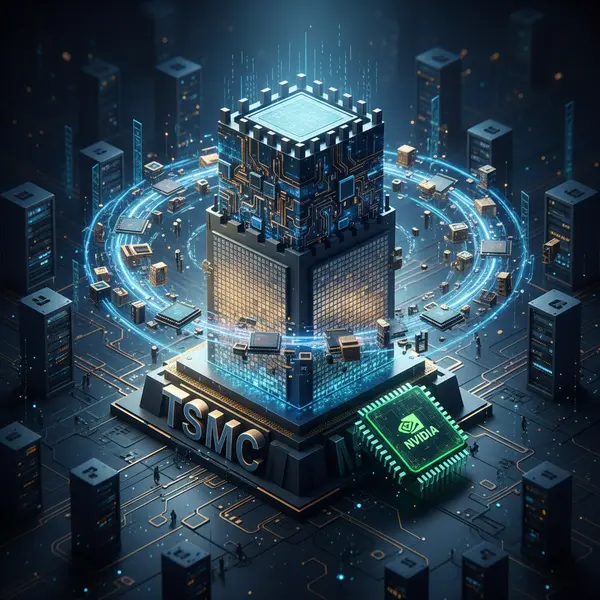
Janus Henderson's Cofsky names TSMC the most critical AI company over Nvidia, citing its foundry lock-in across every leading-edge chip in global production.
- Jonathan Cofsky's $9.35B Janus Henderson tech fund holds TSMC as its largest position, above Nvidia, calling it the pivotal AI infrastructure company.
- TSMC Q1 2026 revenue rose 40.6% year-over-year to a record $35.9B; AI and high-performance computing now represent 61% of wafer revenue.
- Management projects AI chip revenue to compound at more than 50% annually through 2029, with full-year 2026 growth guided above 30%.
Lead
Jonathan Cofsky, co-portfolio manager of the Janus Henderson Global Technology and Innovation Fund — overseeing $9.35 billion in assets — has made Taiwan Semiconductor Manufacturing Co. his fund's largest holding, displacing Nvidia from the top spot. In Cofsky's framing, investors pursuing the best AI stock picks need only answer one question: how much computing power will the world build? That question, he argues, leads directly to TSMC, not to any single chip designer. "This might be the most important company driving AI development right now," he said, articulating a thesis that is gaining traction across institutional desks worldwide.
The Foundry-First Thesis
Cofsky's case reduces to a structural observation: regardless of which fabless designer wins any given market cycle, all leading-edge chips — from Nvidia's Blackwell GPUs to Broadcom's custom AI ASICs to Apple's silicon — are manufactured at TSMC. No peer foundry can replicate its advanced process node capacity at scale. The competitive moat, in this reading, belongs to the company that makes every weapon in the war, not to any single combatant. "Everyone manufactures at TSMC," he noted, encapsulating why the fund's largest position sits with the Taiwanese foundry rather than the world's most recognizable AI chip brand.
The argument reflects a broader institutional re-evaluation of the best AI stock picks for 2026. As the AI infrastructure buildout matures, allocators are increasingly looking beyond Nvidia toward companies that sit upstream of chip competition — foundries, interconnects, power management, and custom silicon architects — all of which depend on TSMC's capacity.
TSMC's Financial Performance
The numbers validate the conviction. TSMC reported Q1 2026 revenue of $35.9 billion, up 40.6% year-over-year in U.S. dollar terms, ahead of consensus estimates near $35.5 billion. Net income surged 58.3% year-over-year to NT$572.48 billion. Gross margins reached 66.2%, exceeding expectations, as advanced process nodes — 7nm and below — accounted for 74% of wafer revenue. High-performance computing and AI-related demand now represents 61% of total revenue, up from roughly 40% two years ago, marking a structural shift in the business mix rather than a cyclical surge.
For Q2 2026, management guided revenue of $39.0 billion to $40.2 billion, approximately 10% sequential growth. Full-year 2026 revenue is projected to grow above 30% in U.S. dollar terms. Capital expenditure guidance of $52 billion to $56 billion — a 32% year-over-year increase — signals that management is matching supply capacity to what it describes as "extremely robust" AI chip orders extending well into the decade.
TSM shares trade near $404 to $423 as of early June 2026. Wall Street carries a consensus Buy rating — 13 of 15 analysts recommend purchase — with average 12-month price targets ranging from $404 to $465.
AI Stock Picks Beyond Nvidia
The fund manager's TSMC call is the most direct articulation of a widening institutional consensus: the top AI companies for long-term structural exposure extend well beyond Nvidia across the entire value chain.
Broadcom has established itself as the second pillar of the AI silicon thesis, designing custom application-specific integrated circuits for Google, Meta, Anthropic, and OpenAI. Q1 fiscal 2026 revenue reached $19.3 billion, with AI chips contributing $8.4 billion; management has guided AI chip revenue past $100 billion by fiscal 2027. Like TSMC, Broadcom manufactures at TSMC's leading-edge nodes, reinforcing the foundry's indispensability. Arista Networks is positioned as the networking beneficiary of AI data center expansion. AI networking revenue is projected to reach $2.75 billion to $3.25 billion in 2026, nearly doubling from $1.5 billion in 2025, as hyperscalers upgrade interconnect architecture for high-density GPU clusters. CoreWeave, the pure-play AI cloud operator, is expected to generate more than $10 billion in 2026 revenue, serving OpenAI, Microsoft, and Meta on infrastructure designed exclusively for AI workloads. Vertiv and Palantir represent the power-management and software layers, respectively, of a full-stack AI infrastructure allocation that institutional investors are assembling as an alternative to single-stock concentration in GPU designers.Geopolitical Dimension
TSMC's structural advantage carries a well-understood concentration risk. Taiwan's geopolitical status remains the most persistent counterargument to a foundry-first strategy. In response, TSMC is accelerating geographic diversification: Arizona fabrication facilities are ramping advanced process production, while expansions in Japan and Germany are underway. The $52–56 billion 2026 capex envelope funds both next-generation process technology at home and this geographic resilience abroad. The geopolitical risk premium embedded in TSM's valuation continues to create a persistent discount relative to U.S.-listed semiconductor peers, even as the operational and financial case strengthens.
Outlook
TSMC enters the second half of 2026 holding records across revenue, margins, and order backlog, with AI demand that shows no signs of decelerating. The fund manager argument — that the top AI company isn't Nvidia but the foundry that manufactures every leading chip regardless of brand — continues to attract institutional capital seeking a more durable structural position in the AI buildout. With AI chip revenue projected to grow at more than 50% compounded annually through 2029, the case for TSMC as the defining infrastructure beneficiary of the AI era is becoming harder for institutional allocators to dismiss.
Mentioned tickers: TSM, NVDA, AVGO, ANET, CRWV, VRT, PLTR, AMD, DDOG, NOW, AAPL