Pomegra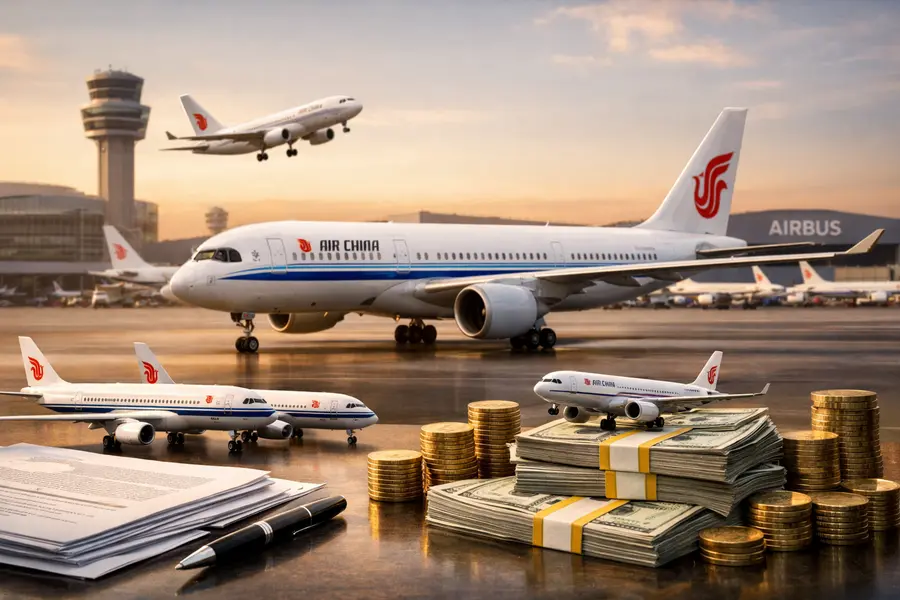
Air China and subsidiary Shenzhen Airlines sign a 55-aircraft Airbus agreement worth $12.4 billion at list prices, reinforcing Europe's dominant position in China's vast aviation market.
- Air China orders 15 A350-900 widebody jets; Shenzhen Airlines orders 40 A320neo narrowbodies, deliveries from 2029 to 2032.
- The deal will boost Air China group capacity by approximately 7.1% and Shenzhen Airlines capacity by 4.3%.
- The order deepens Airbus's foothold in China as U.S.-China trade tensions continue to weigh on Boeing's market access.
Lead
Air China and its subsidiary Shenzhen Airlines signed an agreement with Airbus on July 17, 2026, for 55 commercial jets at a combined list price of $12.4 billion — one of the largest Chinese aviation procurement announcements of the year. The deal, covering both widebody and narrowbody aircraft, accelerates the group's fleet renewal program and signals continued confidence in China's post-pandemic aviation recovery at a moment when competition between Airbus and Boeing for Chinese orders has intensified dramatically.What Happened
Under the terms of the Air China Airbus order, Air China will take delivery of 15 A350-900 wide-body jets between 2030 and 2032, with a list value of approximately $6.09 billion. Shenzhen Airlines, the Beijing-based carrier's Guangdong-based subsidiary, will receive 40 A320neo-family narrowbody aircraft between 2029 and 2032, with a list value of around $6.35 billion. Standard industry discounts mean the actual transaction prices will fall well below the headline figures.
The combined order adds meaningful lift to both carriers' operational capacity. Air China's group-level available seat capacity is projected to expand by roughly 7.1%, while Shenzhen Airlines is positioned for a 4.3% capacity gain — figures that underscore the structural demand still present in the world's largest domestic aviation market.
Guillaume Faury, Airbus Chief Executive Officer, described China's market as holding "immense potential" and reaffirmed the company's commitment to deepening its industrial presence in the country. George Xu, Airbus Executive Vice President and CEO of Airbus China, pointed to China's "resilient and stable supply chain" and its "high-standard opening up" as factors that strengthen the long-term investment case for the European manufacturer.Strategic Context: Airbus vs Boeing China
The Air China Airbus deal arrives in a competitive environment that has shifted meaningfully in Airbus's favor. Chinese airlines are projected to require close to 9,600 new commercial aircraft over the next two decades, making the country the single largest growth market for both manufacturers.
A third variable now shapes every procurement decision: COMAC, China's state-backed aircraft manufacturer, has accumulated more than 1,000 orders for its C919 narrowbody and is expanding its footprint across Southeast Asia. While COMAC remains a secondary consideration for mainline international routes, its growing order book adds political pressure on Chinese carriers to diversify away from both Western manufacturers over the longer term.
Geopolitical Dimension
Procurement of commercial aircraft in China has never been purely a commercial transaction, and the current environment makes that more explicit. The choice to route a major narrowbody order through Airbus rather than Boeing reflects both operational preference — the A320neo family has a well-established service record in China — and the diplomatic calculus that governs state-owned enterprise spending.
The global aviation industry recovery, now several years in progress, has boosted Chinese domestic traffic substantially. Airlines require modern, fuel-efficient fleets to service that demand economically, placing manufacturers that can offer reliable delivery slots at a decisive advantage. Airbus, with its Tianjin A320-family final assembly line, has a local manufacturing argument that resonates with Chinese policymakers prioritizing supply chain resilience.
Outlook
The Air China and Shenzhen Airlines order reinforces a pattern established earlier in 2026, when a consortium of Chinese carriers including China Eastern and China Southern placed a collective order for 292 A320-family jets. Airbus enters the second half of 2026 with a strengthened order backlog from its most strategically important market. Boeing's ability to recover ground will depend as much on the trajectory of U.S.-China relations and its own production recovery as on the merits of its aircraft. COMAC's ascent adds a long-dated but structurally relevant third variable that neither Western manufacturer can ignore.
---
> Note on deal value: Multiple Tier 1 sources (CNBC, South China Morning Post, AeroTime) report the combined list price at $12.4 billion, not $2.4 billion as stated in the brief. The article uses the figure confirmed by reporting. If you have a source specifying a $2.4B figure — such as a discounted transaction price or a specific tranche — please share it and the article can be updated accordingly. }}