Pomegra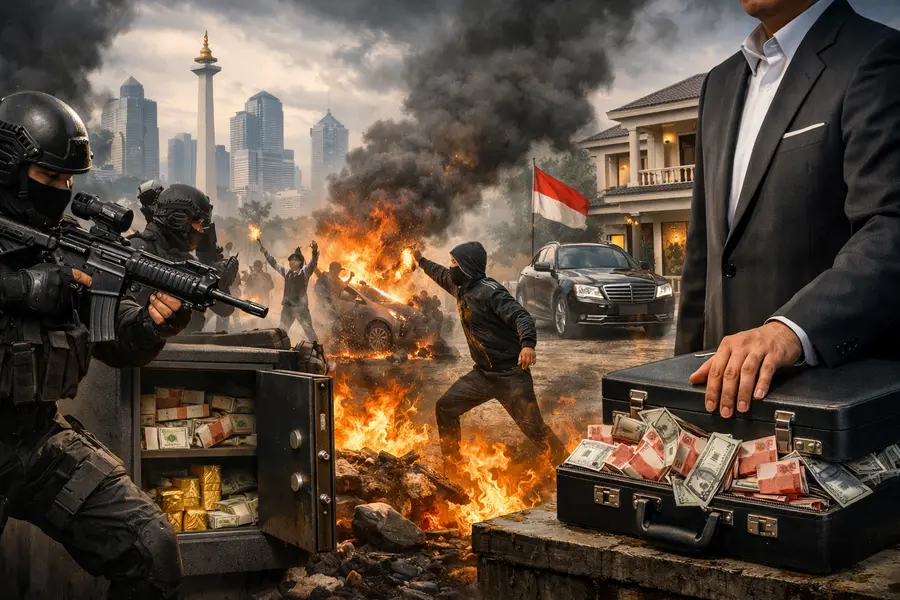
President Prabowo Subianto's anti-corruption raids on senior prosecutors and wealthy industrialists are destabilizing Indonesia's political order, accelerating capital flight, and fueling street protests across Jakarta.
- National Police raided 12 locations and seized Rp 476 billion ($26.3 million) in cash and 74 kg of gold from a senior prosecutor's property.
- Indonesia's 10 richest families have lost a combined $56.7 billion in net worth since January 2026 amid Prabowo's anti-oligarch drive.
- Street protests in Jakarta drew 6,000-plus security personnel as students clashed with authorities over rising fuel costs and governance failures.
Lead
National Police units stormed at least 12 residences and offices across Jakarta, South Tangerang, and Bogor on July 8 and 9, 2026, seizing Rp 476 billion ($26.3 million) in cash and 74 kilograms of gold bars from a property linked to Febrie Adriansyah, Indonesia's Deputy Attorney General for Special Crimes. The Indonesia corruption raids marked the most dramatic escalation yet of President Prabowo Subianto's sweeping tycoons clampdown — a campaign that has rattled the country's billionaire class, triggered institutional infighting, and contributed to sustained Jakarta civil unrest that analysts warn threatens Indonesia political stability heading into the second year of Prabowo's presidency.
What Happened
The National Police's Corruption Eradication Division named Febrie Adriansyah a suspect in three graft cases: alleged corruption at state insurer PT Asabri, state steelmaker PT Krakatau Steel, and a coal supply scheme that investigators say contributed to widespread electricity blackouts and inflicted state losses of Rp 5 trillion ($276 million).
Febrie resigned from his post within days, with the Attorney General's Office citing the need to "maintain the integrity, objectivity, and neutrality of law enforcement." The resignation did little to quell a public row between the police and the AGO. President Prabowo summoned the Attorney General, National Police Chief General Listyo Sigit Prabowo, and Armed Forces Commander General Agus Subiyanto to the Presidential Palace on July 11, instructing all sides to avoid further public friction. The two institutions subsequently moved to close ranks in official statements, though internal tensions remain unresolved.
The raids did not emerge in isolation. Since taking office in October 2024, Prabowo has pursued Indonesia's wealthy industrialist class with a force that surprised even senior officials within his own administration. In early May 2026, his government agreed to establish a new state entity under sovereign wealth fund Danantara to oversee Indonesia's exports of palm oil, coal, and ferro-alloys — sectors that together generated more than $65 billion in revenue last year and that have long been dominated by a small group of powerful families.
Parliament is also debating a landmark asset forfeiture bill that would allow the state to seize property from individuals suspected of corruption in some cases without a criminal conviction — a provision that legal analysts describe as constitutionally novel and that has deepened anxiety among the business elite.
Market Reaction
The combined net worth of Indonesia's 10 richest families has fallen by $56.7 billion since January 2026, according to the Bloomberg Billionaires Index. The Jakarta Composite Index (IDX) has ranked among the world's worst-performing major benchmarks for the year. The Indonesian rupiah is trading near record lows against the dollar. Bond yields have surged as foreign capital exits accelerates, with outflows estimated at Rp 31.5 trillion ($1.8 billion) in recent months.
High-net-worth individuals are moving hundreds of millions of dollars into Singapore and other regional financial centers, responding both to the raids and to the government's proposal for Indonesia's first-ever wealth tax. In May, Prabowo hosted tycoons at his south Jakarta residence and asked them to convert offshore dollar holdings back into rupiah — framing the appeal as a patriotic request rather than a mandate, though the distinction has done little to restore confidence.
Jakarta Civil Unrest
The economic pressure generated by the clampdown has fed directly into street mobilization. On June 12, more than 1,500 students protested in central Jakarta following a roughly 30 percent increase in non-subsidized gasoline prices, the continued weakness of the rupiah, and growing public anger over mismanagement of Prabowo's signature Free Nutritious Meals program, which former agency head Dadan Hindayana was arrested for allegedly corrupting. Authorities deployed more than 6,000 police and military personnel to contain the demonstrations; clashes with security forces broke out at multiple points.
Dozens of protesters were subsequently arrested following rallies in Surabaya, Indonesia's second-largest city, adding a judicial dimension to the unrest. The protests represent the most sustained challenge to Prabowo's authority since nationwide demonstrations over parliamentary spending perks roiled the country in mid-2025.
Strategic Context
The AGO-police rivalry exposed by the raids reflects a deeper structural tension within Indonesia's law enforcement apparatus. Observers note that Prabowo is using multiple overlapping institutions — the National Police, the Attorney General's Office, the Corruption Eradication Commission (KPK), and the newly empowered Danantara — to advance his anti-graft agenda, but without clear delineation of authority. That ambiguity has produced jurisdictional competition that undermines legal predictability and complicates the investment environment.
At the same time, the Indonesia political stability calculus is complicated by the fact that many of the tycoons now under pressure were significant backers of Prabowo's 2024 campaign. Forcing their compliance through asset forfeiture legislation and state entity oversight represents a significant recalibration of the political economy — one that, if sustained, could fundamentally reshape who controls Indonesia's resource wealth.
Outlook
The trajectory of Indonesia's dual crisis — Jakarta raids targeting the institutional structure of the state, and a Prabowo tycoon clampdown eroding the loyalty of the business elite — will determine whether the administration can convert enforcement energy into durable governance reform. In the near term, the rupiah's weakness and continued capital flight are the most pressing indicators to watch. If Prabowo presses ahead with the wealth tax and the asset forfeiture bill simultaneously, further market turbulence and street mobilization remain likely. His ability to manage the institutional rivalry between the police and the AGO will be an early test of whether the anti-corruption drive deepens or implodes under its own contradictions.