 Pomegra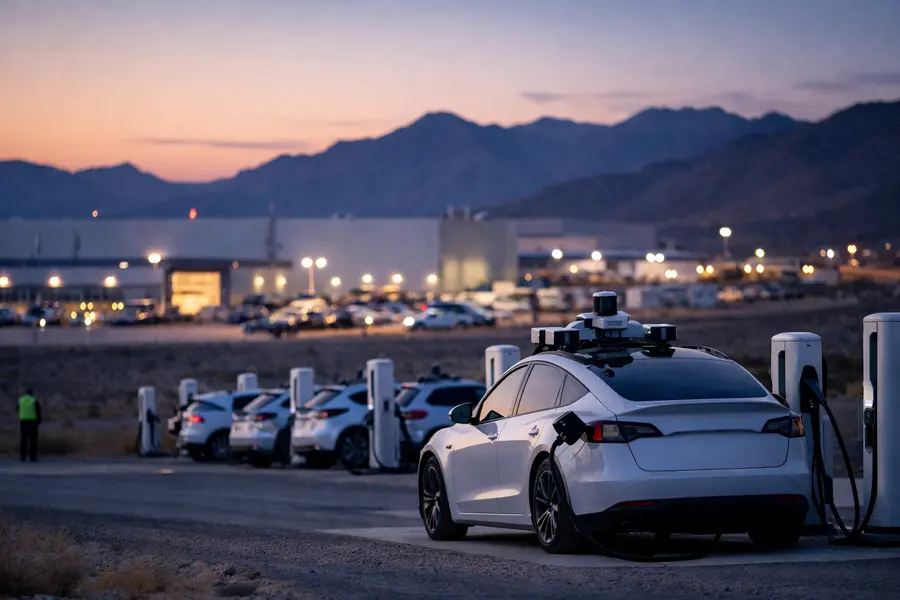
Tesla shares surged more than 5% after Nevada approved 5,000 commercial robotaxi permits in Clark County while the Cybercab simultaneously launched for Austin employees -- the first US commercial-scale autonomous ride-hail green light.
- Nevada's Transportation Authority voted unanimously to issue 5,000 commercial robotaxi permits across Clark County, covering the Las Vegas metro area.
- Tesla's Cybercab began carrying employees in Austin, Texas, the first live US operational deployment of the purpose-built autonomous vehicle.
- TSLA logged one of its largest single-session regulatory-driven moves in years, with volume running well above the 30-day average.
Lead
Tesla (TSLA) surged more than 5% after Nevada's Transportation Authority voted unanimously to approve 5,000 commercial robotaxi permits in Clark County - the Las Vegas metropolitan area - while the company's Cybercab vehicle simultaneously began transporting employees at its Austin, Texas facilities. The paired events mark the first time a US state has authorized robotaxi deployment at commercial scale, delivering a catalyst cluster that rewrites Tesla's autonomous vehicle timeline from speculative to operational.What Triggered the Rally?
The Nevada decision is the regulatory breakthrough that had been the primary gating factor for Tesla's robotaxi commercialization thesis. All five members of the Transportation Authority voted in favor, clearing 5,000 permits for commercial autonomous ride-hail operations across Clark County, home to roughly 2.3 million residents and among the country's most concentrated ride-hail markets by per-capita demand.
The Las Vegas corridor - dense with tourists, 24-hour activity, and short-trip patterns that maximize fleet utilization - represents one of the commercially richest initial deployments any autonomous vehicle operator could target. The volume of permits, 5,000 at launch, signals Nevada's intent to move beyond pilot-stage experimentation into full commercial integration.
At the same moment the Nevada vote concluded, Tesla activated Cybercab rides for employees at its Austin campus, the first live US operational deployment of the vehicle. The simultaneity of both events was not lost on investors.
Why Did TSLA Stock React This Way?
Markets reacted because three distinct uncertainties collapsed in a single session. Regulatory approval, operational launch, and geographic scale had each carried separate risk premiums in Tesla's valuation. Prior to the Nevada decision, autonomous vehicles remained a long-dated option for investors in Tesla and the broader group of ai stocks with exposure to mobility automation.
TSLA shares reached an intraday high during the session with volume running substantially above the trailing 30-day average, indicating broad institutional participation rather than a retail-driven move.
How to Buy Tesla Stock
TSLA trades on the Nasdaq and is accessible through commission-free brokerage platforms as well as full-service accounts. The stock is a component of major indices and a top holding in widely-held funds such as the QQQ, giving investors multiple access points to the autonomous vehicle theme without single-stock concentration.
Strategic Context
Tesla's competitive position in autonomous ride-hail differs structurally from software-first rivals. The Cybercab runs on a Full Self-Driving stack trained across millions of consumer vehicles, giving Tesla a real-world data advantage that purpose-built autonomous vehicle startups cannot replicate in the near term.
Nevada's regulatory framework, by issuing permits at volume rather than in small test batches, establishes a precedent that other state transportation authorities will face pressure to match or exceed. If Clark County operations proceed without material safety incidents over the next several months, it strengthens the case for permit applications in California, Texas, Florida, and other high-density markets.
Outlook
The Nevada permit approval and the Austin employee launch shift Tesla's autonomous vehicle program from a regulatory question to an execution question. The next sequenced milestones - public passenger service in Las Vegas, additional state permit filings, and fleet scale-up - now carry defined timelines rather than speculative probabilities. Tesla's ability to maintain safety performance under public operational conditions and expand its permit footprint at pace will determine whether this week's events mark the start of a sustained autonomous vehicle re-rating or a catalyst that the market has now fully priced.