Pomegra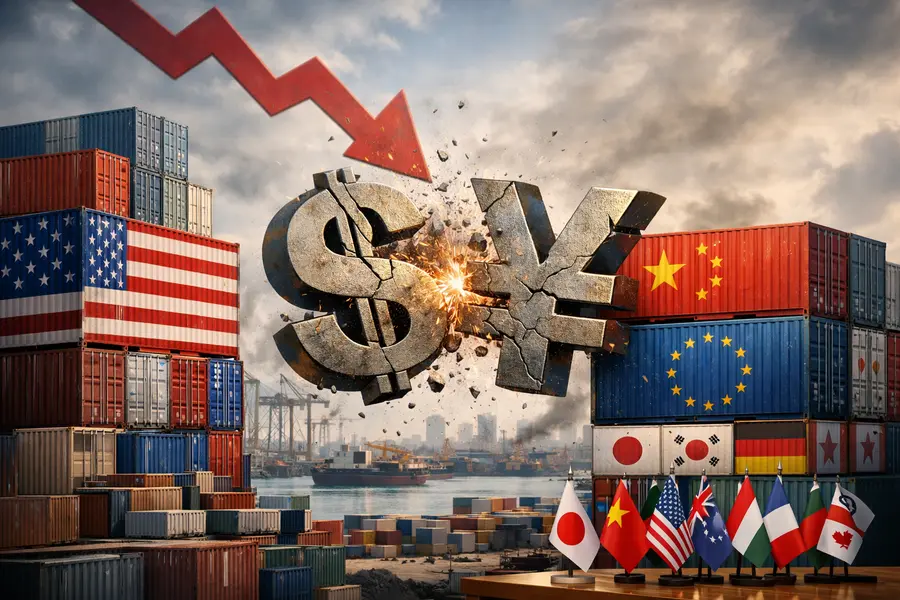
The Trump administration has imposed sweeping new US trade policy duties of 10%–12.5% on 60 major trading partners covering 99.4% of US imports, intensifying the global trade war and sending a fresh shock through financial markets.
- New Section 301 duties of 10%–12.5% took effect July 24, replacing expired IEEPA global tariffs on 60 economies.
- The Trump tariffs 2026 cost the average US household an estimated $1,300–$1,500 annually and lift consumer prices ~1.2%.
- Asian equities slid and Treasury yields rose; major nations including Brazil, Australia, and Japan condemned the measures.
Lead
Washington — The United States activated a new wave of import tariffs on 60 trading partners at 12:01 a.m. Eastern time on July 24, 2026, expanding the most aggressive US trade policy posture since the 1930s. Imposed under Section 301 of the Trade Act of 1974 and justified by a formal forced-labor investigation, the duties affect countries supplying 99.4% of all US imports and cover goods ranging from electronics and apparel to manufactured parts and vehicles. Rates are set at 10% for most covered nations and 12.5% for economies the administration determined had made insufficient commitments to eliminating coerced labor from their supply chains.What Happened
The new tariffs replaced a prior set of temporary 10% global duties that expired at midnight July 23. The administration's shift to a Section 301 legal framework is significant: the Supreme Court earlier in 2026 ruled that the International Emergency Economic Powers Act (IEEPA) did not authorize broad tariff-setting powers, forcing the administration to pivot to a trade-statute mechanism with a different constitutional footing.
The United States Trade Representative announced the duties following a months-long investigation that found all 60 targeted economies had failed to prevent the importation of goods produced with forced labor in violation of US law. China and Japan face the higher 12.5% tier; the European Union falls under a separate 15% rate embedded in a June 2026 bilateral agreement. Steel, aluminum, oil, natural gas, and goods not produced domestically are exempt to limit domestic disruption.
In the same week, the administration threatened Canada with 35% tariffs beginning August 1 on a range of goods, further widening the global trade war.
Market Reaction
Tariff impact on stocks was evident across multiple sessions. Asian equities fell immediately upon the announcement: Japan's Nikkei 225 and South Korea's Kospi led regional declines. US markets exhibited volatility into Friday's open, complicated by simultaneous geopolitical shocks and a weaker-than-expected July jobs report that showed the US economy added only 73,000 positions against a 104,000 consensus estimate.By mid-session Friday, equities found partial footing — the Dow Jones Industrial Average recovered approximately 0.7% and the S&P 500 gained roughly 0.5% from early session lows — though the moves were modest and came against elevated Treasury yields and rising oil prices that continued to cap upside. Technology stocks remained under pressure from separate sector-specific concerns, blunting any broad relief rally.
Importers in sectors heavily reliant on foreign-sourced goods — consumer electronics, apparel, and automotive parts — face the most direct near-term margin exposure as inventories stockpiled ahead of earlier tariff rounds have largely been drawn down.
Strategic and Legal Context
The administration's decision to anchor the tariffs in forced-labor enforcement through Section 301 carries legal advantages over the struck-down IEEPA approach but introduces new political risks. Critics, including several trade-law experts and fiscal analysts, characterize the forced-labor rationale as broadly applied — noting that the investigation's 60-country scope takes in virtually the entire global trading system.
The Committee for a Responsible Federal Budget estimates Section 301 and related Section 338 tariffs replace less than 60% of the revenue that had been collected under the struck-down IEEPA framework. Looking further out, full implementation could generate up to $980 billion in federal revenue through fiscal year 2036, according to budget scoring models.
The Tax Foundation calculates the current tariff regime represents the largest US tax increase as a share of GDP since 1993, with average per-household costs running between $1,300 and $1,500 in 2026. The Yale Budget Lab projects a 1.2% rise in consumer prices directly attributable to tariffs and a 0.4 percentage-point drag on real GDP this year.
Global Response
The international reaction was swift and largely hostile. Brazil condemned the duties as "arbitrary." Australia called the action "unjustified," and Japan's government described the tariffs as "regrettable," signaling potential retaliatory steps. The EU, operating under its June bilateral accord, faces a 15% rate — lower than the new global baseline but still elevated relative to pre-2025 levels.
The breadth of the measures — spanning virtually every major economy — complicates coordinated multilateral resistance, as each nation must weigh bilateral negotiation against collective countermeasures.
Outlook
The imposition of new Trump tariffs 2026 on 60 economies marks a structural escalation rather than a tactical maneuver. With IEEPA authority curtailed by the courts, the administration has embedded its tariff architecture in statutory trade-enforcement mechanisms that are harder to rapidly unwind. Retaliatory responses from major partners — particularly the EU and Japan — remain the principal near-term risk to US equities and supply chains. Consumers will absorb a material share of the cost through higher retail prices, while manufacturers dependent on global inputs face sustained margin pressure. Legislative or judicial challenges to the Section 301 framework represent the most plausible path to near-term relief, though neither carries near-term certainty.
Mentioned tickers: SPY, DIA, QQQ, EWJ, EWZ, EWA, FXI