Pomegra
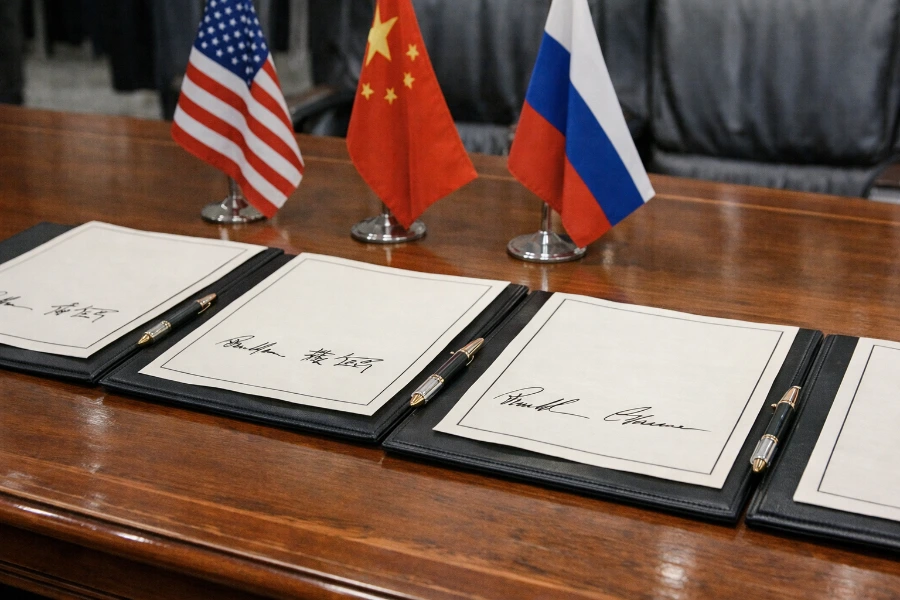
The Shenzhen peace declaration pledges nuclear-risk dialogue among the US, China and Russia but sets no timeline or arms-control plan after New START lapsed.
- The three leaders signed a four-point "Declaration toward Peace" at their first trilateral summit, held in Shenzhen on November 19.
- The text commits to nuclear-risk dialogue but sets no timetable, no arms-control framework and no steps on Ukraine or Iran.
- Brent crude settled near $92 on Thursday and fell about 2% to roughly $90 on Friday as Gulf exports recovered.
Lead
President Donald Trump, President Xi Jinping and President Vladimir Putin signed a symbolic peace declaration in Shenzhen on Thursday. It was the first sit-down of the leaders of the world's three largest nuclear powers. The document reaffirms that a nuclear war cannot be won and must never be fought. It pledges dialogue on reducing nuclear risks and preventing proliferation. It names no date for that dialogue to begin and no negotiating format. The summit took place on the sidelines of the APEC gathering in southern China. It was the first leader-level engagement on nuclear arms since the New START treaty expired in February.
What Did Trump, Xi and Putin Agree in Shenzhen?
The leaders agreed to a four-point text titled "Declaration toward Peace" that sets out principles rather than commitments.
The first point restates that nuclear war cannot be won and must never be fought. The second commits the three governments to dialogue on lowering nuclear risks and curbing the spread of nuclear weapons. The third backs reform of the United Nations. The fourth calls for increased supplies of fuel products to all countries and upholds the immunity of state officials in international courts. That clause is aimed at the International Criminal Court.
The declaration contains no verification provisions, no warhead or delivery-system limits, and no working group. Putin described the statement as one that "did not set ambitious goals" and would not compel compliance. Trump rated the meeting "a 12" on a scale of zero to 10 and said the leaders were "making history." Xi urged the shedding of a "Cold War mentality" and said that when major powers live in harmony, the world is at peace.
Why Does the Missing Timeline Matter for Arms Control?
The absence of a timeline matters because no binding limit on US or Russian strategic forces has existed since February. New START was the last bilateral treaty capping the two largest arsenals, and its lapse ended formal constraints and inspections that had operated for years.
Washington has said it wants a "new, improved and modernized" agreement that includes China. Beijing has little incentive to accept limits. Its arsenal of more than 600 warheads is a fraction of the more than 5,000 believed to be held by each of the United States and Russia. A three-way framework would require China to accept transparency measures it has so far resisted. It would also require Washington and Moscow to negotiate over systems that the 2010 treaty never covered.
The declaration therefore restates a shared principle without resolving any of these structural obstacles. A dialogue with no start date leaves the arms-control vacuum in place. Defense planners in all three capitals can continue to plan for unconstrained force levels.
Geopolitical Dimension: Ukraine and Iran Left Aside
Neither the war in Ukraine nor the conflict involving Iran appears in the declaration. A Kremlin spokesperson said Ukraine was not the central topic of the trilateral session. The subject did feature in the separate Putin-Trump bilateral talks. Putin referred in general terms to the settlement of regional conflicts, including Ukraine, but no measures were announced. Trump called on Xi to help resolve the Ukraine conflict. He also repeated that Tehran cannot have a nuclear weapon, a position that was not carried into the signed text.
The omissions show the limits of the format. The three leaders found common language on abstract nuclear principles. They did not find it on the active conflicts that drive near-term risk. China's role as a potential mediator remains informal, and Moscow and Washington remain divided on the terms of any Ukraine settlement.
How Did Energy and Oil Markets React?
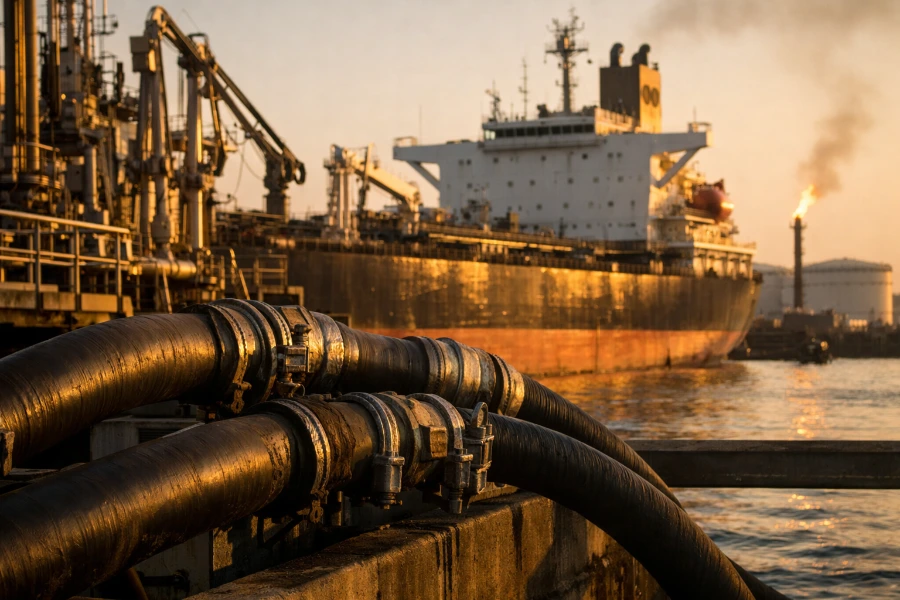
Oil markets showed no clear reaction to the summit, because supply fundamentals dominated. Brent crude settled at $91.98 per barrel on Thursday. It fell about 2% to roughly $90 on Friday. Recovering Middle East exports were the main downward pressure. Tanker shipments through the Strait of Hormuz have returned close to prewar levels. Traffic had been disrupted since Iran closed the waterway after the US attack in February. Expectations of a global crude surplus have also weighed on prices.
The declaration's call for "increased supplies of fuel products for all countries" carries no volumes, mechanisms or sanctions provisions. Trump said that he and Xi both felt strongly that oil must flow through Hormuz. That position is consistent with Beijing's dependence on Gulf crude, but it adds no new enforcement. Russia, a major exporter, has an interest in firm prices. The pledge does not change the existing sanctions and price-cap framework that governs its sales.
What Comes Next?
The next test is whether any of the three governments names negotiators, a venue or a start date for the nuclear dialogue. The 3 to 12 month questions are concrete:
- Whether Washington and Moscow open parallel strategic-stability talks.
- Whether China agrees to any form of data exchange or notification regime.
- Whether the three sides maintain informal restraint on force levels in the absence of a treaty.
The pledge on fuel supplies will be measured against Hormuz shipping data and Russian export volumes. For markets, the declaration is a low-impact event unless it leads to a verifiable process. Oil prices remain tied to Gulf logistics and the supply outlook rather than summit diplomacy.
Outlook
The Shenzhen declaration gives the three nuclear powers a shared statement on the risk of nuclear war. It does not give them a negotiating track. With New START expired, no timeline in the text and Ukraine and Iran outside it, the summit's value depends on follow-up that has not yet been scheduled. Energy markets are focused on Gulf export recovery, with Brent near $90.
Mentioned tickers: None