Pomegra
Trump will hold off on new Iran strikes until the new year while Tehran readies crude shipments past the US blockade and Hormuz traffic stays near shut.
- Trump says he is "not rushing into any decision" on Iran and will assess the situation after the start of the year.
- Iran is positioning to resume crude shipments despite a US naval blockade reinstated on July 14.
- Brent crude has slipped below $90 a barrel, well under the $119 wartime peak.
Lead
President Donald Trump said on Wednesday that he is in no hurry to authorize fresh military action against Iran, telling reporters, "We will see what happens after the beginning of the year." The remark came after roughly two months of relative calm gave way to a week of exchanged strikes. Iran is meanwhile preparing to restart oil exports in defiance of the US naval blockade, and commercial traffic through the Strait of Hormuz remains close to a standstill. The combination keeps the crude oil price sensitive to every headline from the Gulf, even as physical supply has recovered faster than many traders expected.
What Did Trump Say About New Iran Strikes?
Trump said he is "not rushing into any decision," which places any major new escalation beyond the end of 2026. He also played down Iranian threats involving a radiological weapon but warned that "if it does happen, we'll wipe them out."
The stance contrasts with the tempo on the ground. Iran struck an early-warning radar facility in Bahrain, home of the US Navy's Fifth Fleet, on Friday, and a radar system at a helicopter base there on Sunday. A third radar site in Bahrain was targeted on Tuesday and intercepted. On Wednesday, Iran fired at the Ali Al Salem air base in Kuwait. No damage was reported. The US responded on Tuesday with a strike on an Iranian missile launch site on Qeshm Island, near the strait.
The pattern points to calibrated, mostly maritime and air-defense-focused exchanges rather than a return to the large-scale campaign that began with US-Israeli strikes on Iran on February 28.
Can Iran Restart Oil Exports Under the US Blockade?
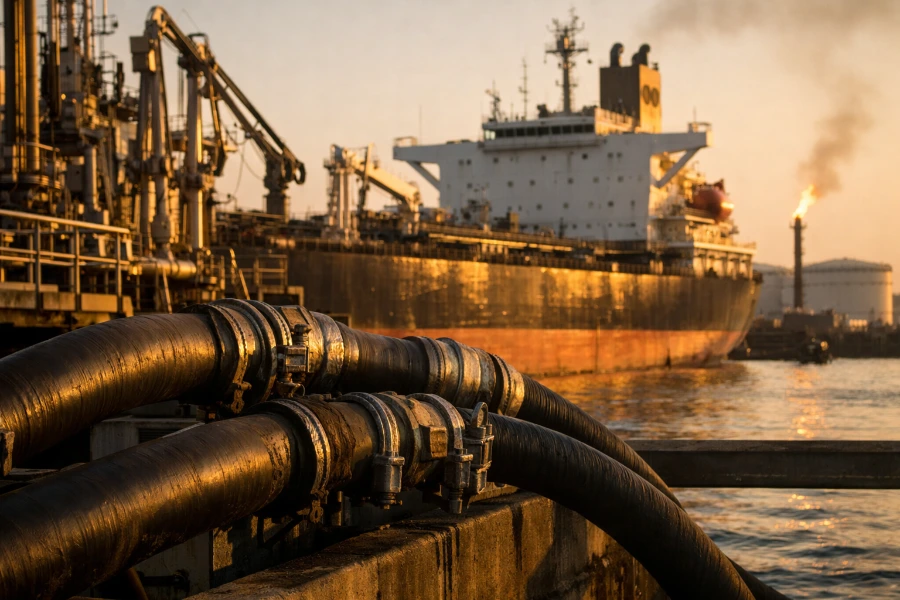
Iran is attempting to, but the physical constraints are severe. Washington reinstated its naval blockade on July 14, and US Central Command has warned that vessels taking Iranian cargo through ship-to-ship transfers will be treated as blockade evaders and face possible seizure.
Iranian crude output fell to about 1.86 million barrels per day in October, a decline of roughly 46%. Exports have been limited largely to overland routes through Iraq, running at an estimated 200,000 to 300,000 barrels per day. Tanker-tracking signals on November 19 showed vessels positioning for loadings, an indication that Tehran intends to test the blockade rather than wait for a diplomatic settlement.
The stakes are fiscal as much as commercial. Crude sales of about $25 billion a year have been cut off, squeezing the finances of the Revolutionary Guards and the payments that sustain Tehran's regional partners. A successful run of cargoes would ease that pressure and force Washington to choose between interdiction at sea and continued restraint.
What Is Happening to the Crude Oil Price?
Prices are range-bound and well below the crisis highs. Brent settled near $92.46 a barrel on November 17, with West Texas Intermediate at $82.95, and has since traded below $90 as markets price in the possibility of additional Iranian barrels.
Before the February 28 strikes, Brent traded near $73.10. It surged more than 50% within 21 days of Hormuz being effectively closed and touched an intraday peak of $119 in mid-March. The retreat since then reflects supply adjustments. The International Energy Agency has said the global oil market returned to surplus in the fourth quarter as Middle Eastern exports recovered faster than demand. Iraq has expanded pipeline capacity through Turkey to 500,000 barrels per day, and Gulf producers have raised output through alternative routes.
Offsetting that, tanker attacks in the strait have reached an unprecedented level. Iran has designated more than half of the tankers Gulf producers use to move crude out to the Gulf of Oman as targets, and exporters have responded by adding another stage of ship-to-ship transfers, raising costs and delays. More than 130 maritime incidents have been recorded since February.
Geopolitical Dimension
The US posture combines economic strangulation with military restraint. The blockade targets Iran's main revenue source, while Trump's decision to defer strikes limits the risk of a new spike in energy prices ahead of the year-end consumption period. Tehran's approach mirrors this logic in reverse: harassing shipping and US installations imposes costs on the Gulf and on global trade without crossing the threshold that would trigger a full American response.
Iran is reported to retain an arsenal of up to 2,500 missiles, which keeps the threat of a sharp escalation credible. Gulf states hosting US forces, notably Bahrain and Kuwait, are now direct targets, and any strike that causes casualties would shift the political calculation quickly.
What Comes Next for Oil and Hormuz?
The near-term path depends on whether Iranian cargoes reach buyers. If tankers are seized or turned back, Brent's recent softness is likely to hold, supported by a market in surplus. If shipments clear the blockade in volume, the confrontation moves from rhetoric to enforcement, and the risk premium in the crude oil price would rebuild quickly.
Trump's timeline implies no decisive US move before January, leaving December as a period of continued tit-for-tat strikes, tanker incidents and blockade enforcement. Shipping through Hormuz, rather than headline diplomacy, remains the variable that most directly determines oil, freight and insurance costs.
Outlook
Trump has deferred the strike decision to 2027, Iran is preparing to challenge the blockade, and Hormuz traffic stays nearly shut. With Brent below $90 and the market in surplus, supply cushions are in place, but a seized tanker or a successful blockade run could change the picture within days.
Mentioned tickers: None