Pomegra
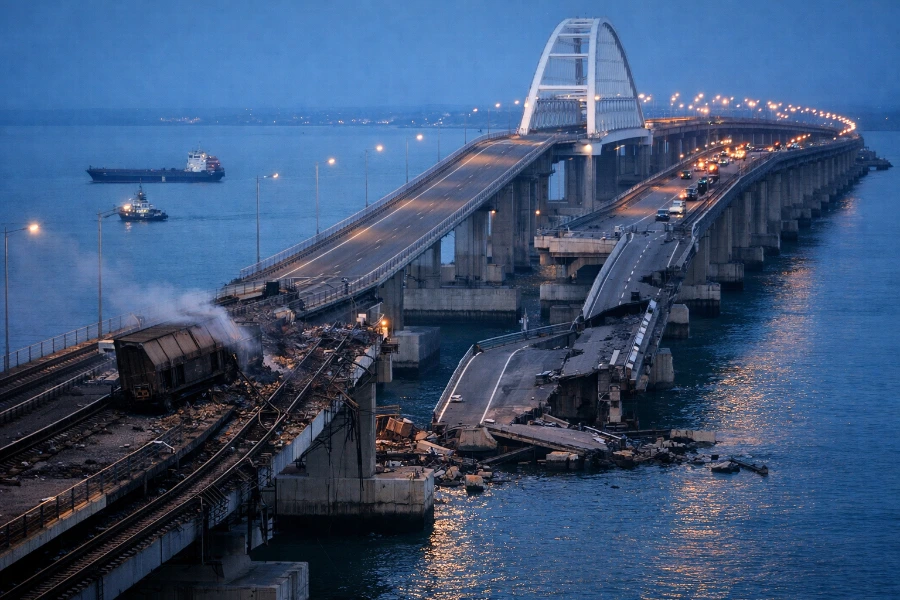
Putin ruled out a limited or energy ceasefire with Ukraine after the Crimean Bridge strikes and promised a "far more painful" response, ending winter de-escalation hopes.
- Putin said on Nov. 19 that Russia will not negotiate energy or Black Sea truces after the Crimean Bridge strikes.
- He promised retaliation "far more painful" than the damage Ukraine inflicted on the bridge.
- Brent crude held near $92 a barrel as the Shenzhen summit produced no ceasefire path.
Lead
Russian President Vladimir Putin ruled out any limited ceasefire with Ukraine on Nov. 19, days after Ukrainian missiles brought down part of the Crimean Bridge. He spoke in Shenzhen at the APEC summit, after a trilateral meeting with Donald Trump and Xi Jinping. He said Moscow had discussed energy and Black Sea truces with its Security Council but would "not negotiate" after the strikes. He said Russia "will respond", and that the response would be far more painful than what Kyiv did to the bridge. He also said the bridge would be restored.
What Happened to the Crimean Bridge?
A Ukrainian Flamingo missile strike on the night of Nov. 17 collapsed a section of the roadway on the 12-mile crossing linking Russia to occupied Crimea. Further strikes hit the railway section, with Neptune missiles used on the night of Nov. 19. Train services were briefly suspended. Putin called the damage "serious" and said the bridge serves civilian purposes only, a claim Kyiv disputes.
The bridge opened in 2018 with Putin personally present. It is a symbol of Moscow's claim to Crimea and a supply route for forces in southern Ukraine.
On Nov. 19, Russia struck two major bridges over the Dnipro River in Kyiv, the first visible sign of the retaliation Putin promised.
What Truces Had Been Under Discussion?
Kyiv had pressed for two limited measures: a moratorium on attacks at sea, and a halt to strikes on energy infrastructure. Under one version, Ukraine would stop hitting Russian oil refineries and Russia would stop hitting civilian power assets. Putin said Russia was hearing "from all sides" calls to stop, and that the idea had been considered by the Security Council before the bridge attacks. That option is now closed.
Leaders of Germany, France, Britain and Ukraine, meeting in Berlin as the Coalition of the Willing, called on Russia on Thursday to agree to an energy ceasefire for the duration of the winter as a first step toward ending hostilities. President Volodymyr Zelensky said Ukraine has repeatedly offered de-escalation steps that Moscow rejected, while Russia strikes Ukrainian infrastructure daily.
Why Does the Bridge Matter for Energy Markets?
The refusal matters for energy because the proposed truce centered on oil and power infrastructure. Ukrainian drone strikes on refineries have cut Russian refinery throughput from about 5.0 million barrels a day a year ago to roughly 3.5 million in November. Removing the refinery-for-power-grid swap from the table means those strikes continue through the winter heating season, as do Russian attacks on Ukraine's grid.
The Black Sea corridor is the other exposure. Without a maritime moratorium, shipping lanes used for grain and fuel exports stay at risk.
How Is the Crude Oil Price Responding?
The crude oil price has shown little reaction. Brent traded near $91.75 a barrel on Nov. 20, down about 0.25%, while WTI stood near $82.84, down 0.44%. Crude has been range-bound, near a four-month low this week, as supply expectations offset geopolitical risk.
The trilateral declaration pledged to increase production and supply of refined petroleum products "for the benefit of all nations". It set no volume target or timetable. European gasoil fell about 1.5% on the announcement. U.S. refineries are already running at 95.7% of capacity, processing 16.9 million barrels a day, which leaves little room to add output quickly. Russian refinery losses therefore keep product markets tighter than crude.
Geopolitical Dimension
The Shenzhen meetings, the first trilateral among the U.S., Chinese and Russian leaders, produced a joint peace declaration but no mechanism for a ceasefire in Ukraine. The White House readout did not mention Ukraine. U.S. envoys met separately with Zelensky and European leaders, so the diplomatic tracks remain split between Washington and Moscow on one side and Kyiv and its European backers on the other.
For Moscow, the bridge strikes are both a military and a prestige loss. Putin has tied negotiating flexibility to his response, and a visible escalation is more likely than concessions over the next three to six months. For Kyiv, the strikes show the reach of its long-range missiles and keep pressure on logistics to Crimea.
What Comes Next?
Three developments matter for the next quarter. The first is the scale of Russian strikes on Ukrainian energy and transport infrastructure as winter deepens. The second is whether European governments push an energy truce through other channels, since Washington has not endorsed one. The third is whether further hits on Russian refineries and ports raise the risk premium in fuel markets, even with crude prices stable.
Outlook
Putin has closed the door on energy and Black Sea truces for now, and the Shenzhen summit produced no replacement framework. Crude oil prices are steady near $92 for Brent, with the real pressure falling on refined products and on Russian refining capacity. Escalation, not de-escalation, is the near-term path.
Mentioned tickers: None