Pomegra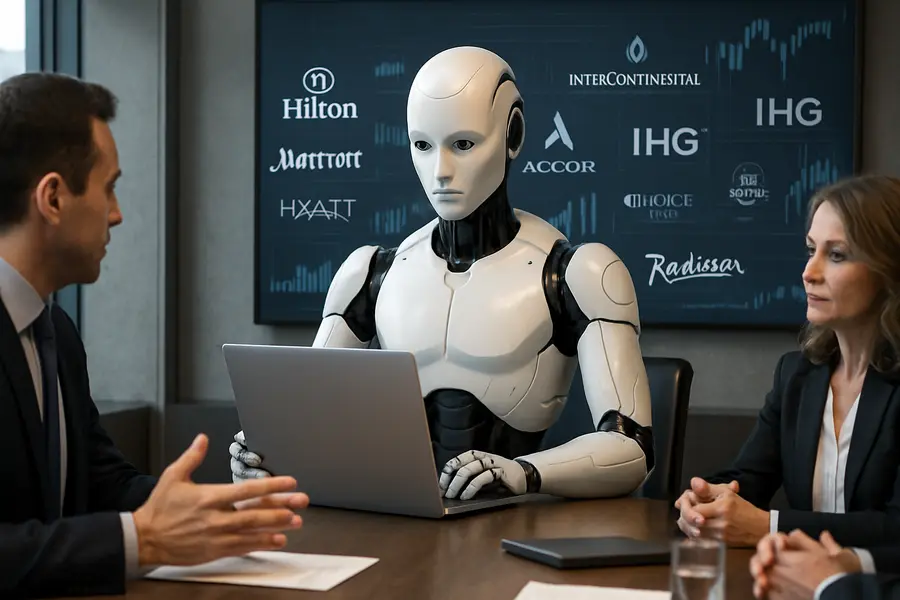
A top-tier global hotel group has signed a Letter of Intent with PHAL, the first agentic AI embedded operator advisory for the hospitality industry, as the sector confronts a widening gap between AI pilots and live, revenue-generating deployment.
- A top 10 global hotel group has signed a Letter of Intent with PHAL, the first agentic AI embedded operator for hospitality.
- PHAL delivers 12-month embedded retainers across agentic AI transformation, people architecture, and institutional performance.
- 82% of hoteliers plan to expand AI use in 2026, yet fewer than half have moved beyond the pilot stage.
What Happened
PHAL — Prakash Hospitality Advisory Pte Ltd — has secured its first institutional mandate from a top 10 global hotel group, marking the hospitality industry's first formal engagement of an embedded agentic AI operator advisory. The Singapore-incorporated firm confirmed a Letter of Intent has been signed, with additional senior mandate conversations active across Asia Pacific and globally. The engagement covers a 12-month embedded retainer, reviewed quarterly, structured around three execution pillars: agentic AI transformation, people architecture, and institutional performance uplift.The news arrives as the global AI in hospitality market accelerates, moving from a $1.2 billion base in 2022 toward a projected $4.5 billion by 2028, a compound annual growth rate of 24.3%. Despite that capital flowing in, industry benchmarks show fewer than 51% of hotel operators have moved AI beyond pilot status, even as 82% report intentions to expand AI use this year.
The Operator Gap — and PHAL's Thesis
PHAL's founding argument challenges a widespread assumption: that stalled hotel AI programs reflect a software deficiency. The firm contends the bottleneck is execution — specifically, the absence of an operator embedded inside the institution across the full cycle required to bring agentic systems to the profit and loss statement.
Founder Saurabh Prakash brings 25 years of senior global hospitality operating and commercial leadership to the model. He spent 15 years at Marriott International, earning recognition as Revenue Leader of the Year Worldwide and induction into the Chairman's Circle in 2006, before holding senior roles at TSA Solutions, Radisson Hotel Group, and Millennium Hotels and Resorts.
PHAL's engagement model is deliberately narrow. The firm takes a focused book of institutional retainers — not a broad software platform — and works inside the client institution, alongside the operator, within existing data governance frameworks. Its agentic AI transformation pillar encompasses infrastructure readiness, governance design, agentic deployment, and a data architecture orchestration layer that integrates across legacy systems rather than replacing them. People architecture addresses organizational redesign and workforce capability in an AI-native operating environment. Institutional performance covers revenue architecture, distribution discipline, cost intelligence, and asset performance.
AI in Hospitality: From Pilot to P&L
The engagement reflects a structural shift in how large hotel groups approach hotel tech investment. Industry data indicates 85% of hospitality professionals plan to direct at least 5% of their IT budgets to AI tools in 2026, with 58% committing upward of 10%. Guest communications rank as the top use-case priority, cited by 58% of operators, followed by operational efficiency, revenue growth, and cost reduction.
Yet survey data consistently surfaces a second problem alongside the pilot-to-production gap: leadership capacity. Deploying agentic AI across a multi-property, multi-brand institution at scale requires not only vendor integration but sustained operational judgment — decisions about data governance, workforce redesign, and system orchestration that sit above any single technology contract.
PHAL's embedded retainer model positions the firm as that missing layer, sitting between the institution's executive team and its technology vendor ecosystem for the duration required to generate measurable P&L impact. The hospitality technology sector has attracted more than $1 billion in investment across 40 startups over the past year, with AI-led platforms capturing the largest share. That supply-side concentration has made the execution gap more, not less, acute for major operators navigating a crowded and fragmented vendor landscape.
Strategic Context
The engagement signals a maturing phase in the AI in hospitality cycle. Early adoption was characterized by point-solution deployments — chatbots for guest messaging, dynamic pricing tools, automated check-in kiosks. Agentic AI represents a qualitative step: autonomous systems capable of reasoning, planning, and taking sequences of actions across the guest lifecycle and operational workflows, without constant human prompt.
For a top 10 global hotel group operating at institutional scale, the governance and organizational redesign requirements are commensurately larger. PHAL's model — operator-embedded, execution-focused, and structured around multi-month accountability — reflects those requirements rather than the shorter-cycle software sales engagements that have characterized most hotel tech relationships.
Asia Pacific, where PHAL is headquartered and where the first mandate is rooted, is among the fastest-growing regions for both hotel supply and enterprise AI adoption, with multiple sovereign and institutional capital pools actively funding hospitality infrastructure and technology.
Outlook
PHAL has indicated it will publish periodic operating briefings drawn from live deployments — a positioning that differentiates the firm from advisory practices that operate at arms length from execution. With additional senior mandate conversations active globally and the agentic AI infrastructure layer for hospitality still nascent, the first institutional LOI establishes a benchmark for how major hotel operators are structuring AI governance and deployment accountability in 2026. The core question for the industry is no longer whether to invest in agentic AI, but whether the institutional machinery exists to convert that investment into sustained performance.
Technology