Pomegra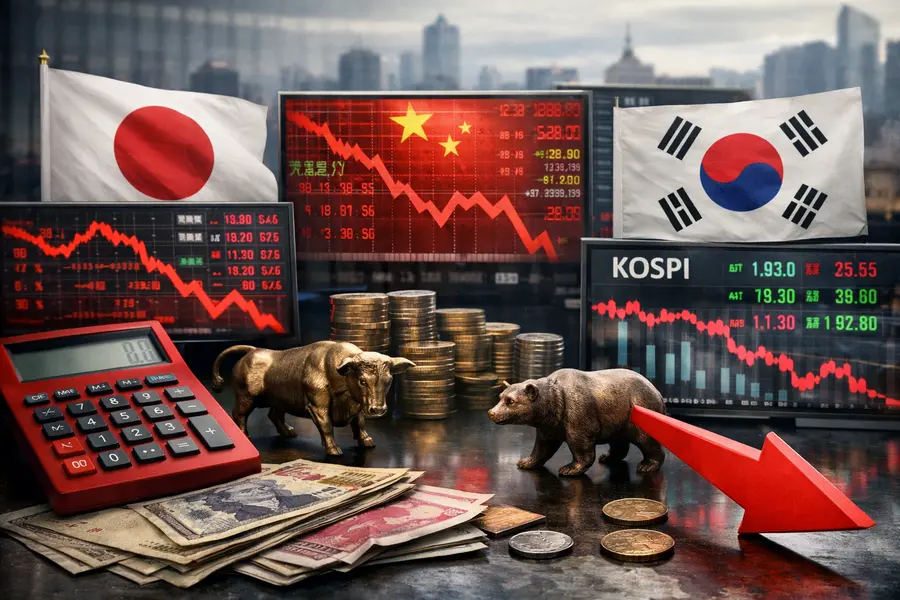
Asian equity markets ended a volatile July 24 session in fractured territory, with South Korean indices absorbing the sharpest losses of the year while Japanese and Chinese benchmarks posted more modest declines and Hong Kong's Hang Seng defied the broader rout.
- South Korea's KOSPI fell as much as 7.89%, triggering circuit breakers; Samsung Electronics and SK Hynix each dropped more than 7%.
- The Nikkei 225 declined roughly 2.5%, extending a weekly loss exceeding 6% as Japan's semiconductor complex bore the brunt of global AI-spending fears.
- The Hang Seng outperformed regional peers, trading near flat and offering a rare pocket of stability in an otherwise bruising Asian stock market news cycle.
Lead
TOKYO/HONG KONG/SEOUL — Asian stock markets delivered a sharply uneven verdict on Thursday, with an estimated $200 billion in regional equity value erased since the latest leg of the technology-driven global market sell-off began in early July. The session crystallized a weeks-long repricing of AI infrastructure stocks that has swept from Wall Street into the heart of emerging markets and developed Asia alike, leaving the region's benchmark indices on divergent paths.What Happened
South Korea's KOSPI suffered the session's deepest wound, plunging between 5.72% and 7.89% at its intraday low — the steepest single-day decline since the pandemic era — before partial stabilisation late in the session. Trading halts briefly activated on KOSDAQ futures as sell orders overwhelmed the circuit-breaker thresholds. Samsung Electronics and SK Hynix, the two companies most exposed to AI memory chip demand, each lost more than 7%, compounding declines that have now erased roughly a third of their combined market capitalization over the past three weeks.
Japan's Nikkei 225 fell approximately 2.5%, a comparatively contained move after the index had already dropped 4.03% on July 17 and logged a weekly loss of 6.44% in the prior period. Tokyo Electron, Advantest, and Kioxia — all deep in the semiconductor supply chain — continued to absorb selling pressure, with Kioxia having shed 16.1% in a single session one week earlier.
China's Shanghai Composite slid between 1.4% and 2.0%, hitting a three-month trough, while the MSCI Asia Pacific Index declined 2.2% across the broader region. Against that backdrop, Hong Kong's Hang Seng emerged as the session's clearest outlier, trading near flat and at points edging fractionally positive — a divergence that analysts attribute to its heavier weighting toward consumer and financial stocks relative to pure-play semiconductor names. Australia's ASX 200 slipped 0.39%, underscoring how the global market sell-off has transmitted across even commodity-oriented markets as oil-price inflation and interest-rate uncertainty compound the AI capex re-rating.Market Reaction
The $200 billion in value erased from semiconductor and cloud-computing stocks across the region traces directly to a single catalyst: Meta Platforms' July 1 announcement that it would begin selling surplus AI computing capacity under the banner of "Meta Compute." The disclosure shattered the long-held assumption that AI infrastructure build-out would generate sustained scarcity premiums for chip-makers and data-center equipment suppliers.
Strategic Context
The July 2026 rout reflects something more structural than a single earnings miss. For three years, consensus portfolio positioning across Asia assumed that AI capital expenditure would remain both enormous and indefinitely expanding — a thesis that justified premium multiples for chipmakers from Seoul to Tokyo. Meta's pivot to selling compute time suggests the AI infrastructure wave has, at minimum, entered a phase of overcapacity, with uncertain return-on-investment timelines for the hyperscaler cohort.
SoftBank Group, down 9.2% in the Nikkei's prior major session, exemplifies the exposure. Its Vision Fund strategy is deeply intertwined with AI infrastructure bets, and its valuation is highly sensitive to any reassessment of technology's near-term earnings power.For emerging markets more broadly, the combination of a stronger dollar, higher oil costs, and a global risk-off rotation creates a compound headwind. South Korea and Taiwan, whose indices are structurally dominated by semiconductor names, face the sharpest earnings revision risk. Markets with more diversified sector compositions — Hong Kong, Indonesia, India — retain relative insulation, which the Hang Seng's resilience on Thursday illustrates in practice.
Geopolitical Dimension
Beyond AI oversupply, energy geopolitics are reshaping the macro backdrop for Asian exporters. Brent crude at triple digits raises import costs for energy-dependent economies, including Japan, South Korea, and China, while also stoking inflation at a moment when central banks have limited room to ease. The Reserve Bank of Australia, facing unexpectedly strong employment data — 76,300 new jobs added in the most recent reporting period — now confronts a credibility test: cut prematurely and reignite inflation, or hold and deepen equity pressure.
U.S.–Iran tensions, meanwhile, have reintroduced a geopolitical risk premium into oil that had been largely absent since mid-2025, adding a layer of uncertainty to forward earnings models across Asian industrials and consumer staples that rely on stable freight costs.
What Comes Next
Investors will closely monitor upcoming earnings releases from major Taiwanese and South Korean chip-makers for signs that order books remain firm despite the sector sell-off. Any signal of resilient AI server demand could trigger a sharp snapback in the names that have fallen 10%–16% in recent weeks. Equally, a sustained retreat in crude toward the $85–90 range — contingent on de-escalation in the Middle East — would reduce inflationary pressure and restore some policy flexibility to Asian central banks.
The Nikkei's ability to stabilise above 64,000 will be closely watched as a technical indicator of whether the broader Asian stock market sell-off has found a floor.
Outlook
Asian markets remain divided between economies with concentrated semiconductor exposure — where the AI overcapacity narrative continues to inflict meaningful damage — and more diversified markets where the global market sell-off has produced a more contained repricing. Until clarity emerges on whether AI infrastructure spending is decelerating or merely pausing, high-beta technology indices across the region face continued headwinds. The near-term trajectory hinges on both the earnings season in progress and the path of energy prices, with geopolitical developments in the Middle East carrying disproportionate weight for inflation-sensitive Asian importers.
Mentioned tickers: 005930.KS, 000660.KS, 6857.T, 6758.T, 9984.T, 6963.T, META, ^N225, ^HSI, ^KS11, ^AXJO