Pomegra
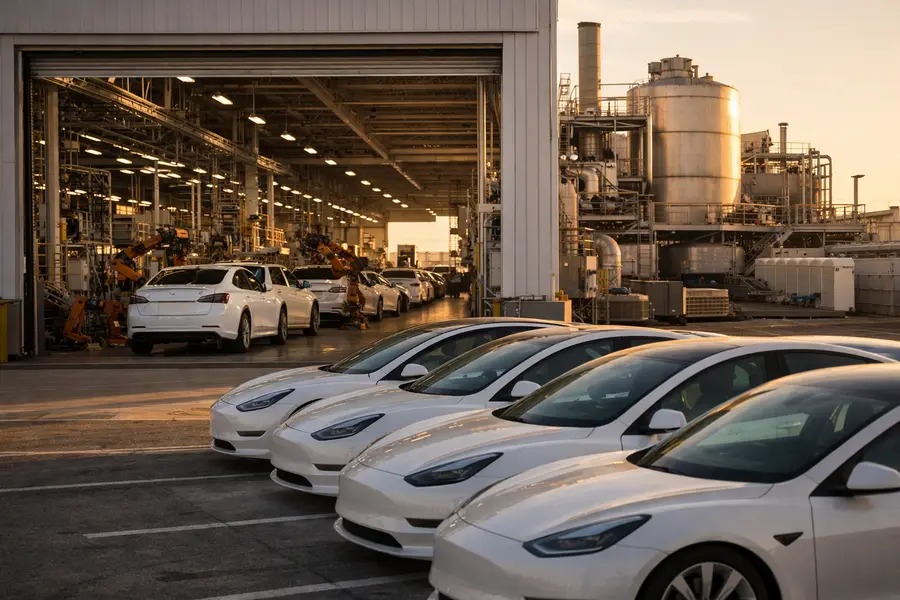
Tesla shares fell 10.77% to $343.69 on Nov. 5 as the Democratic midterm sweep and a 5.5% Nasdaq rout hit AI stocks and clouded Musk's SpaceX merger plans.
- Tesla (TSLA) closed at $343.69, down $41.50, on volume of 79.7 million shares, about double its 37.1 million average.
- The Nasdaq Composite fell 5.5% to 24,315 and entered correction territory, more than 10% below its October peak.
- Musk-linked SpaceX (SPCX) fell 9.05% to $123.62 as the Democratic wins raised questions about data centers and a Tesla merger.
Lead
Tesla (NASDAQ: TSLA) fell 10.77% on Thursday, Nov. 5, its worst session in months, as Democrats' control of both chambers of Congress reshaped expectations for the AI build-out. The decline was roughly double the S&P 500's 4.4% drop. It came two days after the midterm elections and one day after a relief rally that had lifted the Dow by 1,569 points.The Dow Jones Industrial Average lost 1,833 points, or 3.4%. The S&P 500 fell 335 points to 7,354. The Nasdaq Composite dropped 1,422 points to 24,315, erasing the previous session's 1.44% gain.
What Happened to Tesla Stock After the Midterms?
Tesla shares closed at $343.69 after ending Wednesday at $385.19. Volume reached 79.7 million shares. The stock sits about 31% below its 52-week high of $498.83 and remains above its 52-week low of $297.38.
Tesla had been down as much as 4% on Wednesday before trimming losses, as the market rallied on the removal of election uncertainty. Thursday's selling was far heavier and concentrated in companies tied to AI infrastructure and to Musk's political exposure.
SpaceX lost 9.05% to $123.62. Together, Tesla and SpaceX have shed more than $420 billion in market value since Tuesday's close. Musk's personal fortune has fallen by roughly $90 billion over the week to below $800 billion, though he remains the world's richest person.
Why Did the Democratic Sweep Hit Musk's Companies Harder?
The sweep exposed Musk's companies to political and regulatory risk on three fronts: Texas, data centers and merger scrutiny.
Musk spent more than $470 million supporting Republican candidates and causes this cycle, and most of the candidates he backed lost. In Texas, where Tesla and SpaceX have major operations, Democrats flipped the Senate seat and the governorship. Sen.-elect James Talarico and Gov.-elect Gina Hinojosa defeated Ken Paxton and Greg Abbott, both longtime Musk allies. Texas accounts for an estimated 25% to 30% of US data center capacity.
A potential SpaceX-Tesla merger that Musk has promoted now faces the prospect of closer congressional and regulatory review under Democratic control. Investors also priced in a greater chance of oversight of the companies' AI and data center ambitions. Musk responded on X that "data centers in space" looked "pretty appealing right now."
Why Did AI Stocks Sell Off So Sharply?
AI stocks fell because investors concluded that Democratic control in Washington and key states could slow the data center construction that underpins AI demand. Many candidates who pledged to rein in data centers won office. A Wall Street estimate put the share of planned US capacity growth exposed to short-term state moratoria at about 45%.
The chip and infrastructure names took the heaviest losses:
- Nvidia (NVDA) fell 9.2%, after a 3.2% drop on Wednesday.
- Advanced Micro Devices (AMD) fell 17.3%.
- CoreWeave (CRWV) fell 9.8%.
Brent crude rose 2.6% to $97.11 a barrel, recovering most of Wednesday's 9% slide. The oil move added to the volatility but was secondary to the technology rout.
How to Buy Tesla Stock: What Does the Thursday Move Show?
Tesla's valuation reflects expectations for its autonomous driving business as much as for vehicle sales. The company's chief financial officer has said robotaxis should lift 2027 sales and profitability meaningfully. Tesla plans to launch its Cybercab in Dallas this month, but its robotaxi costs have not yet reached the company's target of 30 cents per mile. A slower AI build-out or tighter Texas oversight would bear directly on that timeline.
Market Reaction and Strategic Context
The Thursday selloff reversed a post-election rally built on the view that divided government would reduce policy risk. That view held for one session. The market then concentrated on a narrower question: whether a Democratic Congress and newly Democratic state governments would constrain the sector responsible for much of recent US growth and index performance.
Tesla's position is unusual. It is a carmaker valued as an AI and robotics company, led by an executive whose political bets failed. That combination left it more exposed than most large technology peers to both the sector selloff and the change in Washington.
Outlook
Tesla's 10.8% decline marked the sharpest reaction among large technology names to the election outcome, and it left the stock near the middle of its 52-week range. The near-term direction for TSLA, SpaceX and the wider group of AI stocks depends on three developments: the first concrete state and federal proposals on data center permitting, the regulatory path for a Tesla-SpaceX combination, and the Dallas Cybercab launch scheduled for this month. Until those become clear, trading in the sector is likely to remain volatile and highly sensitive to political headlines.
Mentioned tickers: TSLA, SPCX, NVDA, AMD, CRWV