Pomegra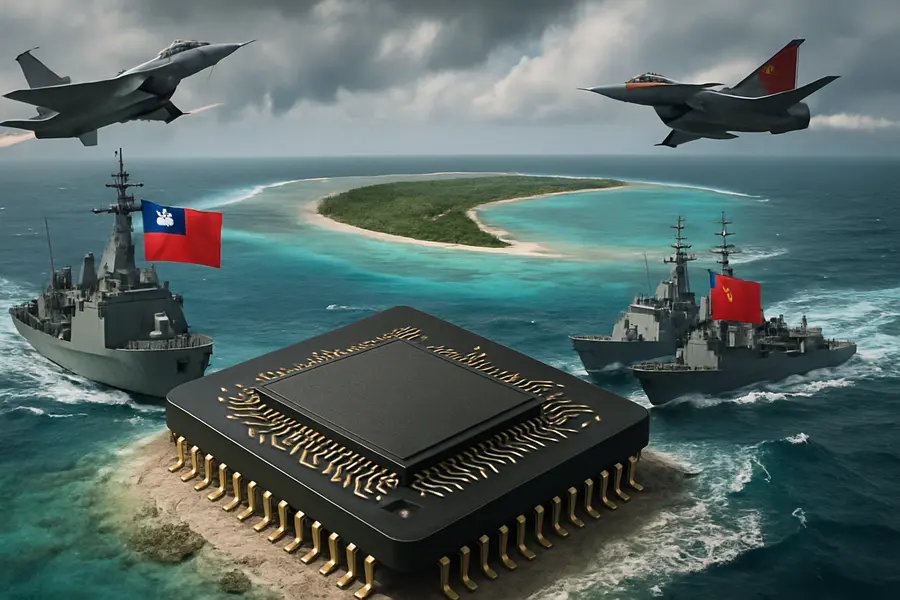
Taiwan and China coast guards clashed twice in a fortnight at Dongsha Atoll, placing South China Sea chip supply routes under fresh geopolitical strain.
- China's CCG-3501 (5,500 tons) entered Dongsha restricted waters May 24; a 33-hour standoff ended 26.6 nautical miles west of the atoll.
- Pratas lies more than 400km from Taiwan's main island and is defended by coast guard personnel rather than a military garrison.
- Taiwan produces over 90% of the world's most advanced semiconductors; a South China Sea blockade would disrupt an estimated $3.9 trillion in annual seaborne trade.
Lead
Dongsha Atoll, South China Sea — Chinese coast guard vessel CCG-3501 pressed into restricted waters surrounding Taiwan's remote Pratas Islands on May 24, 2026, triggering a 33-hour maritime standoff that repeated a fortnight later on June 5, marking the sixth Chinese incursion into the zone this year and signaling that Beijing is systematically probing Taiwan's most isolated and least-defended Pacific outpost.What Happened
China's 5,500-ton patrol vessel CCG-3501 approached Dongsha Atoll — the Taiwan-administered coral chain at the northern edge of the South China Sea — on the morning of May 24. Taiwan's 1,000-ton Coast Guard Administration vessel Taichung intercepted the intruder, and both sides issued repeated radio demands in Chinese and English ordering the other to withdraw. The confrontation persisted for 33 hours before CCG-3501 withdrew to 26.6 nautical miles west of the atoll.
On June 5, a second Chinese coast guard vessel repeated the intrusion. Taiwan's Coast Guard Administration stated the ship had "forced its way" into restricted waters "in disregard of warnings," and that the pattern "undermines the status quo of peace and stability in the Taiwan Strait." Beijing's Taiwan Affairs Office did not immediately respond to comment requests.
Strategic Vulnerability
The Pratas Islands — Dongsha Qundao in Mandarin — sit more than 400 kilometers from Taiwan's main island, placing them at the outer edge of Taiwan's defensive reach. Unlike Taiwan's major military installations, Pratas is administered entirely by the coast guard, with no standing military garrison. The atoll also functions as a national park, keeping its strategic infrastructure deliberately light.
Security analysts note that China has deployed an escalating gray-zone playbook previously applied to Philippine-held features such as Second Thomas Shoal — incremental coast guard pressure designed to test resolve below the threshold of armed conflict — and is now directing it at Taiwan's southern outposts. A Chinese reconnaissance drone briefly overflew the area in January 2026, four months before the vessel confrontations began.
The escalation follows the Trump-Xi summit of May 13–15, 2026, which generated renewed uncertainty about the scope of U.S. security commitments to Taiwan. Regional analysts interpreted subsequent ambiguities in Washington's posture as creating tactical space for maritime coercion.
The Chip Supply Dimension
The strategic stakes extend far beyond the coral atoll. Taiwan is the world's dominant producer of advanced logic chips, manufacturing more than 90% of semiconductors fabricated at 7-nanometer processes and below. Taiwan Semiconductor Manufacturing Co. alone accounts for the majority of global foundry capacity for the chips powering artificial intelligence infrastructure, precision defense systems, and consumer electronics.
Advanced chip manufacturing is already absorbing elevated input costs. Helium prices — a critical fabrication material — have roughly doubled in 2026 amid broader regional supply chain stress. TSMC posted record Q1 2026 results and its market capitalization crossed $2 trillion on June 4, driven by AI-linked demand. TSM shares traded at $408.75 as of June 11, within a 52-week range of $206.20 to $450.16, reflecting both the upside of accelerating data-center buildout and the volatility premium attached to Taiwan's geopolitical exposure.
Wider Economic Consequences
Research modeled by the Institute for Economics and Peace estimates that a full Chinese military campaign against Taiwan could reduce global economic output by up to 2.8%. The U.S. Air Force has assessed that 90% of its precision-guided munitions depend on TSMC-manufactured components, underlining the defense-industrial stakes alongside the commercial ones.
Geographic diversification of advanced semiconductor manufacturing is accelerating: the U.S. CHIPS Act has committed $52 billion to domestic fab capacity, with parallel initiatives in Japan and the European Union. TSMC's Arizona complex remains years from matching the scale and process maturity of its Taiwan operations. In the near term, any sustained Chinese disruption of Pratas or the surrounding sea lanes would stress chip supply chains with no immediate alternative.
Outlook
Beijing's escalating coast guard operations at Dongsha Atoll represent a calculated test of Taiwan's resolve and Washington's response thresholds at one of the most exposed points in Taiwan's administered territory. With six recorded incursions in 2026 and two standoffs inside two weeks, the pattern reflects deliberate pressure rather than isolated navigation. The immediate risk centers on chip supply chain confidence and energy transit through the South China Sea — both vulnerable to gray-zone coercion well short of armed conflict. Until advanced semiconductor manufacturing capacity is meaningfully redistributed, structural concentration in Taiwan will remain the single largest geopolitical risk embedded in global technology supply chains.
Geopolitics