Pomegra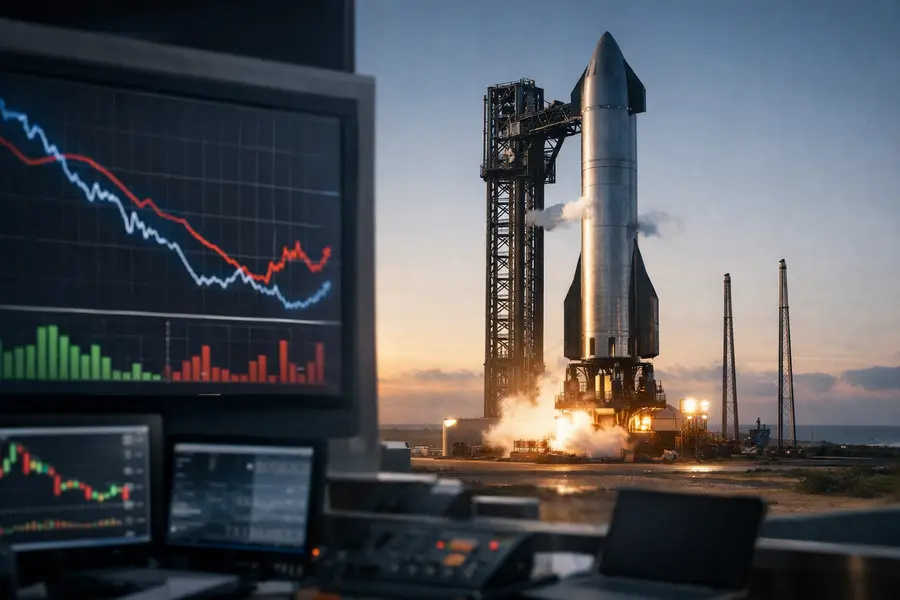
SpaceX shares trade 13% below their record June IPO price as investors brace for a pivotal Starship Flight 13 test on July 24 while surging Falcon 9 government demand provides an offsetting bullish signal for the private space industry.
- SPCX trades near $116.72, down 48% from its $225.64 post-IPO peak, with 911.5 million shares entering the float on August 6.
- Starship Flight 13 targets a 6:45 p.m. ET July 24 launch window, carrying 20 Starlink V3 satellites and testing upgraded heatshield hardware.
- The U.S. Space Force tripled its national security launch contract ceiling to $17 billion, affirming durable demand for Falcon-class vehicles.
Lead
SpaceX (SPCX) shares fell to $116.72 on July 23 — 13.5% below the company's $135-per-share IPO price from June 12 and nearly half its $225.64 post-IPO peak — as the company prepared for a third attempt at launching its Starship Flight 13 vehicle from Starbase in South Texas on July 24. The 90-minute launch window opens at 6:45 p.m. ET. A successful flight would mark the first time Starship has carried a functional payload, deploying 20 next-generation Starlink V3 satellites into orbit, and could serve as a near-term catalyst for the SPCX stock that has struggled since its historic debut as the largest IPO in history.What Happened
The Flight 13 mission has twice been stopped short of liftoff. On July 16, the automated flight termination system aborted the launch one second before ignition after sensors detected underperformance in four of the Super Heavy booster's 33 Raptor engines. A second attempt on July 22 was scrubbed due to adverse weather over the Gulf of America. Engineers subsequently replaced several Raptor engines, updated propulsion software, and completed additional ground testing before clearing the vehicle for the third attempt.
The 407-foot (124-meter) integrated stack now features upgraded Raptor 3 engines on the Super Heavy booster — SpaceX's most powerful and thermally efficient variant — and a modified heatshield on the Starship upper stage. The company has equipped the aft skirt and aft flaps with load-sensing tiles and alternative attachment mechanisms designed to survive higher dynamic pressure during ascent than any previous Starship test flight encountered, generating engineering data critical for the transition to an operational vehicle.
Mission objectives for the upper stage include deploying all 20 Starlink V3 satellites, executing a single Raptor engine relight in space to simulate orbital insertion scenarios, and performing a controlled descent and splashdown in the Indian Ocean. The Super Heavy booster is targeted for a controlled splashdown in the Gulf of America rather than a tower catch, reducing mission complexity while still validating full-stack separation and boostback burn sequences.
Market Reaction
SPCX stock opened lower on July 23 as pre-market participants processed the second scrub. The shares have shed approximately $108 from their intraday peak of $225.64, reflecting a combination of mission uncertainty and structural supply pressure. On August 6, a lock-up expiry releases 911.5 million shares into the tradable float — the single largest post-IPO supply event in U.S. equity history — creating what traders have characterized as a looming supply shock at current price levels.The $60 billion all-stock acquisition of Cursor, the AI code-completion platform, has added dilution concerns ahead of that lock-up date. SpaceX priced the deal in shares rather than cash, implying that management viewed its own equity as a superior currency at the time of announcement — a signal that can cut both ways given the subsequent drawdown.
Analyst opinion on the private space industry leader remains sharply divided. A consensus of sell-side estimates produced an average 12-month price target of $240.04, with individual estimates ranging from $62 at the conservative end — where Morningstar places its fair-value estimate — to $800 at the highest. HSBC initiated coverage with a Hold rating and a $115 target, essentially at par with current trading levels. The debate centers on whether the 64-times-price-to-sales multiple embedded in SpaceX's $1.75 trillion IPO valuation adequately accounts for the timeline risk in Starship's commercialization and the underperformance of Starlink's subscriber revenue relative to pre-IPO projections.
Strategic Context: Falcon 9 Demand
Even as Starship dominates headlines, the workhorse Falcon 9 business provides a more immediate earnings floor. The U.S. Space Force has more than tripled the ceiling of its National Security Space Launch Phase 3 Lane 1 contract vehicle to $17 billion from $5.6 billion, reflecting escalating demand from military and intelligence customers for rapid and reliable orbital access. The Air Force separately authorized launch cadence at Vandenberg Space Force Base to double, from 50 to 100 missions per year — a logistical change driven explicitly by national security payload backlogs.
A Falcon 9 booster set an industry record with its 35th flight in June 2026, underscoring the maturity and reuse economics of SpaceX's flagship launch vehicle. Globally, the industry is on pace for more than 250 orbital missions in 2026, with SpaceX accounting for roughly 40% of total flights. Sustaining a 140-plus-launches-per-year cadence requires continued high-rate Starlink satellite production to fill launch manifest slots alongside commercial and government payloads — a flywheel dynamic that keeps manufacturing economics improving.
Geopolitical Dimension
The tripling of the Space Force contract ceiling reflects a broader recalibration of U.S. launch dependency policy. With rival launch vehicles from United Launch Alliance's Vulcan and emerging international providers still in early operational phases, SpaceX occupies a structurally advantaged position in national security manifests. That concentration creates both revenue visibility for SpaceX and a degree of government incentive to see the company succeed — a backdrop that analysts expect to underpin contract renewal and expansion regardless of near-term Starship outcomes.
NASA's Artemis IV lunar landing mission, currently scheduled for 2028, designates a Starship variant as the Human Landing System. A successful Flight 13 would represent the first operational payload delivery for the Starship architecture and would advance the certification timeline for that contract, which carries its own multi-billion-dollar milestone payments.
What Comes Next
A clean launch on July 24 — or any subsequent attempt in the near-term window — would remove the immediate overhang of Starship technical uncertainty that has shadowed SPCX since the July 16 abort and the subsequent stock slide. Successful payload deployment of the 20 Starlink V3 satellites would validate Starship as a commercial carrier ahead of the more heavily watched booster-catch and point-to-point cargo demonstrations planned for later in 2026.
The August 6 float expansion remains the dominant near-term variable for SPCX regardless of launch outcomes. Beyond that date, investor focus is expected to shift toward Starlink subscriber and ARPU trends in the second half of 2026, the cadence of additional Starship test flights, and the trajectory of the Cursor integration as a driver of SpaceX's enterprise software revenues.