Pomegra
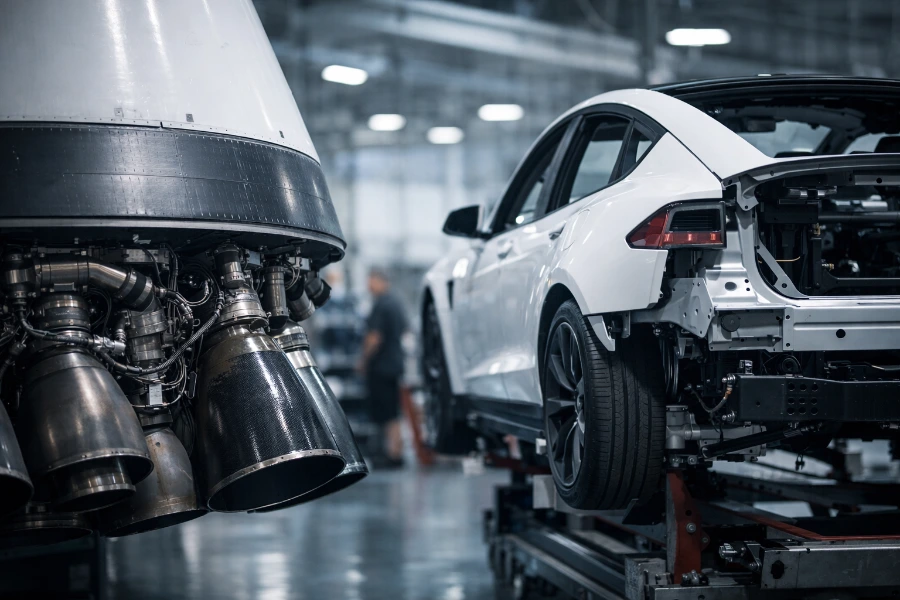
Elon Musk's SpaceX-Tesla merger pitch would create a $3.5 trillion company and could force index funds to buy about $100 billion of its shares in the S&P 500.
- A combined SpaceX and Tesla would be worth nearly $3.5 trillion, the fifth-largest company in the S&P 500.
- Index funds would need to buy roughly $100 billion of the merged company's stock.
- SpaceX is barred from the S&P 500 until June 2027; a Tesla merger could bypass that wait.
Lead
Elon Musk is pitching a merger of SpaceX (SPCX) and Tesla (TSLA) that would give the rocket maker a route into the S&P 500 months before the index's own rules allow. Based on Friday's closing prices, the two companies have a combined market value of nearly $3.5 trillion. Adding that stock to the benchmark would require index funds to buy about $100 billion of it. No formal announcement has been made, but each company has formed a special committee of independent directors to evaluate a deal, with Musk recused because of his conflicts of interest.
Why Is SpaceX Looking for a Backdoor Into the S&P 500?
SpaceX needs a backdoor because S&P Dow Jones Indices declined in June to fast-track mega-cap IPOs. The index provider requires a newly listed stock to trade for 12 months and the company to post four consecutive profitable quarters. SpaceX listed on the Nasdaq in June at a valuation of about $2.6 trillion, so the earliest it could be considered is June 2027.
Index membership matters because of how passive funds operate. Roughly $16 trillion sits in index-tracking strategies globally, and those funds are compelled to buy each constituent in proportion to its weight. A fund tracking the S&P 500, including the SPDR S&P 500 ETF Trust (SPY), must hold every new member the day it joins.
Tesla is already in the benchmark. If a stock-for-stock deal leaves Tesla as the surviving entity, the enlarged share count would flow through the index automatically, with no waiting period. Inclusion and weighting would still depend on deal mechanics and the share of the combined company available to public investors, so entry is not guaranteed.
How Big Would the Index Buying Be?
Index funds would need to buy roughly $100 billion of the combined company, based on its nearly $3.5 trillion value. A stock-for-stock deal would generate passive demand equal to about 10% of the free float. The merged firm's pro forma weight in the S&P 500 would fall between 1.9% and 3.0%, depending on how much stock counts as freely tradable.
The reshuffling would reach beyond a single stock. Tesla's departure from the consumer discretionary sector would trigger outflows of about $4 billion, while the addition of SpaceX would draw $3 billion to $4 billion into communication services. The Nasdaq-100, which tracks about $800 billion in assets including funds such as the Invesco QQQ Trust (QQQ), would face a concentration adjustment of an estimated $10 billion to $14 billion in outflows from other holdings.
Timing adds a second layer. The December Russell index reconstitution could bring another $14 billion to $15 billion of passive demand as share lockups expire.
What Do the Valuations Say About the Deal?
The valuations show two very different companies. Tesla shares are down 13% this year and trade at about 180 times expected earnings, against roughly 18 times for the S&P 500. SpaceX generated $32 billion of revenue in the 12 months through September and recently reported its first profitable quarter.
Musk first floated the combination on Tesla's Oct. 20 earnings call, describing what would be the largest merger in history. Reports of talks since then have pointed to an announcement as soon as next month. Prediction markets put the odds of a formal announcement by Dec. 31 at 28.5%, rising to 73% by July 1, 2027.
Could Regulators Block a SpaceX-Tesla Combination?
Regulators could challenge the deal, and antitrust risk is the most frequently cited obstacle. Former Justice Department officials have flagged that a combined company able to restrict competitors' access to key technologies could draw a challenge. One example is limiting Starlink satellite connectivity to Tesla vehicles, which would disadvantage rival automakers.
Governance is a second hurdle. Musk sits on both sides of the transaction, so the independent committees must negotiate the exchange ratio and protect minority shareholders in each company. A deal that appears to favor one set of shareholders would invite litigation.
How to Buy SpaceX Stock Ahead of Any Merger?
Buying Tesla stock today carries exposure to the same deal, since a stock-for-stock merger would alter the share count, ownership split and index weight of the surviving company. Market pricing already reflects some probability of a transaction, which makes the stock sensitive to every update on the committees' work.
Outlook
The pitch turns a one-year index waiting period into a single corporate transaction. If a deal is announced, the key variables are the exchange ratio, the free float of the combined company, and the S&P committee's treatment of the new entity. Regulatory review and shareholder votes would stretch any completion well beyond the next announcement window. For index funds, the $100 billion estimate marks the scale of the adjustment, and the Russell reconstitution in December is the next scheduled test of passive demand for SpaceX shares.
Mentioned tickers: TSLA, SPCX, SPY, QQQ