Pomegra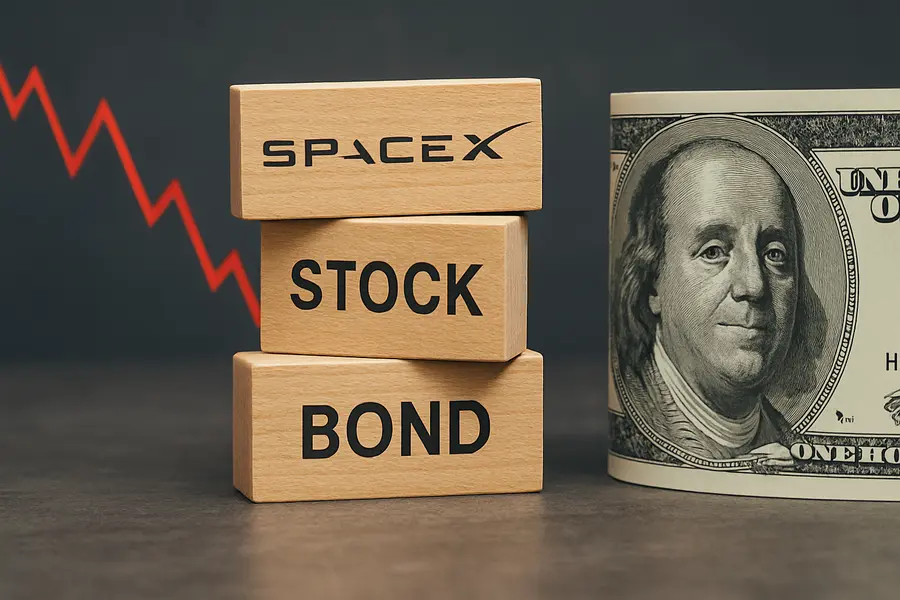
SpaceX's $25 billion bond sale and forced index inclusion are creating concentration risk across multi-asset portfolios just weeks after the largest IPO in history.
- SPCX fell 31% from its June 16 peak to $154.60, erasing roughly $620 billion in market cap while SpaceX tapped debt markets for $25 billion.
- SpaceX bonds drew $89 billion in orders across five tranches but have since posted ~$305 million in paper losses as secondary spreads widen.
- Passive funds tracking the Nasdaq-100 and Russell 1000 face an estimated $22–$27 billion in forced buying, sharpening single-name concentration risk.
Lead
Less than three weeks after its $135-per-share debut on the Nasdaq — the largest initial public offering in history, raising approximately $75 billion — Space Exploration Technologies Corp. (SPCX) is testing the nerve of investors across asset classes. A 31% equity pullback from its June 16 high and mounting losses on a freshly priced $25 billion bond offering are exposing a structural tension: multi-asset portfolios absorbing both the stock and the debt are not spreading SpaceX stock risk — they are concentrating it.
What Happened
SPCX shares peaked above $225 on June 16, briefly lifting the company's market capitalization past $2 trillion, before sliding to $154.60 by June 22 in a four-session slide that erased approximately $620 billion in value. The retreat coincided with the announcement of SpaceX's inaugural debt offering, which some investors interpreted as a signal of elevated capital requirements.
The bond sale, priced on June 22, was structured across five tranches of senior unsecured notes maturing between 2031 and 2056. Coupons ranged from 5.35% on $7 billion of five-year paper to 6.65% on $3.5 billion of 30-year notes, with three intermediate tranches priced at 5.65%, 5.875%, and 6.60%. The offering attracted nearly $89 billion in orders — more than 3.5 times the $25 billion raised — placing it among the largest U.S. investment-grade bond transactions of the year.
SpaceX bonds have since underperformed sharply. Paper losses relative to Treasuries totaled approximately $305 million within days of settlement, with the longest-dated tranche widening as much as 28 basis points past its issue spread, effectively erasing the concession underwriters had built into the deal. Analysts cited a $600 billion decline in SpaceX's equity value, weak technicals from upsized supply, and investor uncertainty over the company's credit profile as the primary drivers.The Concentration Problem
The simultaneous presence of SPCX shares and SpaceX bonds in multi-asset portfolios is drawing pointed concern from credit and equity strategists. The SpaceX diversification case collapses under examination: the risk embedded in both instruments traces to the same narrow set of operational dependencies — continued subscriber growth for the Starlink satellite internet service and the successful commercialization of the Starship heavy-lift rocket program.
"Owning SPCX equity and SpaceX bonds isn't diversification," one senior capital markets specialist noted. "It's the same execution risk across two instruments." A material setback in Starlink's growth trajectory or a delay in Starship's development would simultaneously impair the equity thesis and weaken the credit case — a dynamic standard portfolio construction frameworks do not capture.
Starlink generated $11.4 billion in 2025 revenue, representing 61% of total company sales and growing approximately 50% from 2024. Yet SpaceX recorded a GAAP net loss of nearly $5 billion for the full year and a further $4.28 billion loss in the first quarter of 2026 alone. Total 2025 revenue reached $18.7 billion against adjusted EBITDA of $6.6 billion. SPCX currently trades at approximately 104.7 times trailing price-to-sales, a valuation that leaves minimal margin for operational missteps across either the stock or the debt.
Passive Investing Risk and Forced Buying
The passive investing risk dimension of SpaceX's market debut introduces a structural amplifier. S&P Global's index committee excluded SPCX from the S&P 500 on profitability grounds — the company does not satisfy the index's requirement for positive earnings in both the most recent quarter and the trailing four-quarter aggregate. However, inclusion in the Nasdaq-100 and Russell 1000 triggered an estimated $22 billion to $27 billion in mechanical buying from passive vehicles.
FTSE Russell's semi-annual reconstitution added SPCX to its U.S. benchmarks effective late June, forcing index-tracking funds to acquire an estimated $5.4 billion in shares within a narrow window near the closing bell. Combined with parallel MSCI fast-track inclusion, the concentrated volume of forced buying in a stock with limited float decouples near-term price discovery from fundamental valuation — a dynamic that compounds the inherent SpaceX stock risk for investors arriving through passive exposure.
The same mechanical flows that drove index-related inflows can reverse. When reconstitution windows close and rebalancing adjusts benchmark weights, passive holders may find their position size reflects index mechanics rather than a deliberate view on SpaceX's risk-reward profile.
Market Reaction
Analyst price targets for SPCX range from $62 to $310, with a consensus estimate near $221 — above recent trading levels but capturing significant dispersion in assumptions around Starship's commercial timeline and Starlink's competitive durability. The wide spread reflects genuine uncertainty about the path to GAAP profitability that would eventually qualify SpaceX for S&P 500 inclusion and a more stable passive investor base.
Outlook
SpaceX's simultaneous equity selloff and bond spread widening in the weeks following its historic IPO underscores the complexity of absorbing a $1.75 trillion debut into global capital markets. SpaceX bonds and SPCX equity may perform well over time if Starlink sustains its growth rate and Starship reaches commercial scale, but the near-term configuration presents overlapping pressures. Passive investing risk from forced index buying adds price-agnostic demand that can obscure fragile fundamentals. Investors seeking genuine SpaceX diversification face a straightforward structural constraint: until the company's financial profile diverges meaningfully across its equity and credit instruments, the two represent the same bet expressed in different wrappers.
Mentioned tickers: SPCX