Pomegra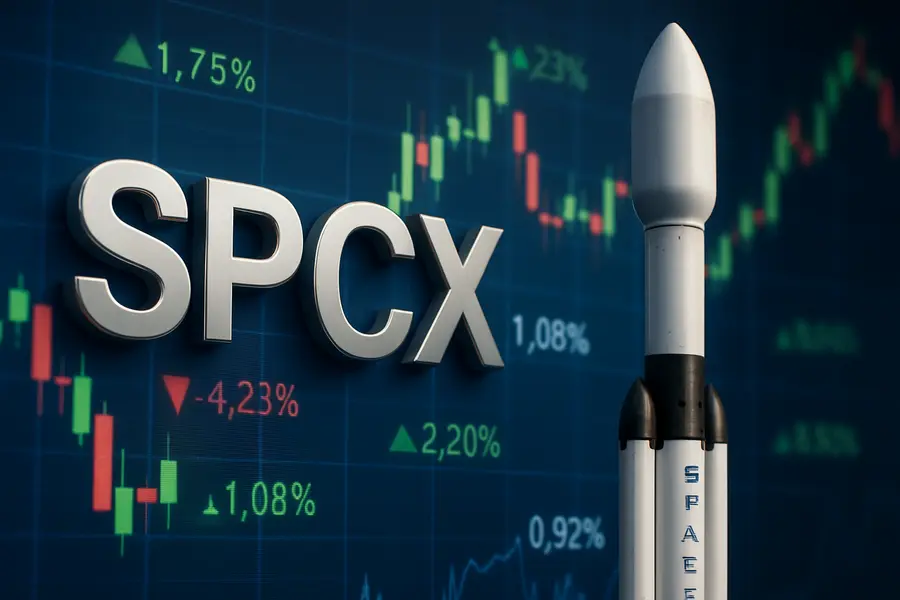
SpaceX's record $75 billion Nasdaq debut has reset valuation benchmarks for the space economy, leaving institutional investors weighing a 63%-margin satellite business against a price-to-sales ratio that rivals peak-era tech multiples.
- SPCX opened at $150 on June 12, closed at $160.95 — a 19% first-day gain — and hit $225.64 on June 16 before retreating to ~$185.
- Starlink generated $11.4 billion in 2025 revenue at a 63% EBITDA margin, accounting for 61% of SpaceX's $18.7 billion total.
- Average revenue per Starlink user has compressed from $99 in 2023 to $66 in Q1 2026, flagging early pricing pressure as the subscriber base scales.
Lead
Space Exploration Technologies Corp. (NASDAQ: SPCX) completed the largest initial public offering in capital markets history on June 12, 2026, pricing 566 million shares at $135 and raising approximately $75 billion on the Nasdaq exchange. The deal valued the company at roughly $1.77 trillion at offer, and first-day trading pushed that figure past $2 trillion before the bell — a threshold previously reached only by a handful of U.S. mega-cap technology firms. As of June 19, SPCX trades near $185, implying a market capitalization of approximately $2.4 trillion, and institutional positioning across the space economy has accelerated sharply in the week since listing.What Happened
SpaceX's S-1 filing, submitted in May 2026, provided the first authoritative look at a company that had operated as a closely held private entity for 24 years. The document disclosed $18.7 billion in 2025 revenue and confirmed that Starlink, the low-Earth-orbit satellite internet constellation, had become the company's dominant revenue and profit engine — not rocket launches.
The IPO priced at the top of its indicated range. Shares opened at $150 on debut day, an 11% premium to the offer price, and closed at $160.95 — a 19.2% first-day return. Momentum carried SPCX to an intraday all-time high of $225.64 on June 16 before a 3% pullback brought shares back to their current trading range.
Market Reaction
Trading volume on the debut session was among the heaviest ever recorded for a single equity on the Nasdaq. The listing catalyzed a broader rally in space industry equities: satellite hardware manufacturers, ground-systems suppliers, and launch-adjacent companies all recorded material gains in the days following the SPCX debut, consistent with the "SpaceX adjacency" trade that had been building in the pre-IPO secondary market.
Analyst consensus stands at six Buy ratings versus one Sell. The average 12-month price target is $187.80, with a street-high of $310 and a street-low of $62 — a range that reflects genuine disagreement over how to discount a business operating at the intersection of sovereign infrastructure, consumer broadband, and frontier aerospace.
Financial Architecture: Starlink as the Core
The S-1 financials clarify a structural shift that had been visible only partially in secondary-market data. Starlink generated $11.4 billion in 2025 revenue — up roughly 50% year-over-year — and $4.4 billion in operating profit, funding the broader enterprise at a time when the launch and Starship programs remained net consumers of capital.
In the first quarter of 2026, the connectivity segment reported $3.26 billion in revenue and $1.19 billion in operating income, representing 29% year-over-year growth. The business model is 85% recurring subscription revenue, and Starlink's EBITDA margin of 63% is structurally comparable to software infrastructure businesses rather than traditional aerospace.
Subscriber growth supports that trajectory: the constellation served 9.2 million users at year-end 2025 and 10.3 million by the end of Q1 2026, with projections pointing toward 16.8 million by December 2026. The offsetting variable is average revenue per user, which has declined steadily from $99 in 2023 to $66 in Q1 2026 — reflecting price reductions in competitive markets and a shift toward lower-tier residential plans.
Strategic Context
SpaceX controls an estimated dominant share of commercial mass launched to low-Earth orbit globally, underpinned by the reusable Falcon 9 booster and its low marginal cost per kilogram. The Starship super-heavy program, designed to reduce launch costs by another order of magnitude, remains the central long-term competitive moat — though the S-1 disclosed that the path to full reusability is less defined than pre-IPO communications suggested, drawing pointed attention from investors focused on development timelines.
The company's position within the U.S. defense and intelligence community, secured through contracts with the Department of Defense and direct satellite broadband deployments in active conflict zones, provides a revenue floor that purely commercial peers cannot replicate.
Space Industry Trends and Competitive Dynamics
The broader space industry is expanding rapidly. The space economy reached $630 billion in 2025 and is tracking toward $1.8 trillion by 2035, growing at approximately 9% annually. Equity funding into space technology companies surged 152% in the first four months of 2026 compared with the same period in 2025, with $3.71 billion raised across 44 rounds.
SpaceX's primary competitive risks are not from legacy launch providers. Amazon's Project Kuiper is building a competing LEO constellation, though operational satellites only began reaching orbit in April 2025 and no commercial broadband product is yet available to consumers. China's Spacesail presents the most structurally credible long-run challenge: backed by state capital exceeding $1 billion, it is targeting a 15,000-satellite constellation by 2030 and plans to initiate broader commercial services by year-end 2026. Starlink's ARPU compression to $66 reflects, in part, early pricing adjustments in markets where Spacesail's eventual entry is anticipated.
Blue Origin's New Glenn launcher remains subscale relative to Falcon 9 reuse economics; ULA's Vulcan Centaur faces a protracted certification timeline. Neither is positioned to contest launch economics meaningfully in the near term.Tech Investment 2026: Valuation Debate
The central tension for tech investment 2026 in SPCX is the valuation construct. At current prices, SpaceX trades at a price-to-sales ratio of approximately 60 — placing it among the most richly valued large-cap equities globally. That multiple assigns substantial terminal value to Starship-enabled businesses (point-to-point transport, lunar logistics, Mars infrastructure) that carry no revenue today and face multi-year development risk.
Long-range modeling by institutional space-sector researchers places SpaceX's base-case valuation at $2.5 trillion by 2030, with an optimistic scenario reaching $3.1 trillion — contingent on Starship achieving commercial reusability, Starlink ARPU stabilizing above $60, and continued DoD contract expansion.
Elon Musk Stocks: Governance Overhang
Elon Musk retains voting control of SpaceX following the IPO, a structure the S-1 disclosed explicitly. Institutional investors evaluating Elon Musk stocks across his portfolio — Tesla (NASDAQ: TSLA), X Corp., xAI, and now SPCX — must account for the concentration risk inherent in a single individual's strategic direction and public profile. Musk's governance position insulates SpaceX from activist pressure but also limits the mechanisms by which institutional shareholders can influence operational or capital-allocation decisions.Outlook
SPCX's first week of trading establishes a clear institutional narrative: Starlink's recurring cash flow is the durable asset; Starship is the optionality premium; and the valuation implies near-flawless execution across both. ARPU compression, Spacesail's trajectory, and unresolved reusability timelines are the variables most likely to test that narrative over a 12-to-24-month horizon. For institutional investors building space industry exposure, SPCX represents the most liquid and direct access point to what is now the world's largest commercial space enterprise — though the entry multiple demands scrutiny commensurate with its scale.