Pomegra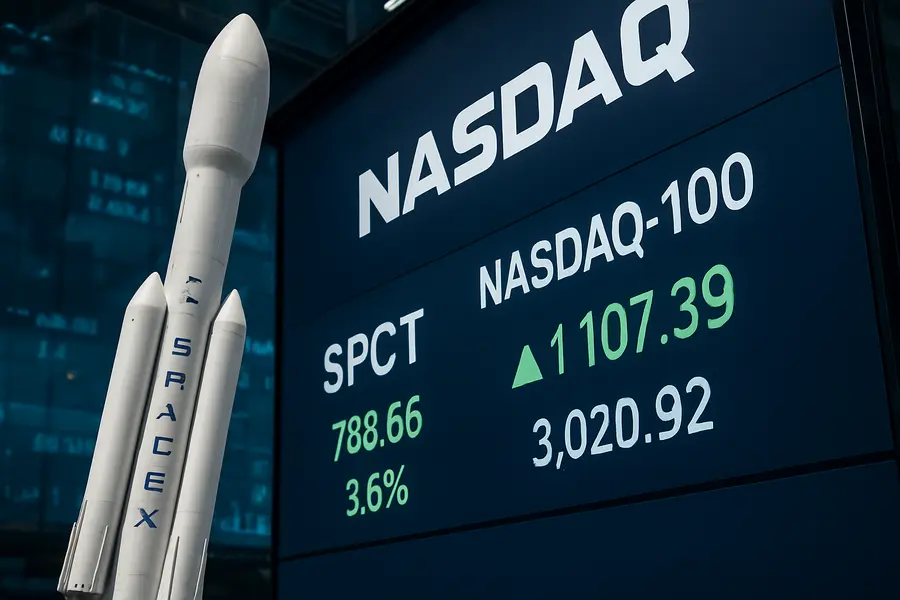
Space Exploration Technologies will enter the Nasdaq-100 on July 7, 2026, triggering an estimated $4.3 billion in passive inflows just weeks after its historic $75 billion market debut.
- SpaceX (SPCX) priced at $135 and closed its June 12 Nasdaq debut at $160.95, a 19% first-day gain on a record $75 billion raise.
- SPCX becomes the first company to enter the Nasdaq-100 under a fast-track rule allowing large-cap IPOs eligibility after just 15 trading days.
- An estimated $4.3 billion in passive fund inflows is projected ahead of the July 7 effective date, drawn from the more than $800 billion tracking the index.
Lead
Space Exploration Technologies Corporation will join the Nasdaq-100 Index before the opening bell on Tuesday, July 7, 2026, Nasdaq confirmed on June 26, making SPCX the first stock to enter the index under the exchange's newly adopted fast-track eligibility framework. The addition comes fewer than four weeks after SpaceX completed the largest initial public offering in market history, raising $75 billion at $135 per share and closing its debut session at $160.95 — a 19.2% first-day gain that pushed its implied market capitalization above $2.1 trillion.What Happened
SpaceX stock news moved quickly from historic IPO to index eligibility in a compressed timeline that would have been impossible under the exchange's prior rules. Effective May 1, 2026, Nasdaq revised its index methodology to allow any newly listed company ranking among the top 40 constituents by market capitalization to qualify for the Nasdaq-100 after just 15 trading days, with the minimum public float requirement eliminated outright.SPCX easily cleared both thresholds. The company's market debut on June 12 ranked it among the six largest U.S.-listed companies by market cap on day one, and its float — though small relative to total shares outstanding — satisfied the revised criteria. Index-tracking funds and product sponsors are scheduled to begin purchasing shares after market close on July 6, with the SpaceX Nasdaq-100 entry taking effect the following morning.
Market Reaction
Since its Nasdaq debut, SPCX has traded with notable volatility. Shares briefly spiked to an all-time high of $225.64 on June 16, four days after listing, before retracing to $147.11 on June 23 — a drawdown of roughly 35% from peak. The stock was trading near $153.23 as of June 27, still above its IPO price but well off its intraday highs, reflecting the tension between intense retail and institutional demand and lingering questions about the company's path to profitability.
SpaceX reported a net loss of $4.3 billion in the first quarter of 2026 in its IPO prospectus, underscoring that the company's $2 trillion-plus valuation rests heavily on the long-term commercial potential of its Starlink satellite internet business and next-generation launch infrastructure rather than near-term earnings.Strategic Context
The timing and structure of the Nasdaq index changes are significant beyond SpaceX itself. Nasdaq's rule revision signals a deliberate effort to capture marquee listings before rival exchanges can attract them, and the fast-track framework is now available to any future mega-IPO that clears the market cap threshold. For investing in SpaceX, index inclusion transforms what was initially an event-driven, high-volatility trade into a structural holding for tens of millions of passive investors worldwide.
JPMorgan estimated that SpaceX's Nasdaq-100 inclusion alone could generate approximately $4.3 billion in mechanistic buying from index-tracking vehicles. The Invesco QQQ Trust (QQQ), the largest ETF benchmarked to the Nasdaq-100 with more than $300 billion in assets, will be among the funds required to establish positions. Additional passive inflows of roughly $3 billion are projected from simultaneous Russell index reweighting, where SPCX joined the Russell 1000 and Russell 3000 in a separate process that preceded the Nasdaq-100 announcement.
SPCX is expected to enter the Nasdaq-100 with a weighting of less than 1%, reflecting the gap between its total market capitalization and its publicly tradable float, which remained under 5% at the time of listing. The constrained float amplifies price sensitivity: even moderate index-driven demand represents a substantial fraction of available shares, a dynamic traders have already priced into options markets ahead of the July 7 date.
The Broader Technology Landscape
SpaceX's Nasdaq-100 entry repositions the index — already heavily weighted toward software, semiconductors, and AI infrastructure — toward physical-world technology at planetary scale. The company's Starship heavy-lift program, Starlink satellite network, and a nascent point-to-point terrestrial travel business represent capital-intensive infrastructure bets with decade-long payoff horizons.The dual listing on Nasdaq Texas, announced alongside the primary exchange listing, adds a secondary layer of regulatory and structural innovation. Nasdaq Texas, which launched in 2025 as the first major new U.S. stock exchange in years, attracted SpaceX partly through the symbolism of a Texas-headquartered company choosing the state's home exchange, though all trading activity is fully interoperable with the national market system.
SpaceX's arrival at the Nasdaq-100 also raises compositional questions for the index's largest constituents. Apple, Microsoft, Nvidia, Amazon, and Meta currently dominate weighting; SPCX's sub-1% entry will require a proportional reduction in other members' weights through standard rebalancing mechanics — one of the mechanics tracked by ETF analysts as a secondary market-impact channel.