Pomegra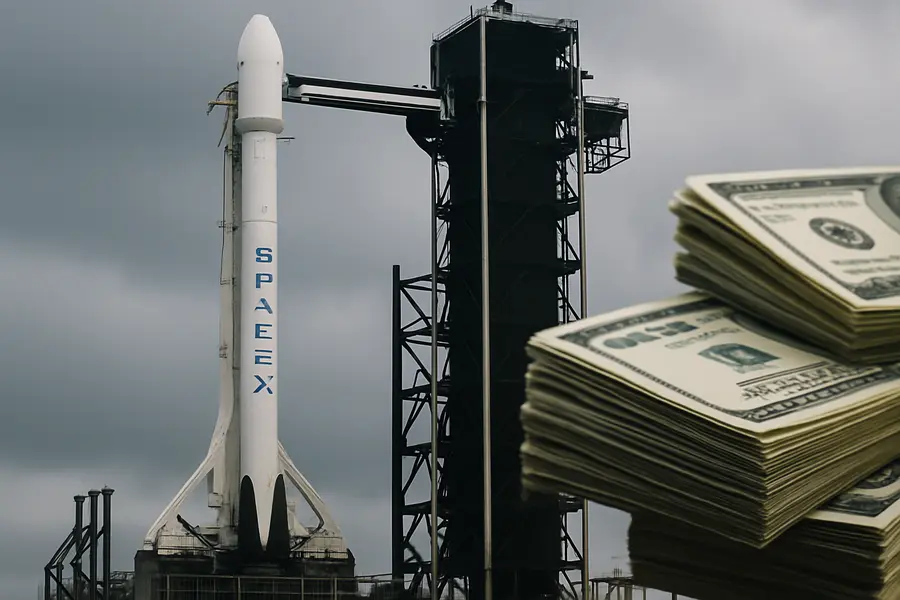
I have all the data needed. Writing the article now.
- SpaceX (SPCX) priced its IPO at $135 on June 11, raising $75 billion in the largest public offering in capital markets history.
- The stock surged 67% to an all-time high of $225.64 on June 16 before retreating sharply, closing at $177.94 on June 18.
- Morningstar values SpaceX at $780 billion — less than half the IPO price — citing an indeterminate economic moat and xAI integration risks.
---
SpaceX's record-breaking Nasdaq debut has left institutional investors divided over whether a $3.1 trillion implied valuation is justified by fundamentals — or marks the apex of a space-economy bubble.
Lead
SpaceX (NASDAQ: SPCX) shares fell for a second consecutive session on June 18, 2026, sliding as much as 10% intraday and trimming the company's market capitalization to approximately $2.35 trillion, one week after its record-setting debut on the Nasdaq. The pullback follows a brief run to a fully diluted implied valuation of roughly $3.1 trillion at the stock's June 16 peak — a level now drawing pointed scrutiny from institutional investors who question whether the space economy's most important public listing has outrun its financial reality.What Happened
SpaceX locked in an IPO price of $135 per share on the evening of June 11, 2026, valuing the company at $1.77 trillion and raising $75 billion — surpassing Saudi Aramco's 2019 offering to become the largest initial public offering in history. The stock opened at $150 on June 12, closed its first trading day at $160.95 — a 19% premium — and continued climbing through the week, reaching $225.64 on June 16 before reversing sharply. The Federal Reserve's decision on June 17 to hold interest rates unchanged provided little support, as investors rotated away from high-multiple growth names. By June 18, SPCX had surrendered more than 21% from its all-time high, with volume running well above average.
Valuation in Question
The SpaceX valuation debate centers on a single, uncomfortable ratio: at the IPO price of $135, the company traded at roughly 73 times trailing annual sales of approximately $11.4 billion. At the June 16 peak, that multiple expanded further. Morningstar published a pre-IPO analysis placing fair value at $780 billion — a 55% discount to the listing price — citing an indeterminate competitive moat and warning that the xAI integration poses a "material threat of value destruction." Boston College analysts raised parallel concerns about potential losses for pension funds, endowments, and retirement accounts exposed to the offering.
The analyst community remains unusually split. Price targets for SPCX span $75 to $200, one of the widest ranges seen for a freshly listed mega-cap. Critics note that sustaining the post-IPO peak valuation would require revenue growth rates and margin expansion that border on implausible under conventional discounted cash flow models.
The Starlink Foundation
Starlink remains the core of the SpaceX investment thesis — and its only confirmed profitable segment. The company's S-1 filing revealed that the satellite internet division generated $4.42 billion in operating income for full-year 2025, with adjusted profit of $7.17 billion, an 86% year-over-year increase. In the first quarter of 2026 alone, Starlink produced $3.26 billion in revenue and $1.19 billion in operating income, underpinned by 10.3 million subscribers across 155 countries as of March 31. Analysts at Quilty Space project subscriber counts will reach 16.8 million by year-end 2026.That trajectory is real — but the mathematics are hardening. Subscriber growth in mature markets is decelerating, and competitive pressure from ground-based fiber expansion and emerging low-orbit rivals is intensifying. Starlink's revenue per user must climb substantially for the business to justify being priced as a technology platform rather than an infrastructure utility.
Governance and Structural Risks
Institutional capital has flagged several structural concerns that did not arise when SpaceX operated as a private company. The February 2026 merger between SpaceX and Elon Musk's artificial intelligence venture xAI was not conducted at arm's length — Musk controlled both entities, creating an unresolved related-party conflict that governance-focused funds say warrants a discount.
The balance sheet adds another layer of complexity. SpaceX carries $30 billion in total debt against $16 billion in cash, with $20 billion of that liability tied to a short-term bridge loan used to fund AI infrastructure acquisitions; the loan matures 15 months after the IPO. A more immediate pressure arrives June 30, when Q2 earnings are released — the same date insiders become eligible to liquidate up to 20% of their pre-IPO holdings, creating a potential supply shock at an already sensitive moment in the stock's early trading life.
Space Economy and Market Contagion
The ripple effects of SpaceX's listing have reshaped the broader space economy. Competing operators bore the cost of SPCX's debut: Firefly Aerospace shed more than 18% the day SpaceX began trading; Rocket Lab (RKLB), Redwire, and Intuitive Machines each fell at least 10%; satellite operators Planet Labs (PL) and AST SpaceMobile (ASTS) dropped a similar amount as institutional capital consolidated around the new mega-cap benchmark.
SpaceX itself has articulated a total addressable market of $28.5 trillion — encompassing $370 billion in space services, $1.6 trillion in connectivity, and $26.5 trillion in AI-adjacent opportunities. Institutional investors do not dispute the scale of the opportunity; the disagreement is over what fraction of that market SpaceX will realistically capture, and over what time horizon.
Outlook
SpaceX enters its second week as a public company under meaningful valuation pressure. The stock's June 18 close of $177.94 leaves SPCX up 32% from its IPO price but well below the peak levels that briefly implied a $3.1 trillion enterprise value. Q2 earnings on June 30 will be the first chance for management to address investor concerns directly, with Starlink subscriber growth, xAI integration costs, and guidance on the bridge loan refinancing likely to dominate the agenda. The market's verdict on whether the SpaceX stock price finds a durable floor will also serve as a proxy for how public markets intend to price the space economy at industrial scale.
Mentioned tickers: SPCX, RKLB, PL, ASTS, TSLA