Pomegra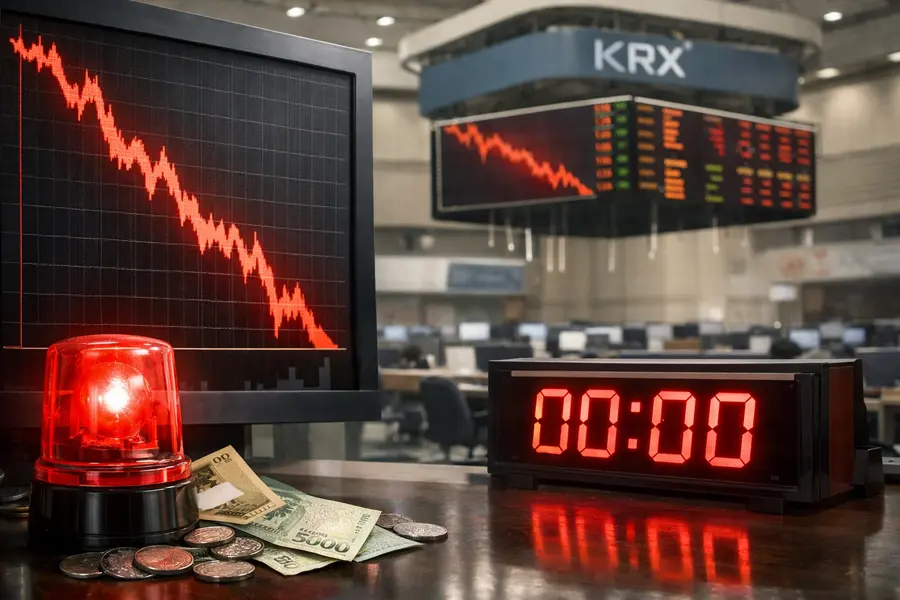
South Korea's Kospi index lost more than 17% across two sessions on July 28–29, halting the Korea Exchange twice in a row for the first time in its history.
- The Kospi index closed at 6,023.63 on July 28, down 10.84% — its fourth-largest single-day decline on record.
- Back-to-back circuit breakers on the Korea Exchange marked an event without precedent in the bourse's modern history.
- SK Hynix posted record quarterly operating profit of ₩60.54 trillion yet missed analyst consensus near ₩64 trillion, igniting cascading forced sales across leveraged retail positions.
Lead
Seoul's benchmark Kospi index lost more than 17% across two trading sessions on July 28 and 29, 2026, producing one of the sharpest two-day drawdowns recorded by any major global equity index this year. Trading on the Korea Exchange was halted for 20 minutes on each of the two successive days — a historic first — as a convergence of disappointed earnings expectations, record-high margin debt, and concentrated leveraged-ETF bets turned a sentiment reversal into a rout. The two sessions together erased gains that had taken months to accumulate and wiped out hundreds of trillions of won in market capitalisation.
What Happened
On July 28, the Kospi index fell 10.84%, closing at 6,023.63 — its fourth-largest single-session percentage decline in its recorded history. A Stage 1 circuit breaker suspended trading as losses exceeded the 8% threshold. Semiconductor majors led the selling: Samsung Electronics fell more than 13%, and SK Hynix dropped more than 14%.
The following morning brought the second shock. SK Hynix released April–June results that were, by any conventional measure, exceptional: revenue and operating profit both set all-time quarterly records, with operating profit reaching ₩60.54 trillion. Yet the figure came in roughly ₩3.5 trillion below the analyst consensus of approximately ₩64 trillion. Against a market priced for perfection and leveraged to absorb no disappointment, the miss was enough to restart the selloff. The Kospi fell a further 8% on July 29, triggering a circuit breaker for the second consecutive session — an occurrence with no precedent in Korea Exchange history.
Over the two days combined, the Kospi index surrendered more than 17%.
The Leverage Trap
The velocity and depth of the decline reflected structural vulnerabilities that had accumulated during the bull run. Margin loans outstanding on the Korea Exchange peaked at ₩38.63 trillion on June 24 — the highest level ever recorded — and remained at ₩34.37 trillion as of July 15. A large share of that exposure was concentrated in single-stock leveraged exchange-traded funds tied directly to Samsung Electronics and SK Hynix, products that multiplied gains through the rally but compounded losses with equal force once sentiment shifted.
Retail investors, who had absorbed early selling pressure by purchasing a net ₩11.47 trillion of Kospi shares across three sessions, turned net sellers on July 29, offloading ₩1.97 trillion in a single day. One leveraged ETF linked to SK Hynix fell more than 28% intraday on July 29, closing down nearly 14%; measured from its June 25 high, it had by then lost 78.77%, with a maximum drawdown exceeding 86%.
AI Optimism Meets Structural Reality
The two-session crash arrived at the conclusion of a rally that ranked among the most spectacular in global equity markets in recent memory. The Kospi index rose roughly 116% from its previous cycle low to an all-time high of 9,385.59 on June 19, 2026, briefly elevating South Korea to the world's sixth-largest equity market. The thesis was explicit: Korean chipmakers, led by SK Hynix and Samsung Electronics, would be the principal beneficiaries of accelerating global AI infrastructure spending, particularly surging demand for high-bandwidth memory.
The narrative fractured when reports circulated that China's ChangXin Memory Technologies had commenced mass production of domestically developed deep-ultraviolet chipmaking equipment. The development placed a competitive threat on a shorter timeline than most investors had priced, reframing the long-term demand outlook for Korean memory producers and triggering a reassessment of valuations built on assumptions of durable supply dominance.
Government Response and Regulatory Reckoning
South Korea's principal financial authorities convened an emergency meeting on the evening of July 29. Finance Minister Koo Yun-cheol presided alongside the Bank of Korea Governor, the Financial Services Commission Chairman, and the Financial Supervisory Service Governor. The minister acknowledged publicly that the government had not adequately evaluated the risks posed by single-stock leveraged ETFs before permitting their introduction and that their market-destabilising effect had been underestimated.
Regulatory action followed immediately. From August 5, 2026, the minimum cash balance required to trade single-stock leveraged ETFs on the Korea Exchange was tripled to ₩30 million (approximately $20,300). Authorities also signalled consideration of a further ceiling capping individual investor exposure to such products at 20% of total financial assets.
Currency Counterpoint
The equity rout produced a counterintuitive outcome in the currency market. The South Korean won gained roughly 8% against the US dollar in July — its strongest monthly performance since March 2009 — trading near ₩1,435 per dollar in late July. The Bank of Korea's hawkish posture anchored the currency: second-quarter GDP expanded 0.6%, double the central bank's own forecast of 0.2%, while June consumer inflation reached 3.2%, a three-decade high. Capital continued to flow into Korean fixed-income markets even as equities collapsed.
Outlook
The Kospi index found a floor near 5,262 in late July before staging a sharp rebound. The two-session rout, however, exposes unresolved questions that will define the market's trajectory: whether AI-driven memory demand can sustain the earnings trajectories embedded in chipmaker valuations, whether Korean retail investors will return to a market characterised by extreme leverage and sector concentration, and whether the new ETF restrictions will prove durable enough to contain systemic risk if sentiment deteriorates again.
The Korea Exchange has tightened circuit-breaker mechanisms. Regulators have moved on leveraged products. The structural imbalances that converted an earnings miss into a historic two-day decline, however, were years in the making — and are unlikely to be resolved by a single emergency meeting.
Mentioned tickers: 005930.KS, 000660.KS, ^KS11