Pomegra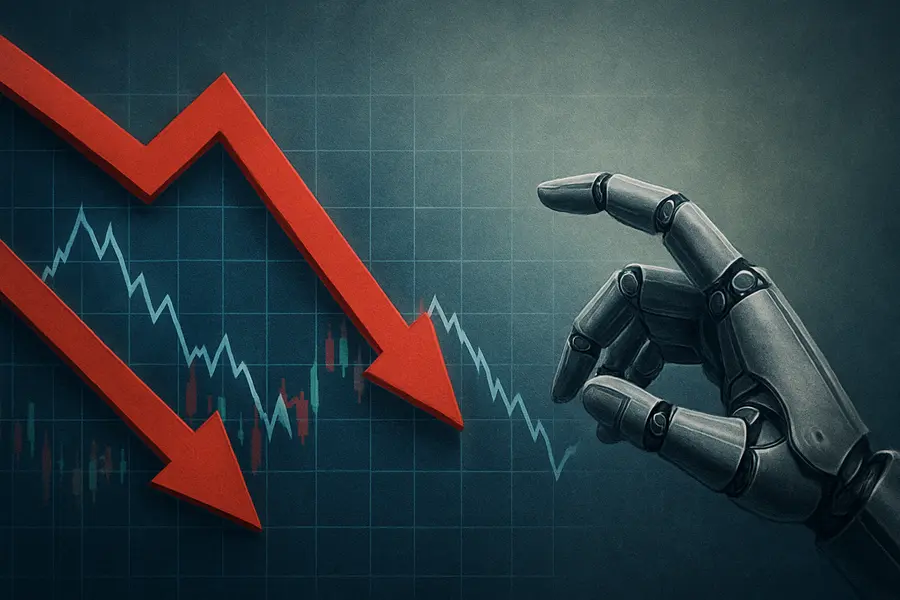
Now I have enough data to write the article. Here it is:
- The Nasdaq Composite fell 4.6% for the week ended June 27, posting five straight losing sessions; the S&P 500 shed nearly 2%.
- An OpenAI IPO delay report and a high-profile talent departure from Google DeepMind amplified AI valuation concerns, dragging chip stocks sharply lower.
- Big Tech's combined 2026 capital expenditure exceeded $452 billion while free cash flow declined, triggering a broad investor expectations reset.
---
The S&P 500 and Nasdaq snapped a two-week win streak as AI stock jitters and Big Tech capex concerns triggered the steepest tech market selloff of 2026.
Lead
U.S. equity markets closed the week of June 23–27, 2026, sharply in the red as escalating AI stock jitters converged with a high-profile report that OpenAI is weighing a postponement of its initial public offering to 2027, snapping a two-week winning run for both the S&P 500 and the Nasdaq Composite. The Nasdaq settled Friday at 25,297.62, down 4.6% on the week, while the S&P 500 closed at 7,354.02, off nearly 2%. The Dow Jones Industrial Average, carrying lighter technology exposure, rose 0.6% over the same period. By Friday's close, the Nasdaq had recorded five consecutive losing sessions and stood 5.5% below the all-time high it set on June 2.
What Happened
The tech market selloff gained momentum after a report emerged indicating that OpenAI is leaning toward delaying its public listing until 2027 rather than accepting a market valuation below its $1 trillion target in a volatile environment. CEO Sam Altman is reported to favor holding for more favorable conditions rather than compromising on price. Because Microsoft (MSFT) holds an approximately 27% stake in OpenAI — carrying an estimated value of roughly $135 billion — the disclosure transmitted directly into megacap technology sentiment.
The Nasdaq decline 2026 intensified on June 24, when the index plunged more than 2.2% in a single session to 25,587 — the steepest single-day drop since April 2025 — while the S&P 500 fell 1.44% to 7,365. Alphabet (GOOGL) shed between 6% and 10% over two sessions, compounded by news of a high-profile AI researcher departing Google DeepMind for Anthropic, raising questions over competitive moats in foundational model development. Amazon (AMZN) fell approximately 4% during the stretch.
Chip Stocks Lead the Decline
Semiconductor names bore the deepest losses of the week. Micron Technology (MU) tumbled as much as 13% in a single session before partially recovering. Nvidia (NVDA) dropped 6% on its worst day of the stretch, while Advanced Micro Devices (AMD) fell more than 6% on June 23. Broadcom (AVGO) shed between 3.7% and 4.4% across sessions. Semiconductor stocks collectively wiped an estimated $1.3–$1.4 trillion in combined global market value over the period.
The AI stock jitters were not confined to Wall Street. South Korean chipmakers Samsung and SK Hynix each fell roughly 12% in a single session on June 23, among the sharpest single-day declines for Korean technology stocks in recent memory. Japanese investment group SoftBank (9984), with deep exposure to the AI ecosystem as a major OpenAI backer, tumbled more than 12% in Tokyo trading, erasing approximately $38 billion in market capitalization in one day.
The AI Capex Reckoning
Beneath the OpenAI headline lies a structural repricing that drove this week's AI stock jitters. Combined 2026 capital expenditure commitments from Microsoft, Alphabet, Amazon, and Meta (META) exceeded $452 billion, while free cash flow at these companies declined materially year-over-year. The market, which had previously rewarded megacap technology firms for accelerating AI infrastructure spending, shifted to demanding a clearer timetable for capital returns.
Microsoft's shares have now fallen approximately 25% year-to-date, illustrating how sharply sentiment toward AI-heavy balance sheets has deteriorated. The OpenAI IPO delay report amplified existing concern: as the most closely watched private AI company, OpenAI's reluctance to test public markets at its stated valuation functions as a barometer of where institutional money currently prices the broader AI opportunity. The funding environment for the AI buildout is tightening, and equities levered to that buildout are being repriced accordingly.
Market Rotation
More defensive areas demonstrated relative resilience as investors rotated away from technology into industrials, energy, and consumer staples — a pattern consistent with mid-cycle de-risking rather than a broad equity exit. The Dow Jones outperformance of 0.6% for the week reflected that rotation explicitly.
The S&P 500 snap win streak interrupted a run of two consecutive weekly gains that had restored confidence following earlier June volatility. Despite the reversal, the Nasdaq remains approximately 10% higher year-to-date, and the S&P 500 is substantially above its 2025 close — context that frames the current move as a correction within a longer bull market rather than a structural breakdown.
Outlook
The pace of recovery for both the S&P 500 and Nasdaq will likely hinge on forthcoming quarterly results and capital expenditure guidance from the hyperscalers. If major technology companies signal a moderation in AI spending growth alongside improving free cash flow trajectories, the conditions that produced this tech market selloff could ease. Conversely, further evidence of IPO market weakness, continued talent attrition at leading AI labs, or deteriorating margins from AI infrastructure investment risk extending the Nasdaq decline 2026 beyond its current drawdown. The week demonstrated that even in a structurally bullish AI cycle, investor patience with capital expenditure absent a clear path to cash return has defined boundaries.