Pomegra
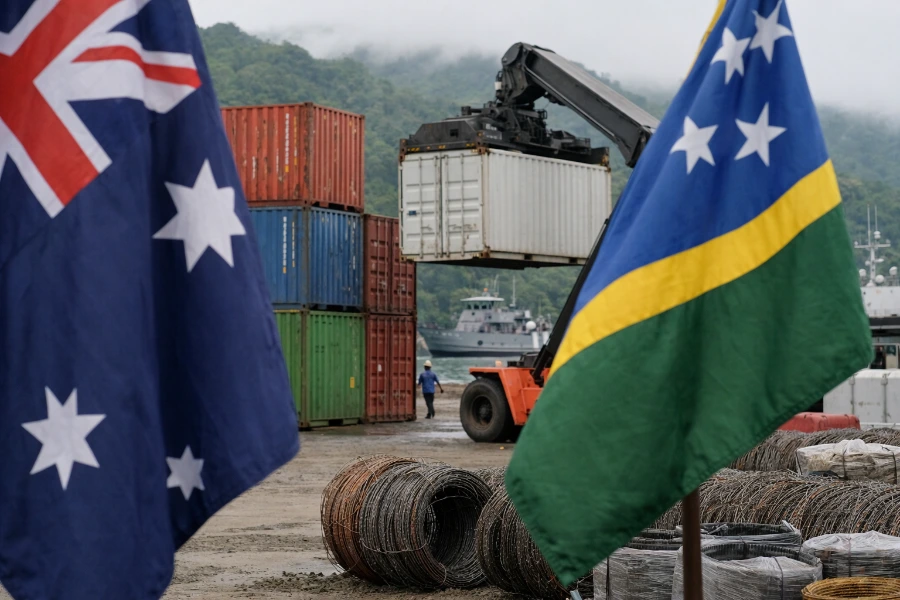
Solomon Islands signed a security treaty with Australia on Nov. 25 and told Beijing it won't renew its 2022 China pact, reshaping Pacific security ties.
- Honiara and Canberra signed the treaty on Nov. 25 and committed A$980 million (about US$644 million) in Australian funding.
- The Solomon Islands has told China its 2022 policing and security pact will lapse in April 2027.
- The treaty bars foreign military or security bases and gives Australia a say in sensitive infrastructure decisions.
Lead
The Solomon Islands signed a wide-ranging security treaty with Australia in Canberra on Wednesday, Nov. 25. Prime Minister Matthew Wale and Australian Prime Minister Anthony Albanese signed it. Honiara has also notified Beijing that it will not renew the five-year security arrangement it signed with China in 2022. That pact expires in April 2027. The sequence makes Australia the country's preferred security partner and ends the most contested element of China's formal presence in the South Pacific.
What Does the Australia Treaty Require of Honiara?
The treaty commits the Solomon Islands to refuse any request from a foreign power to establish a military or security base on its territory. It also requires Honiara to consult Australia on national security decisions and on the development of sensitive infrastructure such as ports, telecommunications and energy assets. In return, Australia will help expand the country's police and border force. It has committed about A$980 million (roughly US$644 million) in development funding, including an estimated A$142 million for the government's free-education policy. The package also includes improved visa and work arrangements for Solomon Islanders in Australia. The treaty names the Pacific Islands Forum as the primary channel for regional security cooperation. Honiara's one-China policy, in place since it switched recognition from Taiwan to Beijing in 2019, is unchanged.
What Was in the 2022 China Pact?
The 2022 agreement allowed China to rotate police training teams through the Solomon Islands and kept about two dozen Chinese police in the country at any one time. The deal was signed under then-Prime Minister Manasseh Sogavare. It alarmed Canberra and Washington because early drafts that circulated publicly raised the possibility of Chinese naval access. Both governments warned at the time that a Chinese military foothold about 2,000 kilometres from Australia's northeast coast would alter regional strategic calculations. Both Honiara and Beijing denied any intention to build a base.
Why Did Honiara Walk Away From the China Pact?
The decision follows a change of government. Wale took office in May 2026 and has since faced one motion of no confidence. The timing and the size of the Australian offer point to a negotiated trade of security alignment for development financing. Strategic analysts describe the outcome as a major gain for Canberra. Wale declined to answer questions about the Chinese arrangement, citing a non-disclosure clause. Sogavare, now in opposition, has accused Australia of "checkbook diplomacy" and warned that Honiara risks losing ties with China. Government documents show members of parliament received discretionary grants of up to A$118,000 each from a A$23 million assistance package. That detail has sharpened the domestic argument over whether the shift reflects national interest or political patronage.
How Has China Responded?
Beijing has not directly addressed the treaty. It has said it does not engage in geopolitical contests or bloc confrontation, and that cooperation between states should not target any third party. China remains the Solomon Islands' largest trading partner and a significant lender and infrastructure builder. Its commercial footprint in timber, mining and construction is unaffected by the lapse of a police-focused pact. The near-term question is whether Beijing treats the lapse as a bilateral matter or responds with economic pressure, as it has in other disputes with governments that shifted alignment.
What Does It Mean for Pacific Security Competition?
The treaty adds to a pattern of Australian bilateral security agreements across the Pacific, built on the premise that financing and mobility rights can anchor partnerships. Canberra has paired policing support, infrastructure funding and labour-mobility access to counter offers from Beijing. The Solomon Islands has been the most visible test of that approach since 2022.
The economic channels run through three areas:
- Development finance: Australian grants replace part of the Chinese policing and infrastructure support that underpinned the earlier relationship.
- Critical infrastructure: Consultation rights give Canberra a voice over ports, undersea cables and telecoms contracts that Chinese firms have bid on in the region.
- Labour mobility: Expanded work access for islanders in Australia ties household remittances to the Australian relationship.
For shipping and sea lanes, the treaty keeps the approaches to Australia's northeast free of a foreign naval facility, as long as the base ban holds.
What Happens Next?
Over the next three to twelve months, three developments will matter most. The first is ratification and publication of the full treaty text, which has not been released. The second is Wale's survival in parliament, since a successful no-confidence motion could reopen the question. The third is the handover of Chinese police duties before April 2027 and any Chinese diplomatic or commercial response. Structurally, the episode shows that Pacific governments can renegotiate security alignments when a change of government coincides with a larger financing offer. That keeps the regional contest between Canberra and Beijing open.
Outlook
The Solomon Islands has moved from a China-linked policing arrangement to a treaty-based partnership with Australia within four years. The A$980 million package, the base prohibition and the infrastructure consultation requirement give Canberra a durable position. Domestic scrutiny of the financial terms, a fragile parliamentary majority and Beijing's response to the lapse are the main risks to the arrangement.
Mentioned tickers: None