Pomegra
Houthis say they hit Saudi Arabia's Ras Tanura refinery and Riyadh's financial district; Brent crude slipped to $90.97 as Riyadh reported drone interceptions.
- Houthis claimed fires at Ras Tanura, Saudi Arabia's largest refinery at 550,000 barrels per day, on Nov. 25.
- The Saudi-led coalition said air defences destroyed four drones and did not confirm the refinery was hit.
- Brent fell 0.5% to $90.97 and WTI fell 0.6% to $81.58 as supply-glut concerns outweighed the risk premium.
Lead
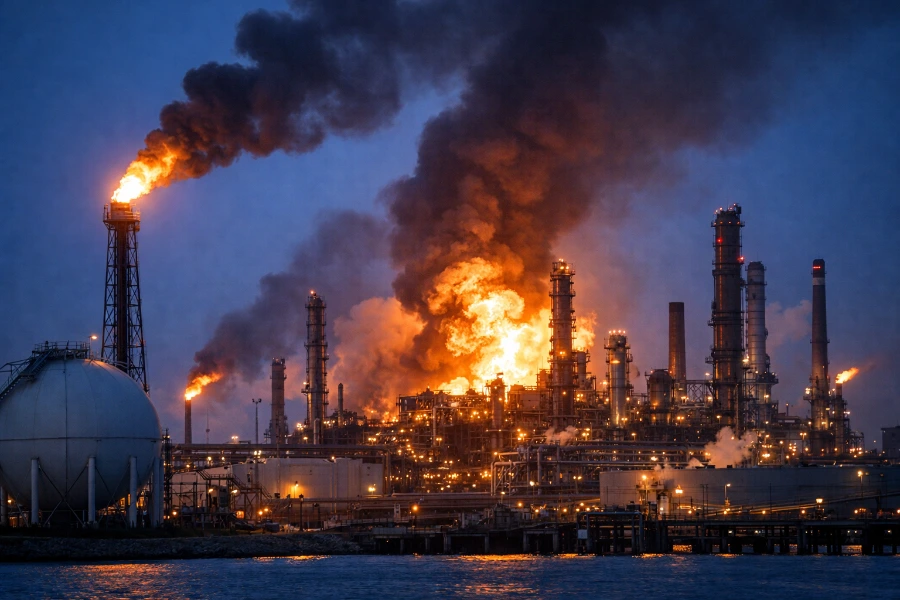
Yemen's Iran-aligned Houthis said on Wednesday, Nov. 25, that they attacked the Ras Tanura refinery on Saudi Arabia's Gulf coast and Riyadh's financial district. Houthi military spokesman Yahya Saree said the refinery strike caused fires and that the financial district was hit in three phases, with "significant damage." The Saudi-led coalition said air defences intercepted and destroyed four drones over Ras Tanura in the Eastern Province. It did not confirm that the facility was struck. Saudi Arabia's government and Saudi Aramco (2222.SR) had not immediately commented on operations at the site.
What Happened at Ras Tanura and in Riyadh?
The Houthis claimed a drone and missile campaign against two high-value targets in under 24 hours. Ras Tanura is the kingdom's largest refinery, with capacity of 550,000 barrels per day, about 16% of Saudi refining capacity. Its adjacent terminal can load roughly 6.5 million barrels per day.
Satellite imagery showed thick black smoke around the refinery, covering an area of roughly 600 square kilometres. The coalition's account is limited to the four intercepted drones.
In Riyadh, Saudi civil defence said 11 people were wounded on Tuesday when a strike hit a tower in the financial district. The tower is the headquarters of the Public Investment Fund. An earlier attack on Nov. 19 caused damage but no injuries, making this the second strike on the district in under a week.
Why Did the Crude Oil Price Barely Move?
The crude oil price fell on Wednesday because supply-glut concerns outweighed fears of disruption. Brent futures slipped 43 cents, or 0.5%, to $90.97 a barrel. West Texas Intermediate futures fell 47 cents, or 0.6%, to $81.58. Both benchmarks had gained in the previous session.
An IEA report this month pointed to a market surplus, which has kept prices contained. Attacks on ships near the Strait of Hormuz and the exchanges between Saudi Arabia and the Houthis have added uncertainty about how long that holds.
The reaction contrasts with late October. After a Houthi claim of a ballistic missile strike on Ras Tanura on Oct. 27, Brent rose about 1.6% to near $115.69. Prices have since fallen by roughly $25 a barrel as inventories and spare capacity reassured traders. The market is pricing the probability of lost barrels, not confirmed outages.
Why Is Ras Tanura Such a Sensitive Target?
Ras Tanura combines refining and export infrastructure in one complex, so damage there can cut both domestic product supply and crude loadings. The complex has been hit repeatedly this year. Iranian drones struck it on March 2, and operations were suspended for about two weeks. Terminal loadings fully resumed in late June, and the Oct. 27 claim followed.
The Houthis have targeted Saudi infrastructure since Yemen's civil war reignited in July amid spillover from the US-Iran conflict. Earlier attacks disrupted Aramco operations, cancelled international flights to Riyadh and forced the postponement of major events, including the AFC Asian Cup.
The benchmark for scale is September 2019, when strikes on Abqaiq and Khurais briefly knocked out 5.7 million barrels per day, about half of Saudi output. Nothing reported so far approaches that scale.
Geopolitical Dimension
The strikes on the Public Investment Fund tower show the Houthis widening targets from energy assets to the financial centre of Saudi Arabia's economic diversification push. That raises costs for foreign investment, aviation, insurance and event hosting, even when interceptions succeed.
For energy markets, the main channels are physical outages at Eastern Province facilities, shipping risk around Hormuz and the Red Sea, and insurance premiums on regional cargoes. Gulf producers have the spare capacity and storage to absorb short disruptions. Repeated hits would test that buffer and the credibility of Saudi air defences.
What Comes Next for Oil Prices?
Oil prices over the next three to twelve months depend on whether strikes cause verified outages, not on the number of claims. If Ras Tanura loadings continue uninterrupted, the glut narrative and OPEC+ capacity disputes are likely to remain the dominant drivers, keeping Brent near $90. A confirmed shutdown of the terminal or damage to processing units would shift the focus to supply security and revive the risk premium seen in October, when Brent traded above $115.
Traders will watch Aramco's operational statements, satellite data on the site, tanker loading schedules and further Houthi launches toward Riyadh.
Outlook
The Houthis claim fires at Saudi Arabia's largest refinery and damage to Riyadh's financial district, while the coalition reports only intercepted drones. Brent near $91 reflects a market that sees ample supply and no confirmed loss of exports. The risk is cumulative: a fourth major attack on Ras Tanura in 2026 and a second on the Riyadh tower in a week point to an escalating campaign that can still tighten supply.