Pomegra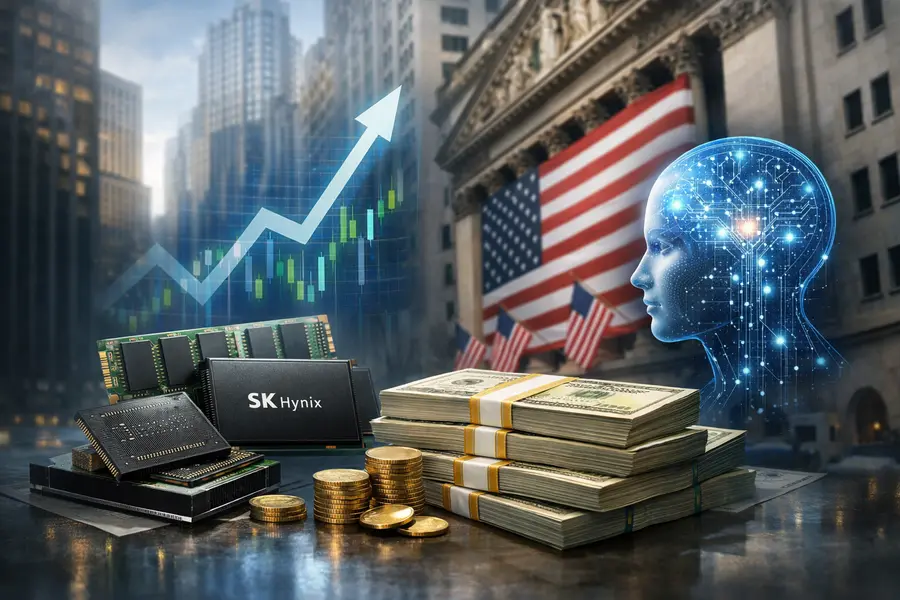
SK Hynix files for a landmark $29.4 billion Nasdaq listing as the world's dominant high-bandwidth memory maker capitalizes on surging AI memory chip demand from data-center giants.
- SK Hynix filed a Form F-1 registration on June 30, 2026, to list 177.9 million ADSs on Nasdaq under ticker SKHY, targeting $29.4 billion.
- The global semiconductor IPO would be the largest ADR listing in history, exceeding Alibaba's $21.8 billion New York debut in 2014.
- Proceeds will fund the Yongin Semiconductor Cluster, advanced packaging capacity, and EUV lithography equipment to expand HBM output.
Lead
SK Hynix filed its Form F-1 registration statement with U.S. securities regulators on June 30, 2026, setting the stage for a Nasdaq dual listing under ticker SKHY that could raise $29.4 billion — making it the single largest initial public offering by a foreign company in U.S. history. The South Korean chipmaker, which controls roughly 60% of the global high-bandwidth memory (HBM) market and serves as the primary memory supplier to Nvidia, is moving to access U.S. capital markets at the peak of an AI-driven memory supercycle that pushed its Korea-listed shares up 770% over the prior twelve months.What Happened
SK Hynix formally launched the SK Hynix US IPO process after months of anticipation, offering 177.9 million American Depositary Shares at a price to be determined through negotiations with underwriters. Trading is expected to commence on or around July 10, 2026.
Three cornerstone investors — Baillie Gifford Overseas, Coatue Management, and Situational Awareness Partners — committed to purchasing a combined $7 billion of ADSs at the IPO price, providing a floor of institutional demand before the book formally opens. BofA Securities, Citigroup, Goldman Sachs, and JPMorgan are serving as global coordinators.
Demand for the deal exceeded the available share count ahead of pricing, a reflection of the investor appetite for pure-play exposure to the AI memory chip demand cycle that has dominated technology sector capital allocation since late 2023.
Strategic Context
The listing converts years of technical leadership into permanent balance-sheet firepower. Proceeds are earmarked for three capital priorities: Phase 1 of the Yongin Semiconductor Cluster in South Korea, scheduled to begin coming online in 2027; the Cheongju P&T7 advanced packaging facility; and procurement of extreme ultraviolet (EUV) lithography scanners, which are essential for manufacturing next-generation memory at sub-10-nanometer geometries.
Beyond Korea, SK Hynix is simultaneously constructing a $4 billion HBM packaging plant in Indiana — its first American manufacturing footprint — aligning with Washington's semiconductor onshoring agenda and deepening its strategic ties to U.S. hyperscale customers.
The company has disclosed that customers had already secured its entire 2026 memory output, confirming that this global semiconductor IPO is a capacity-expansion play rather than a balance-sheet repair.
AI and Technology Angle
High-bandwidth memory has emerged as one of the most acute bottlenecks in AI infrastructure. Each Nvidia H100 and H200 GPU requires multiple HBM stacks to feed the processor's arithmetic units at the bandwidth speeds needed for large language model training and inference. As AI clusters scale from thousands to hundreds of thousands of accelerators, HBM demand compounds accordingly.SK Hynix has moved faster than rivals on the technology curve. Together with Samsung and Micron, the company passed qualification and entered production of HBM4 — the latest generation — to supply Nvidia's upcoming Vera Rubin accelerator platform. Nvidia and SK Hynix formalized a multiyear technology partnership in 2026 to co-develop memory architectures for AI factories, tying the two companies' roadmaps together through the end of the decade.
The financial results reflect that positioning. First-quarter 2026 revenue reached W52.6 trillion ($34.5 billion), a 198% year-over-year increase; full-year 2025 revenue totaled W97.1 trillion ($63.8 billion). Margins at those volumes provide the internal cash generation to fund capex, but the IPO accelerates the timeline for the Yongin cluster, which carries a long-term investment commitment of approximately $400 billion through 2050.
Market Reaction
Tech investment sentiment around the deal has been unambiguously strong. The cornerstone book was oversubscribed before the retail and institutional allocation process opened, a dynamic not seen at this deal size since the immediate post-pandemic technology wave. SK Hynix's Korea-listed shares — ticker 000660.KS on the Korea Stock Exchange — had pulled back roughly 20% from a June peak before the F-1 filing, a cooling that analysts attributed to profit-taking rather than fundamental deterioration.The listing is being watched as a barometer for broader appetite in the global semiconductor IPO market. If SKHY prices at the upper end of its indicated range and trades higher on debut, it is expected to encourage a pipeline of semiconductor and AI-infrastructure names that have been holding back from U.S. market listings.
Geopolitical Dimension
The dual listing carries strategic dimensions beyond capital markets. By establishing a meaningful U.S. equity presence and manufacturing footprint, SK Hynix is positioning itself as a systemically important participant in American semiconductor supply chains — a consideration that carries weight as Washington and Seoul deepen bilateral ties under the CHIPS and Science Act framework.
HBM chips are not subject to the same export-control restrictions as leading-edge logic chips, but the underlying manufacturing technology increasingly is. SK Hynix's Indiana facility and Nasdaq listing give the company regulatory standing and political capital that a Korea-only posture could not provide, particularly as advanced packaging techniques begin to intersect with national-security definitions of controlled technology.Outlook
The SK Hynix Nasdaq debut — if it prices as anticipated — will mark the largest tech investment event in U.S. equity markets since Arm Holdings listed in September 2023. The capital raised will accelerate HBM capacity ahead of the next wave of AI accelerator demand, with Nvidia's Vera Rubin platform arriving in 2026 and its successor already in co-development. Competitor Samsung Electronics has disclosed plans to match SK Hynix's output expansion, and Micron Technology is scaling its own HBM line in the United States, suggesting that AI memory chip demand will need to absorb a substantial increase in industry supply by 2027–2028. The pace of that absorption — driven by hyperscaler capex budgets at Microsoft, Google, Amazon, and Meta — will ultimately determine whether the HBM supercycle extends or corrects. For now, SK Hynix is betting $29.4 billion that the build-out is nowhere near finished.
Mentioned tickers: SKHY, NVDA, INTC, MU, 000660.KS, MSFT, GOOGL, AMZN, META