Pomegra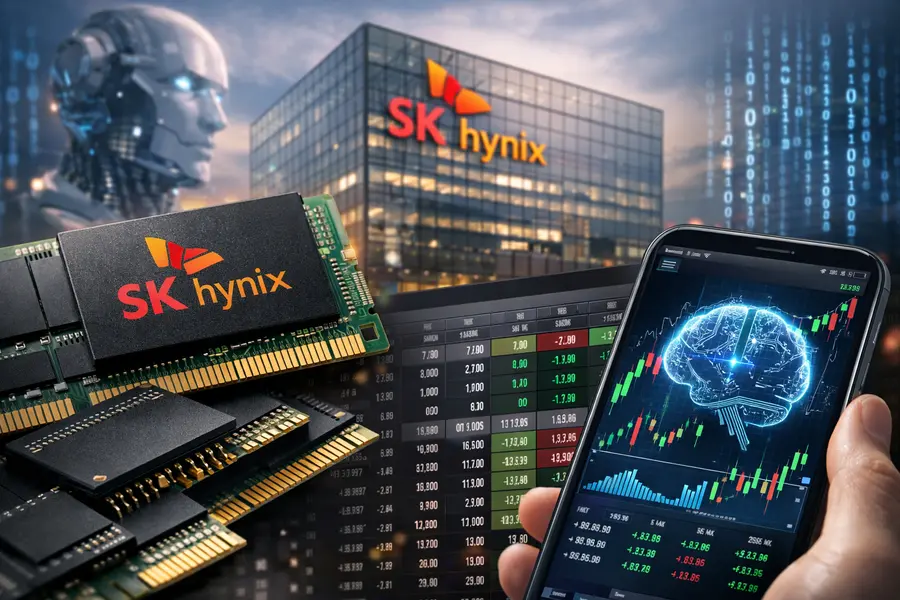
I now have sufficient data to write the article. Here it is:
- SKHY options launched Tuesday on Cboe with five monthly expiries through March 2027; roughly 150,000 contracts changed hands by midday.
- Retail options premium averaged a record $6.7 billion per day last month, running 65% above the prior-year pace and fueling demand for retail investor AI stocks.
- SK Hynix holds approximately 56% of the global HBM market and is estimated to capture 70% of Nvidia's next-generation HBM4 orders.
---
SKHY options began trading on Cboe Tuesday, four days after SK Hynix's record $26.5 billion Nasdaq listing, as retail investors targeting AI supply chain exposure flooded into the new semiconductor trading activity.
Lead
SK Hynix (Nasdaq: SKHY) options made their U.S. debut Tuesday, July 14, 2026, two trading sessions after the South Korean memory chipmaker completed the largest U.S. listing by a foreign company in history — a $26.5 billion offering priced at $149 per share. Cboe Global Markets listed five monthly expiries through March 2027 under existing regulatory frameworks, as a cohort of retail investors known for targeting AI infrastructure chokepoints sought leveraged access to one of the semiconductor cycle's most prominent names.What Happened
Cboe listed options on SK Hynix's American Depositary Receipts beginning Tuesday morning, with five monthly expiries covering the third Friday of July, August, September, and December 2026, and March 2027. Roughly 150,000 contracts changed hands by midday. While call contracts outnumbered puts in raw volume, the single most active directional position by contract count was call-selling — a pattern consistent with holders of the underlying equity writing covered calls to harvest premium rather than expressing fresh bullish conviction.
Volume fell short of the pace set by adjacent AI-memory products. Micron Technology (Nasdaq: MU) and the Roundhill Memory ETF (Nasdaq: DRAM) each logged approximately 380,000 contracts over the same period — more than double SKHY's midday figure. The VanEck Semiconductor ETF (NYSE: SMH) recorded comparable activity to Micron, while SKHY semiconductor trading activity outpaced smaller names including Marvell Technology and Sandisk.
Retail Context: The Bottleneck Trade
The options debut arrived on a wave of advance retail enthusiasm. A cohort of individual investors structured around the AI supply chain bottleneck thesis — targeting suppliers whose constrained production sets the ceiling on AI buildout — had been positioning in SKHY since before its Nasdaq listing.
"People are about to get SK Hynix specifically because Nvidia's made it very clear they're going to need a continuous supply of memory," said Gav Blaxberg, founder and CEO of Wolf Financial. "You have a demand super-cycle and there are only a few companies that can supply to that scale."
SK Hynix fits the template precisely. Its primary product — high-bandwidth memory — is the specialized DRAM mounted directly on the processors powering generative AI workloads. No functional substitute exists, no fast-ramping alternative manufacturer has emerged, and a lengthy qualification process locks in supply relationships years in advance.
That scarcity logic has driven record retail participation across the broader options market. Daily retail options premium averaged $6.7 billion in June 2026, exceeding the prior monthly record set in May by 15% and running 65% above the trailing twelve-month average. Demand for leveraged, AI-linked retail investor AI stocks shows little sign of abating.
SK Hynix's Structural Position
The investment case centers on SK Hynix's dominance in high-bandwidth memory. The company held a 56.4% share of the global HBM market through the first quarter of 2026. For Nvidia's forthcoming Rubin GPU platform — successor to the Blackwell architecture underpinning current data-center buildouts — UBS estimates SK Hynix is positioned to capture approximately 70% of HBM4 orders.
Those dynamics produced exceptional financial results. SK Hynix posted KRW 52.6 trillion in first-quarter 2026 revenue alongside a 72% operating margin — a record — driven by HBM3E shipments to Nvidia (Nasdaq: NVDA) and Advanced Micro Devices (Nasdaq: AMD). Commercial HBM4 deliveries commenced in the second quarter of 2026. In June, the company announced a formal technology partnership with Nvidia to co-develop memory architecture aligned with next-generation AI infrastructure.
The $26.5 billion Nasdaq listing, completed July 10, stands as the largest U.S. capital raise by a foreign company on record. SKHY shares opened approximately 13% above the $149 IPO price on debut day, reflecting strong institutional demand. Post-debut volatility followed after Seoul-listed shares experienced a severe single-session drop — among the steepest in nearly two decades — before the SKHY ADR steadied ahead of Tuesday's options launch.
Historical Precedent: Micron's Arc
The most-cited parallel among retail investors is Micron Technology, the only U.S.-headquartered HBM producer. Micron shares gained approximately 1,000% over the preceding twelve months before a 23% decline from their late-June high — a trajectory illustrating both the scale of returns available in the HBM semiconductor segment and the volatility absorbed along the way.
SK Hynix arrives on Nasdaq with a structural distinction. Its $1.03 trillion market capitalization is anchored by a deep, liquid Seoul market, providing price-discovery grounding that pure-play U.S. IPOs typically lack. The ADR also gives non-Korean retail traders their first direct, exchange-listed path to the HBM supply chain outside of Micron.
Outlook
Whether SKHY options volume builds from Tuesday's opening pace depends in part on how retail capital that pre-positioned in the underlying equity recalibrates following the listing surge and subsequent correction. The preference for call-selling over outright directional bets in the debut session points to partial hedging behavior among early holders — consistent with profit-taking after a significant first-week move.
SK Hynix's broader investment thesis remains structurally intact. HBM4 ramp volumes tied to Nvidia's Rubin platform timeline are expected to surface in third-quarter 2026 earnings, providing the near-term catalyst window that will test whether the AI memory demand cycle is sustaining or peaking. Until that data arrives, the SKHY options market will function as a live measure of how deeply the retail investor AI stock trade has embedded itself within the semiconductor supply chain's most constrained — and most strategically critical — link.
Mentioned tickers: SKHY, MU, NVDA, AMD, SMH, DRAM, MRVL