Pomegra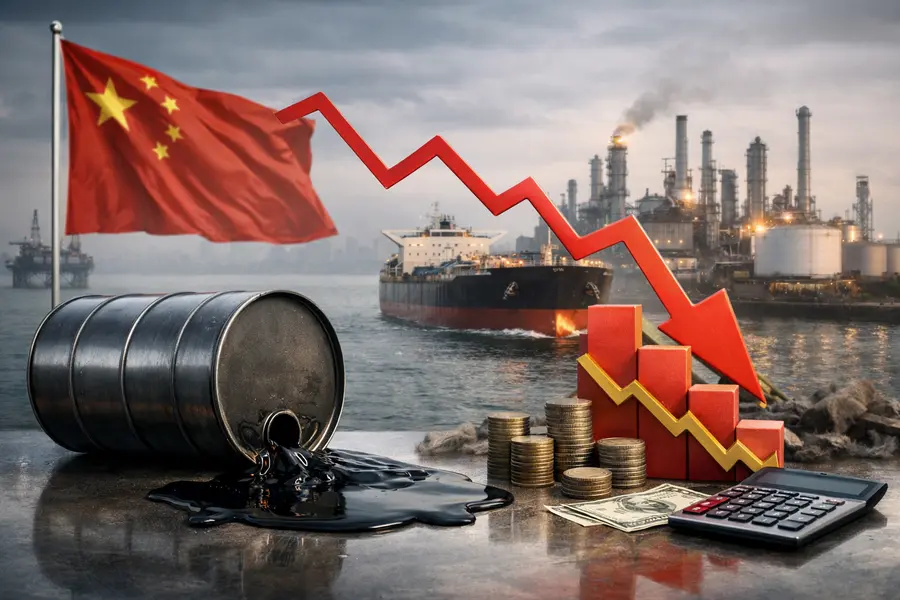
China's crude oil imports plunged 41% year-on-year in June 2026 to their lowest level in nearly a decade, as refinery utilization hit decade lows and structural shifts in energy demand reshape the country's import trajectory.
- China's June crude imports fell 41.3% to 29.27 million tons — just 7.12 million barrels per day — the lowest reading since October 2016.
- Refinery utilization dropped to 57.72% in June, a near 10-year low, driven by weak domestic fuel demand and export quota restrictions.
- Accelerating EV and LNG adoption is structurally eroding China's oil import appetite, raising the prospect that peak crude demand has already passed.
Lead
Beijing — China's crude oil imports crashed to their lowest level in nearly a decade in June 2026, falling 41.3% year-on-year to 29.27 million metric tons — equivalent to 7.12 million barrels per day — according to official customs data released Monday. The figure marks the steepest monthly collapse in recent memory and confirms a sustained China oil imports drop that began in February, when the country was averaging roughly 11.7 million barrels per day. Imports have since declined by approximately 4 million barrels per day, reshaping near-term global supply and demand balances.What Happened
The June reading extends a slide that has accelerated sharply through the first half of 2026. China's crude oil imports fell around 40% from February through May before tumbling again in June, with seaborne arrivals declining to approximately 6 million barrels per day. Middle East sourcing hit its lowest level in a decade, with Iranian crude purchases alone dropping roughly 40% from May to below 800,000 barrels per day.
Refinery utilization bore the brunt of the adjustment. Crude distillation unit utilization fell to 57.72% in June, compared with approximately 14.8 million barrels per day in processing capacity active through 2025. Refiners are drawing down elevated inventory stockpiles rather than booking fresh cargoes, removing near-term urgency from the import market.
Beijing's export quota tightening — rolled out starting May via vessel-by-vessel approval controls — compounded the pullback. By restricting refined product exports, policymakers curbed one of the primary incentives for independent refiners to keep runs elevated, directly suppressing crude intake volumes.
China Energy Demand: Structural Shift Underway
Beyond the policy overlay, China's energy demand is undergoing a durable transformation that industry observers say cannot be reversed through stimulus alone.
Electric vehicle penetration has moved rapidly from novelty to mainstream. Surging registrations of new energy vehicles (NEVs) — including battery-electric cars and plug-in hybrids — have materially cut per-capita gasoline consumption in road transport. Simultaneously, the rapid adoption of LNG-fueled heavy-duty trucks has begun displacing diesel demand in freight, historically a pillar of China's petroleum consumption growth.
Construction activity, another major diesel consumer, has softened alongside the ongoing property sector correction, which has reduced infrastructure-related fuel usage across multiple commodity chains. Together, these trends are compressing the demand base that once made China the engine of global crude growth.
The Centre for Research on Energy and Clean Air noted in its May 2026 snapshot that China's accelerating energy transition has shifted the country toward a "substantial energy surplus" in several segments, meaning domestic supply, renewables, and reduced consumption are collectively outpacing prior import requirements.
China Economic Slowdown and the Demand Ceiling
The collapse in imports cannot be fully separated from the broader China economic slowdown context. The OECD projects China's GDP growth will ease to 4.6% in 2026, down from 5.0% in 2025, before slowing further to 4.4% in 2027. Beijing has set its official growth target at 4.5%–5% for the year — its least ambitious since 1991 — and Q2 2026 quarterly expansion is forecast at just 0.9%, down from 1.3% in the first quarter.
Tepid industrial activity, cautious consumer spending, and a still-fragile property market have collectively suppressed energy-intensive economic output. Fiscal authorities have responded with bond issuance and accelerated spending, maintaining a budget deficit target of around 4% of GDP, but the transmission to energy-sector demand has been limited.
Global Oil Impact
The global oil impact of China's demand retreat has been substantial, if complicated by geopolitical crosscurrents. China's import contraction has absorbed a significant portion of the supply shock generated by the Iran conflict that erupted in late February 2026, which at its peak threatened Strait of Hormuz flows and briefly pushed Brent crude toward $100 per barrel.
By effectively stepping back from the spot market, China's reduced crude demand has helped cap global prices and allowed physical balances to tighten more gradually than supply disruption alone would have implied. Analysts estimate the Chinese pullback has contributed meaningfully to keeping Brent in check through the spring and into summer.
However, a prolonged China absence from the market removes a structural floor under global prices. Saudi Arabia and other core OPEC+ producers have calibrated output strategies around Chinese demand assumptions that no longer hold. Any sustained re-stocking cycle from Beijing — once inventories draw down sufficiently — will amplify the next price move upward.
What Comes Next
The near-term outlook for Chinese crude imports remains subdued. Refinery run rates are unlikely to recover quickly given existing inventory overhangs and the continued cap on product export quotas. Independent refiners, whose aggressive spot buying once underpinned China's import records above 11 million barrels per day, have reduced operational scale substantially.
The structural picture is more consequential. Peak Chinese crude import demand — long debated as a distant future event — may have quietly arrived. EV fleet expansion is compounding year-on-year, and the government's energy policy continues to reward domestic clean energy development over fossil fuel dependency. If GDP growth stabilizes in the 4.5%–4.6% range and the transport transition sustains its current pace, incremental crude demand growth from China could remain near zero or turn negative in coming years.
For global markets, that recalibration carries implications across the oil supply chain: Middle East exporters, tanker operators, global refiners, and commodity trading desks have all built business models on the assumption of steadily rising Chinese appetite. That assumption now warrants fundamental review.
Outlook
China's June crude import collapse to 7.12 million barrels per day marks more than a cyclical correction — it reflects the convergence of refinery oversupply, policy-driven export controls, and accelerating structural demand erosion driven by EVs and LNG substitution. With GDP growth cooling and construction activity subdued, a sharp near-term rebound looks unlikely. For global oil markets, China's reduced footprint is simultaneously cushioning prices from geopolitical disruption and raising longer-term questions about the demand foundation that has anchored crude markets for two decades.
Mentioned tickers: USO, BNO, XOM, CVX, SLB, BP, SHEL, TTE, PTR