Pomegra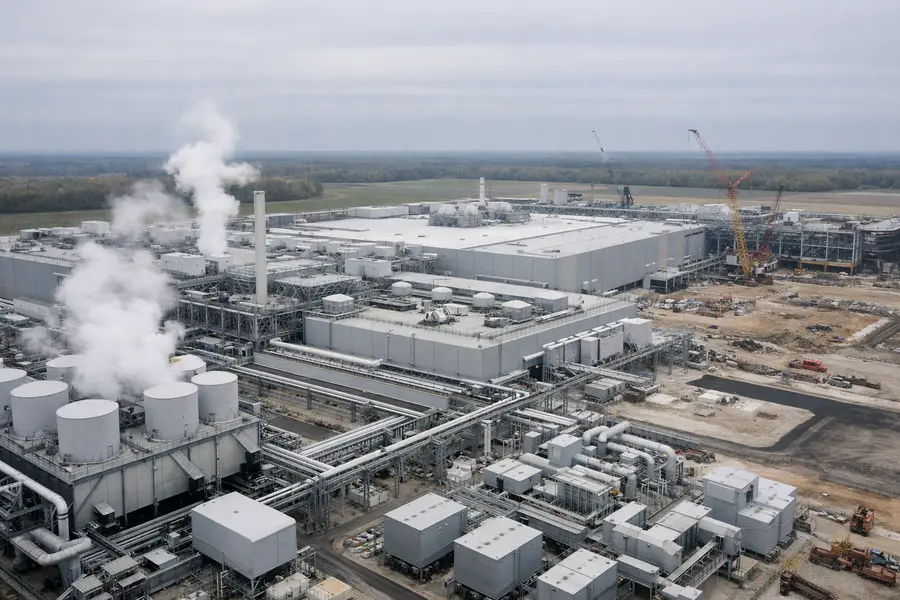
SK Hynix confirmed it is exploring a deal with Intel to make memory chips at Ohio's New Albany fab, as INTC and SK Hynix shares both jumped sharply on the news.
- Intel (INTC) gained as much as 5% and SK Hynix surged 3% after reports of exploratory talks surfaced September 16, 2026.
- Two deal structures are under discussion: a capacity lease at Intel's New Albany facility and a joint venture with major cloud providers.
- SK Hynix confirmed it is exploring options but stressed no deal is finalized; South Korean regulatory review adds timeline risk.
Lead
Reports of preliminary talks between SK Hynix and Intel Corp. (INTC) to establish U.S. memory chip production at Intel's $20 billion New Albany, Ohio campus broke on September 16, 2026, sending ai stocks broadly higher -- Intel gained as much as 5% in early trading and SK Hynix shares climbed 3% in Seoul, while rival Micron Technology (MU) held flat. SK Hynix, the world's second-largest memory-chip maker and the primary supplier of high-bandwidth memory for AI accelerators including those built on Nvidia (NVDA) silicon, confirmed it is exploring options but stressed that no agreement has been reached.
What Deal Structures Are on the Table?
Two distinct arrangements are under evaluation. The first would have SK Hynix lease a portion of Intel's New Albany campus to install and operate its own memory fabrication lines. The second, structurally more complex, would form a joint venture between SK Hynix, Intel, and one or more major cloud computing companies seeking guaranteed domestic supplies of advanced memory. The product mix -- whether output would be high-bandwidth memory, conventional DRAM, or NAND flash -- has not been decided, and no fabrication equipment has yet been ordered, a step that carries roughly a two-year lead time.
Why Is Washington Pressure Driving This Move?
U.S. policy pressure to localize critical semiconductor supply chains is the deal's primary catalyst. SK Hynix has already committed $3.87 billion to a West Lafayette, Indiana facility for HBM advanced packaging and R&D, targeting mass production in the second half of 2028. An Ohio manufacturing agreement would add an earlier and larger-scale production node, directly addressing the longstanding concern that American AI infrastructure depends on memory capacity concentrated in South Korea and Taiwan.
For Intel, a partnership would inject commercial momentum into a project progressing slowly. Construction at New Albany began in 2022 and the campus is not expected to reach operational status until 2031. An anchor tenant of SK Hynix's scale could help Intel unlock remaining CHIPS Act disbursements and rebuild investor confidence in its foundry ambitions, which have faced sustained pressure following multiple rounds of capacity pullbacks.
How Do Chip Stocks Read This Development?
The VanEck Semiconductor ETF (SMH) and leveraged instruments such as Direxion Daily Semiconductor Bull 3x Shares (SOXL) track memory sector developments closely, with capacity expansion announcements tending to generate sector-wide moves. Micron Technology (MU) -- the only major memory producer already operating domestic fabs -- held flat on the reports, reflecting its existing position as the U.S. market's incumbent supplier. A functional SK Hynix-Intel arrangement would introduce competition to that position but could simultaneously validate the broader investment case for domestic memory manufacturing.
Regulatory Hurdles in Seoul and Washington
Any arrangement transferring advanced memory technology to a U.S. facility faces review under South Korea's Industrial Technology Protection Act. High-bandwidth memory and leading-edge DRAM are classified as national core technologies under Korean law, requiring Seoul government approval before export. That review process introduces a material timeline risk to any deal structure, particularly for HBM -- the product most urgently in demand from cloud and AI hardware customers.
Production economics present a second constraint. Fabricating chips in Ohio carries significantly higher labor and construction costs than equivalent output in South Korea. Any viable U.S. venture would likely require a combination of CHIPS Act subsidies, tariff protection, and long-term supply contracts from hyperscaler customers to reach competitive unit economics.
Outlook
If closed, an SK Hynix-Intel arrangement at New Albany would represent the first domestic U.S. production of advanced memory at industrial scale, with broad implications for AI data center supply chains. Near-term signals to watch include the South Korean government's posture on technology export approval, Intel's next quarterly guidance on its foundry business, and whether major cloud providers formally enter deal discussions. With no structure finalized and regulatory review pending, both the opportunity and execution risk remain substantial.