Pomegra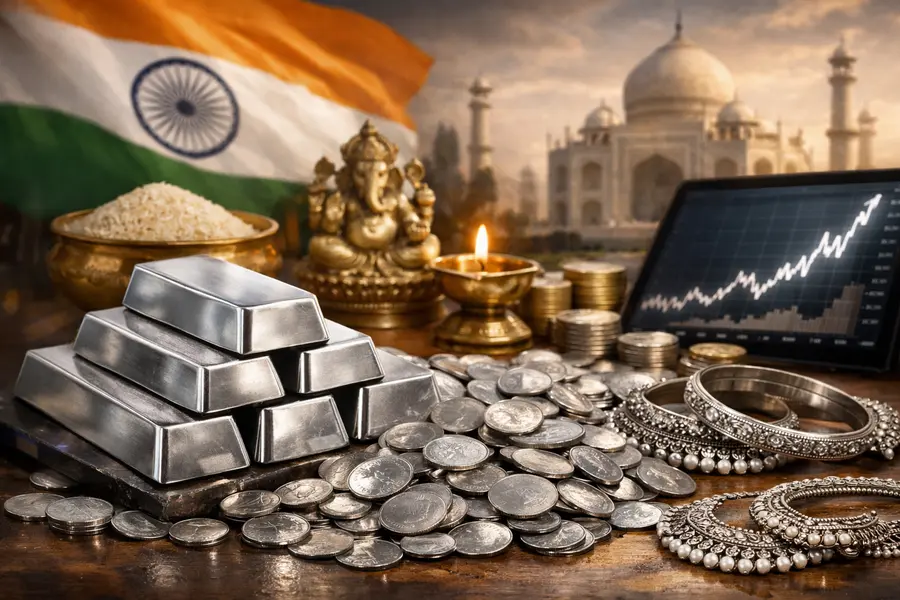
Silver prices reached a historic peak in early 2026 as India's surging industrial and investment demand overwhelmed global supply, pushing the precious metal to levels never recorded in its trading history.
- Silver reached an all-time high of $121.64 per ounce internationally, while India's MCX hit ₹4,00,780 per kilogram.
- India's silver imports surged 129% year-on-year, with total FY2026 spending hitting a record $12 billion.
- India now accounts for approximately 25% of global silver consumption, up sharply from prior years.
Lead
Silver touched an all-time high of $121.64 per troy ounce on January 29, 2026, capping a 147% rally that began in mid-2024 and accelerated sharply into the new year. India was the central force behind the move: the world's most populous nation recorded a 129% year-on-year surge in silver imports during the April–December period and committed $12 billion to silver purchases over the full fiscal year ending March 2026, more than double the $4.8 billion spent the prior year. On the Multi Commodity Exchange (MCX), India's primary domestic commodity platform, silver futures struck a parallel record near ₹4,20,934 per kilogram — a 73% advance from the start of the year in less than four weeks.What Happened
The silver price surge built over months, rooted in a structural tightening of the physical market rather than a speculative spike in a single session. India's demand, historically driven by jewellery and religious festivals, transformed in character over 2024 and 2025. Industrial offtake — led by photovoltaic manufacturing, electronics, and electrical components — emerged as a structural pillar, displacing seasonal patterns that had previously allowed international traders to forecast Indian import rhythms with reasonable accuracy.
Front-loaded buying amplified the move. As prices climbed through the second half of 2025, Indian importers accelerated purchases, anticipating further tightening and potential export restrictions by major producing nations. This behavior compressed the normal supply response timeline, creating a demand-side shock that physical supply networks were not positioned to absorb at pace.
India's Pivotal Role
India now commands approximately 25% of global silver consumption, importing roughly 6,000 metric tons per year at a total import value of $9.2 billion — a 44% year-over-year increase in dollar terms even before the January 2026 price peak is fully factored. The scale of that commitment reshaped global silver flows in ways that persisted into the price record.
During the height of the rally, investment demand from Indian buyers remained robust even as jewellery demand softened by roughly 20%, an unusual divergence that underscored a shift in the domestic buyer profile. Indian retail investors, institutional buyers, and industrial end-users all competed simultaneously for available inventory, squeezing domestic premiums above international benchmarks and prompting an extraordinary drawdown in registered warehouse stocks.
Geopolitical anxiety over supply chains — specifically concerns that a major silver-producing nation might curtail exports — added a precautionary layer to India's buying calculus. Supply is heavily concentrated: the top five producing countries account for the overwhelming majority of global mine output, and any disruption in even one major exporter's capacity has historically had outsized effects on the spot precious metals market.
Industrial and Investment Drivers
The structural case for silver rests on two reinforcing pillars. First, the global energy transition: solar panel manufacturing, which uses silver paste as a conductive agent, accounted for a substantial share of worldwide industrial silver demand in 2025. As governments across Asia, Europe, and the Americas accelerated renewable energy deployment, off-take from photovoltaic producers became a floor under global demand independent of financial market conditions.
Second, electrical and electronics applications — ranging from semiconductors and printed circuit boards to automotive components in electrified vehicles — represent a large and expanding segment. Unlike gold, which functions almost exclusively as a monetary and ornamental metal, silver's dual identity as both a precious metal and an industrial commodity creates demand that is less discretionary and more structurally persistent.
On the investment side, exchange-traded products backed by physical silver recorded sustained inflows throughout the rally, with German, Australian, and Indian buyers providing demand that offset softer retail participation in North America.
Market Reaction
The all-time high did not hold. Within 36 hours of the January 29 peak, silver underwent one of the sharpest single-asset corrections in modern commodity history, falling 33% as the CME Group raised margin requirements on silver futures, forcing leveraged long positions to liquidate rapidly. The dollar simultaneously strengthened after the U.S. Federal Reserve signalled no near-term rate cuts, compressing the relative appeal of non-yielding commodities.
By mid-2026, international silver traded near $55–62 per ounce — roughly 44–54% below the January record — while MCX silver futures stabilized in the ₹2,30,000–2,75,500 per kilogram range. India's silver import regime added another complication: in May 2026, the government raised bullion import duties amid currency pressures, causing Indian silver imports to fall 87% month-on-month to $75.57 million, sharply curtailing the flow that had helped catalyze the record.
Outlook
Silver's all-time high reflected a genuine structural shift in its demand profile, with India's emergence as the defining marginal buyer confirming a reorientation of global precious metals flows away from Western financial markets toward Asian industrial and investment demand. The violent post-peak correction illustrated how quickly leverage-driven markets can reverse even historically justified moves.Looking ahead, the medium-term demand fundamentals — solar manufacturing, electronics, and India's expanding investment culture — remain intact. Import duty headwinds and a stronger U.S. dollar represent near-term constraints, but institutional consensus points to prices recovering toward the $80–106 per ounce range by end-2026 as macro conditions stabilize. Whether the January 2026 peak represents a genuine ceiling or a preview of the next structural move higher will depend primarily on India's ability to sustain its position as the world's dominant silver buyer once import restrictions ease.