Pomegra
Ukrainian drones struck Russia's Ryazan refinery on October 15, ending a short pause and extending a campaign that cut diesel exports by more than 75%.
- Drones set the Ryazan refinery on fire on October 15, days after Kyiv paused strikes under a U.S.-brokered energy ceasefire.
- Russian diesel exports fell to 141,000 barrels per day in September from 608,000 a year earlier.
- Brent settled at $109.86 on October 16, the highest since May, as supply risks mounted.
Lead
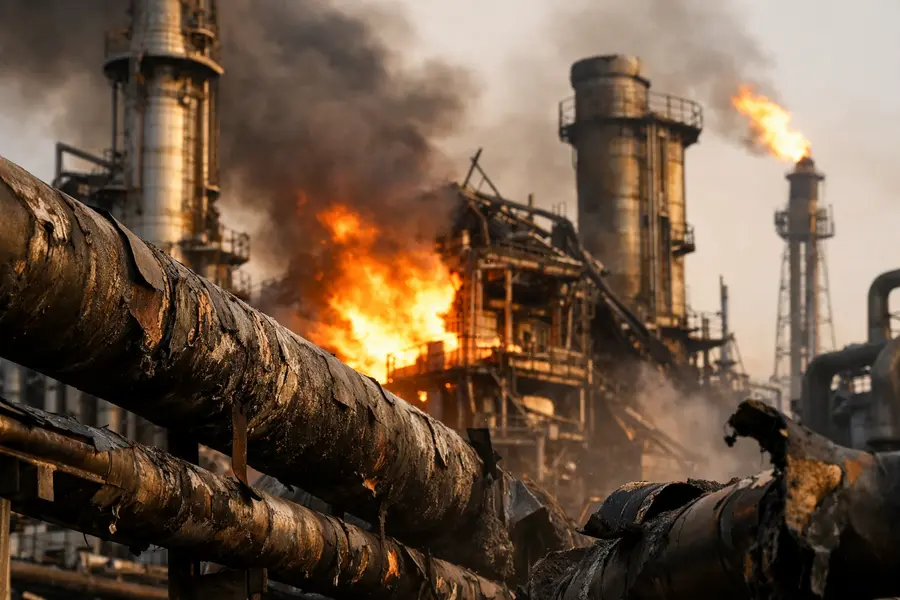
Ukrainian drones hit the Ryazan oil refinery, about 300 kilometers southeast of Moscow, on October 15. The strike ended a three-day halt in attacks on Russian energy sites that Kyiv had observed after U.S. President Donald Trump announced an "energy ceasefire." The regional governor confirmed a fire at the plant and reported no casualties. The refinery is owned by Rosneft (MOEX: ROSN) and handles nearly 5% of Russia's refining throughput. A primary crude-processing unit was halted after the attack.
What Happened at the Ryazan Refinery?
Drones struck the Ryazan refinery on the morning of October 15 and started a fire, according to the Ryazan governor. Authorities cancelled classes and kindergarten attendance in the Oktyabrsky district and part of the Sovetsky district. The closures affected 14 schools and 25 kindergartens.
The plant has been hit before. On September 6, drones damaged its Isomalk-2 low-temperature isomerization unit, which produces high-octane gasoline components.
Why Did Ukraine Resume Strikes on Russian Energy Sites?
Kyiv resumed strikes because Moscow kept attacking Ukraine's power grid and fuel depots during the pause. Russia never formally acknowledged the ceasefire. President Volodymyr Zelensky told the Financial Times that the block on refinery attacks was lifted, saying "We're done."
The reversal exposed the weakness of the U.S.-brokered arrangement. It had no verification mechanism and covered only one side's behavior in practice. Four days after the announcement, the pause had collapsed.
How Badly Has Ukraine's Campaign Damaged Russian Diesel Exports?
Russian diesel exports have fallen by more than 75%. Shipments dropped to 141,000 barrels per day in September, against 608,000 a year earlier. Russia ranked as the world's second-largest diesel supplier, behind only the United States.
Ukrainian drones have struck Russian refineries at least 70 times since the start of 2026. Russian refining output has dropped to its lowest level in two decades. Half of Russia's six largest diesel-producing refineries have cut output sharply or stopped it. The Kirishi plant is fully shut, while the Volgograd and NORSI refineries run at about one-quarter of nameplate capacity.
Moscow banned diesel exports in July to protect domestic supply. Shipments have since partly resumed under a Trump-Putin arrangement that included a U.S. suspension of some sanctions. Russian cargoes are returning to their traditional destinations, but at a fraction of earlier volumes.
What Does the Strike Mean for Crude Oil Price and Diesel Markets?
The strike adds upside pressure to a market that is already tight, particularly for refined products. Brent crude touched $110 a barrel on October 16 and settled at $109.86, up 3.7% on the day and the highest close since May. The move also reflected Houthi attacks on Saudi Arabia and wider Gulf shipping risk, so the Ryazan strike was one factor among several. Brent futures stood near $108.82 on October 21.
Diesel has moved more sharply than crude. With Russian barrels scarce, refineries elsewhere must process more crude to meet demand, which widens refining margins. The International Energy Agency has warned that diesel supplies will probably stay constrained well into 2027.
Strategic Context
Ukraine's strategy targets the refined-product chain, not crude production. Refineries are concentrated, costly to repair and reliant on imported components. Damage to a distillation or conversion unit can take months to fix, which is why export volumes have not recovered even as the Kremlin eases its export ban.
For Russia, the effects reach the budget as well as fuel logistics. Lower refined-product exports cut hard-currency earnings and force more crude into export channels that depend on shipping and sanctions rules. The domestic market also faces fuel shortages and price controls.
Geopolitical Dimension
The episode shows the limits of Washington's mediation. The energy ceasefire gave Moscow a way to reduce pressure on its refineries, while Kyiv's compliance was visible and Russia's was not. Zelensky's decision to resume strikes signals that Kyiv will treat energy infrastructure as leverage in any broader negotiation.
For consuming countries, the strikes add to supply risks in the Gulf. Europe and Asia rely on diesel imports for freight and agriculture, and both are exposed to higher costs through the winter heating season.
What Comes Next for Russian Refining?
Further strikes are likely in the near term, since Kyiv has withdrawn its restraint and the target list is long. Repairs at Kirishi, Volgograd and NORSI will determine how quickly Russian diesel exports can recover toward last year's levels. The three plants are the main constraint on any rebound.
The next signals are whether Moscow halts attacks on Ukrainian power infrastructure and whether Washington re-brokers a ceasefire with verification terms. Without a deal, refined-product markets are likely to stay tight through the first quarter of 2027.
Outlook
Ukraine's October 15 strike on Ryazan ended a brief pause and confirmed that its refinery campaign continues. Russian diesel exports are down more than 75%, refining output is at a two-decade low, and Brent is near $109. The IEA expects diesel constraints to last into 2027. Unless a verifiable energy truce emerges, product markets stay exposed to Ukrainian strikes and Gulf supply risks.
Mentioned tickers: ROSN