Pomegra
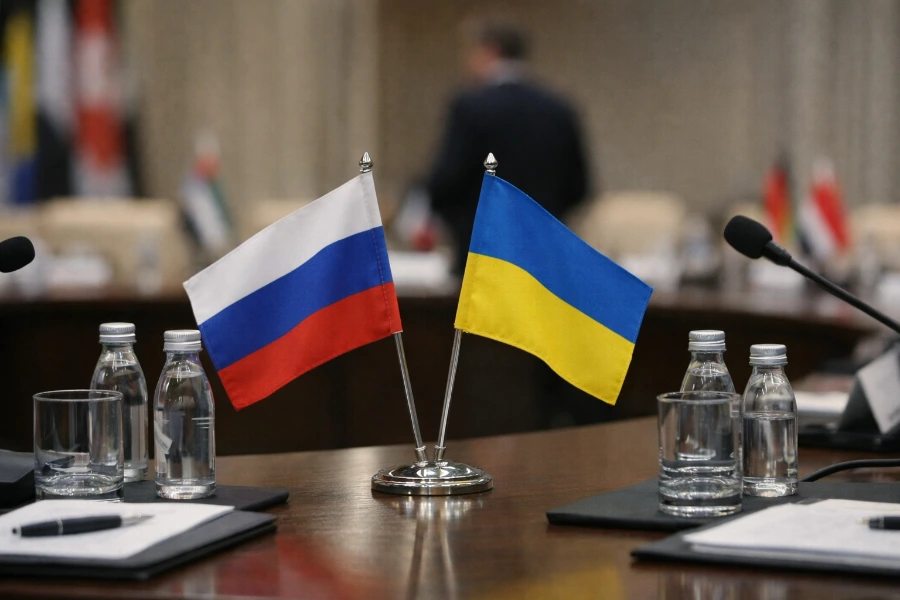
Russia will join US-mediated Ukraine peace talks in Abu Dhabi on Nov. 10-11, and the MOEX Russia index and oil markets are tracking the outcome.
- Russia confirmed a trilateral round with the US and Ukraine in Abu Dhabi for Nov. 10-11, led on the Russian side by Vladimir Medinsky.
- Prediction markets price a Russia-Ukraine meeting by Nov. 30 at about 96.6%, up 28.6 points in a week.
- The MOEX Russia index closed Friday at 2,463.82; Brent settled at $98.32 on US-Iran deal hopes.
Lead
Russia has confirmed it will take part in US-mediated peace talks with Ukraine in Abu Dhabi on Nov. 10-11, with presidential aide Vladimir Medinsky heading Moscow's delegation. The Kremlin announced the format on Nov. 3. Moscow has since sent a higher-level team than in earlier rounds. The talks are scheduled to cover post-war security arrangements, de-escalation and humanitarian issues.
What Is on the Agenda in Abu Dhabi?
The Abu Dhabi round is meant to cover security arrangements, de-escalation and humanitarian issues, according to the framework set out by US envoy Steve Witkoff. Washington is acting as convener, bringing Russian and Ukrainian delegations into one format. Previous rounds in the United Arab Emirates and Geneva produced procedural progress but no settlement.
A separate track is running in parallel. The White House has scheduled a meeting on a local ceasefire in the Kherson region, following a six-day pause around Oleshky that ended on Monday and allowed civilian evacuations. Kyiv said Russian forces used that pause to reinforce their positions. President Volodymyr Zelensky maintains that no settlement can be negotiated without Ukraine at the table.
European governments are also set to join the Abu Dhabi talks despite objections from the Kremlin. This adds a third bloc to a process that has so far been shaped mainly by Washington and Moscow.
Why Are Prediction Markets Pricing a Meeting at 97%?
Prediction markets put the odds of a Russia-Ukraine meeting by Nov. 30 near 97% because both delegations have been formally confirmed and a date and venue are fixed. The Polymarket contract on a meeting by Nov. 30 stood at 96.6% on the evening of Nov. 8, up 28.6 points in seven days. Its resolution criteria require an in-person meeting between authorized representatives of both countries aimed at a ceasefire, peace agreement or comparable de-escalation.
The price measures the likelihood of a meeting, not of a deal. A contract on an actual ceasefire trades far lower, and a face-to-face session in Abu Dhabi would settle the meeting contract regardless of what is agreed.
How Are Russian Markets Reacting?
Russian equities have moved in a narrow band as talks approached. The MOEX Russia index rose 0.34% to 2,463.82 points in Friday's main session, extending a range of roughly 2,450 to 2,480 that has held in recent sessions. The dollar-denominated RTS index slipped 0.08% to 944.94. The yuan gained 6.25 kopecks to close at 12.283 rubles.
Domestic stocks have drawn support from diplomatic headlines, including Vladimir Putin's contacts with Nordic leaders on resuming the trilateral format. Trading remains thin and dominated by domestic retail flows, so index moves have been modest compared with the scale of the political stakes.
What Does This Mean for Oil and Sanctions?
Energy is the main economic channel linking the talks to global markets. Russian crude and refined product exports fund a large share of the federal budget, and any ceasefire framework would raise the question of sanctions relief and price-cap enforcement.
Oil prices are currently driven more by the Middle East than by Ukraine. Brent futures settled at $98.32 a barrel on Friday, up 3 cents on the day, after a weekly fall of about 16%, the steepest since 2020. WTI lost nearly 13% over the same period. The sell-off reflected bets on a US-Iran agreement, while tanker incidents near Hormuz kept a risk premium in the market. A credible Russia-Ukraine ceasefire would add downward pressure through lower risks to Black Sea shipping and Russian refining and export infrastructure.
What Comes Next?
Three scenarios frame the near term. In the first, the Abu Dhabi round ends with a technical outcome such as prisoner exchanges, humanitarian corridors or a local truce in Kherson, which keeps the process alive without touching territory. In the second, the talks stall on territorial questions and security guarantees for Ukraine, and the sides agree only to reconvene. In the third, the stronger Russian delegation and European participation open a track toward a broader de-escalation framework.
The Kremlin has also floated a Russia-US-China leaders' summit, though no date has been set. Any movement toward that format would shift the discussion from battlefield arrangements to sanctions, trade and reconstruction financing, with direct effects on energy markets and Russian asset pricing over the next three to twelve months.
Outlook
Russia's attendance at the Abu Dhabi talks on Nov. 10-11 makes a Russia-Ukraine meeting before month-end close to certain, but a settlement remains distant. Markets will watch for concrete humanitarian or ceasefire outcomes, the MOEX Russia index around its 2,450-2,480 range, and Brent near $98, where Middle East diplomacy currently carries more weight than Ukraine.