Pomegra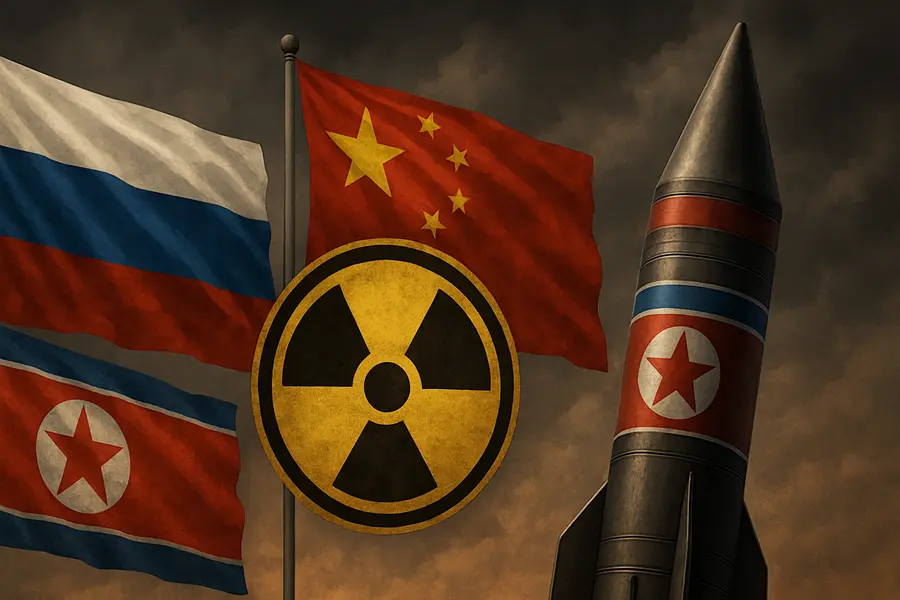
China drops denuclearization language during Xi's Pyongyang summit, joining Russia in backing North Korea as its nuclear arsenal expands to historic levels.
- Xi Jinping visited Pyongyang on June 8–9, 2026, omitting all reference to denuclearization in official readouts for the first time in two decades.
- North Korea unveiled a third uranium enrichment site days before Xi's arrival and pledged to raise missile output by 150% within five years.
- With Russia and China shielding Pyongyang at the UN Security Council, no new sanctions regime remains viable.
Lead
SEOUL/BEIJING — Chinese President Xi Jinping concluded a two-day state visit to Pyongyang on June 9, 2026, pledging "strategic cooperation" with Kim Jong Un while conspicuously declining to invoke the phrase "denuclearization of the Korean Peninsula" in any official communication — a deliberate omission that analysts describe as a watershed shift in China's two-decade posture on the North Korea nuclear question. The visit, Xi's first to the North Korean capital since 2019, followed Russia's earlier normalization of Pyongyang's nuclear status and the June 4 revelation of a previously undisclosed uranium enrichment facility, signaling that the geopolitical architecture once constraining North Korea's weapons program has effectively collapsed.
What Happened
Days before Xi's arrival, Kim unveiled a third uranium enrichment site and declared that nuclear fuel production had more than doubled over the past five years. Kim simultaneously announced plans to increase missile production capacity by 150% within five years and pledged to expand the nuclear arsenal "at an exponential rate."
Current intelligence estimates place North Korea's assembled warhead count at approximately 50, with sufficient fissile material to produce up to 90. Projections circulated in Western assessments suggest that figure could reach 150 or more by the end of the decade. At a military parade in late 2025, Pyongyang debuted the Hwasong-20 — a solid-fuel, road-mobile intercontinental ballistic missile with a stated range of 9,300 miles and multiwarhead capability — placing the entire continental United States within potential striking distance.
During the Pyongyang summit, Xi called for "powerful momentum" in bilateral ties and described the relationship as carrying "a special sense of closeness." Beijing's official readouts made no mention of the "denuclearization of the Korean Peninsula," a formulation that had anchored Chinese diplomatic language since the Six-Party Talks of the early 2000s.
Strategic Context
The omission carries weight beyond diplomatic protocol. Beijing's position represents what security specialists characterize as a very significant policy shift to tacitly accept the reality of a nuclear North Korea. For nearly two decades, China co-sponsored UN Security Council sanctions resolutions against Pyongyang and publicly endorsed the denuclearization framework. That framework is now functionally void.
Russia moved first. Following the signing of the Comprehensive Strategic Partnership between Moscow and Pyongyang — a mutual defense arrangement concluded in 2024 — Russian Foreign Minister Sergei Lavrov stated in 2025 that Moscow "respects" North Korea's possession of nuclear weapons and "understands the rationale" behind its nuclear development. North Korean troops subsequently deployed alongside Russian forces in Ukraine, gaining live combat experience in drone warfare and combined-arms operations. Researchers at 38 North and the Asia Society have documented the plausibility of Russian propulsion system transfers relevant to Pyongyang's ambition to field a nuclear-powered ballistic missile submarine.With both Russia and China acting as Pyongyang's guarantors at the UN Security Council, no additional sanctions resolution is viable. North Korea has secured two permanent veto holders willing to neutralize any multilateral response.
Geopolitical Dimension
Xi's decision to visit Pyongyang at this moment is partly a recalibration. North Korea's deepening military and economic integration with Russia since 2022 had tilted Pyongyang's strategic orientation toward Moscow, reducing Beijing's leverage over Korean Peninsula dynamics. The summit — coming shortly after Xi's separate meeting with U.S. President Trump in Beijing — reflects a Chinese effort to reassert primacy in North Korean affairs without abandoning the broader strategic alignment with Moscow.
The arrangement emerging across Russia, China, and North Korea is less a formal alliance than a network of transactional convergences: Pyongyang provides artillery, manpower, and missile technology to Moscow; Moscow provides energy, food, and technical expertise to Pyongyang; Beijing provides diplomatic cover, trade access, and strategic reassurance to both. None of the three requires a named pact. The architecture functions on shared interests in eroding American-led security frameworks in the Indo-Pacific.
Kim's calculus is straightforward. With Russia ensuring military and economic lifelines and China dropping its last significant political condition — nuclear rollback — Pyongyang faces no structural incentive to negotiate. The Kim government has for years characterized nuclear status as irreversible; the events of June 2026 substantially validate that characterization on the international stage.
Regional Impact
South Korea and Japan now face a North Korean nuclear arsenal growing in both size and sophistication, unconstrained by multilateral oversight. Extended deterrence commitments from Washington remain formally intact, but the strategic environment has shifted: Pyongyang's warhead count, delivery systems, and diplomatic insulation have all expanded simultaneously. Seoul has signaled renewed interest in indigenous deterrence capabilities; Tokyo is accelerating counterstrike capacity under a defense posture revised in 2022.
For U.S. policy, the convergence presents a compound problem. Washington's ability to apply pressure through Beijing — a central pillar of North Korea diplomacy since the Obama administration — has diminished markedly. Russia's wartime normalization of Pyongyang's nuclear identity forecloses the Security Council as a lever. Bilateral engagement, which produced no durable agreement under prior administrations, remains the only available diplomatic channel.
Outlook
The June 2026 Xi–Kim summit marks the effective close of the multilateral denuclearization framework that shaped Northeast Asian geopolitics for two decades. North Korea is expanding its nuclear and missile programs with the explicit or tacit backing of both UN Security Council veto holders aligned against Western-led pressure. In the near term, Pyongyang is expected to conduct additional weapons tests to validate new delivery systems and advance its nuclear-powered submarine program. The structural shift in China's posture — from reluctant sanctions partner to silent nuclear acquiescent — resets the region's security calculus and narrows the diplomatic tools available to the United States and its allies in ways that will define Korean Peninsula stability for years ahead.
Mentioned tickers: LMT, RTX, NOC, GD, BAGeopolitics