Pomegra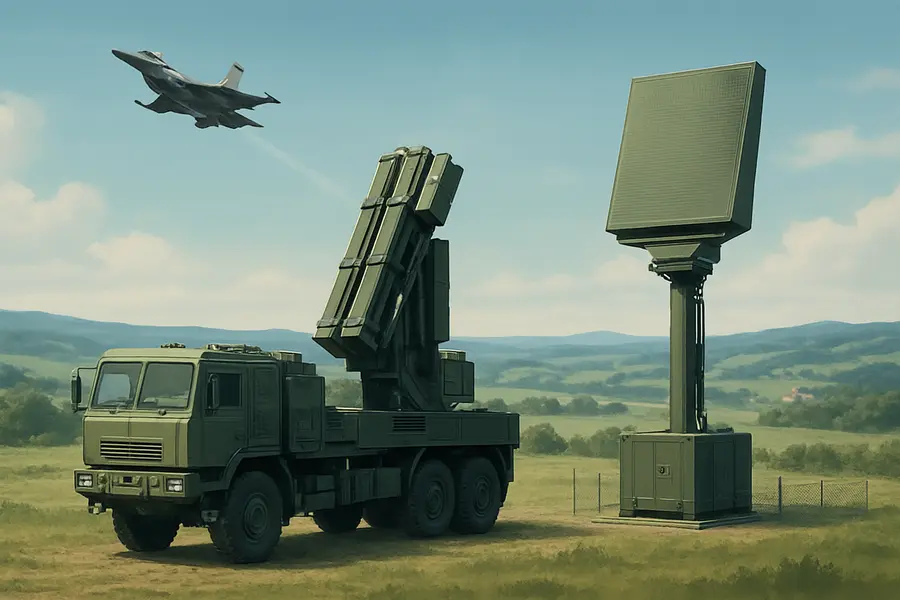
Rheinmetall and LIG Defense & Aerospace form a majority Rheinmetall joint venture to deliver layered European air defense across all NATO intercept tiers.
- Rheinmetall and LIG D&A signed an MOU on June 15, 2026, at Eurosatory, Paris, to establish a majority Rheinmetall-held joint venture.
- The first product, the C-PGM/ESHORAD, targets 20 km range at a high five-figure euro unit cost — far below €1 million-plus for Patriot-class interceptors.
- Rheinmetall (RHM) fell approximately 4.6% on announcement day; LIG D&A (079550.KS) carries a consensus of 17 buy ratings and zero sells.
Lead
Rheinmetall AG and LIG Defense & Aerospace — South Korea's foremost precision-guided munitions developer — agreed on June 15, 2026, to form a joint venture covering the full spectrum of European air-defense requirements. The memorandum of understanding, signed at the Eurosatory defense exhibition in Paris, directs the partnership to localize and produce LIG's missile systems on European soil, with Rheinmetall holding majority ownership. The announcement positions the Rheinmetall LIG Nex1 venture as a single-source supplier for layered European air defense stretching from very-short-range guns to long-range interceptors across NATO territory.What Happened
On Eurosatory's opening day, the two companies formalized a strategic defense industry M&A arrangement that pairs Korean missile technology with German air-defense infrastructure. Under the MOU, the joint venture will localize, further develop, and market LIG D&A's medium-range surface-to-air missiles — including the combat-proven Cheongung-II (M-SAM II) — and its long-range L-SAM system inside Europe. Those capabilities will integrate alongside Rheinmetall's existing very-short-range air-defense (VSHORAD) portfolio, anchored by the gun-based Skynex platform.
Four days later, on June 19, the partners detailed their first concrete product: the C-PGM/ESHORAD, a guided interceptor derived from LIG's Korean SAAM missile and embedded in Skynex. The round is engineered for approximately 20 km range with a 6–7 km engagement ceiling, purpose-built to defeat Russian glide bombs, aircraft, and helicopters. Its target price falls in the high five-figure euro range, a fraction of the €1 million-plus cost of Patriot PAC-3 MSE and THAAD interceptors — redefining the per-round economics of the short-to-medium-range tier.
Strategic Context
The partnership addresses a structural gap in European air defense: NATO Europe holds extensive VSHORAD assets and a constrained inventory of long-range interceptors, but the mid-range layer — capable of defeating massed drones, cruise missiles, and precision glide bombs — remains thin across most alliance members. By combining Rheinmetall's system-integration expertise and industrial presence in Germany and across EU member states with LIG's production-ready missile portfolio, the joint venture delivers a complete layered air-defense solution from a single industrial source.
This structure also satisfies a core logic of contemporary defense industry M&A: rather than pursuing clean-sheet interceptor development — measured in decades in Western Europe — Rheinmetall acquires access to operationally validated Korean designs and manufactures them inside the EU, fulfilling local-content requirements embedded in European defense-funding frameworks and meeting the industrial sovereignty criteria that increasingly govern NATO procurement decisions.
Geopolitical Dimension
European air defense has shifted from a procurement priority to a security-policy emergency since 2022. NATO's Hague Summit commitment — 5% of GDP allocated to core defense requirements by 2035, with 3.5% dedicated to NATO defense expenditure — channeled unprecedented capital into member-state procurement budgets. Global military spending reached $2.89 trillion in 2025, with European outlays tracking toward €380–400 billion and procurement accelerating faster than overall defense budgets.Production capacity, however, has not kept pace. U.S. and European interceptor lines, already stressed by Ukraine aid commitments, faced additional drawdown as Middle Eastern conflicts consumed PAC-3 MSE and THAAD rounds at rates measuring in the hundreds over a matter of days. South Korea, which built its domestic defense industrial base under a persistent North Korean threat, emerged as the natural gap-filler: its production lines are running at scale, its systems are combat-tested, and its export posture toward NATO members has expanded dramatically — Seoul is now the second-largest arms supplier to European alliance members, behind only Washington.
The Rheinmetall LIG Nex1 venture embeds security tech developed under real-threat conditions directly into European industrial infrastructure, serving both near-term procurement demand and the EU's longer-term push for strategic autonomy in defense.
Market Reaction
Rheinmetall AG (ETR: RHM) fell approximately 4.6% on June 15, the announcement day. The decline reflected broader caution around the company's pipeline rather than a specific market verdict on the LIG deal: concurrent doubts about the Main Ground Combat System program and a sector-wide defensive rotation weighed simultaneously. RHM last traded at approximately €946.60, well inside its 52-week range of €900.20 to €2,008.00, indicating the stock remains considerably below its prior-year peak as investors recalibrate expectations around European rearmament contract pacing.LIG Defense & Aerospace's Seoul listing (KRX: 079550) has outpaced regional benchmarks through 2026, trading at 913,000 KRW with a unanimous 17-analyst buy consensus and zero sell recommendations as of late May.
Outlook
The joint venture advances toward formal incorporation with Rheinmetall holding majority shares; no closing date was specified in the June MOU. The C-PGM/ESHORAD represents the immediate commercial opportunity, with European and NATO procurement offices prioritizing short-range gap-fillers as an urgent near-term requirement. Broader adoption of LIG's MRAD and LRAD systems depends on procurement cycles across Germany, Poland, the Baltic states, and other front-line NATO members — markets where Rheinmetall holds deep institutional relationships. If the venture meets its per-unit cost targets, it stands to reshape the economics of European air defense at the precise moment when volume and affordability, not peak performance, have become the defining constraints for NATO planners.
Mentioned tickers: RHM, 079550.KS