Pomegra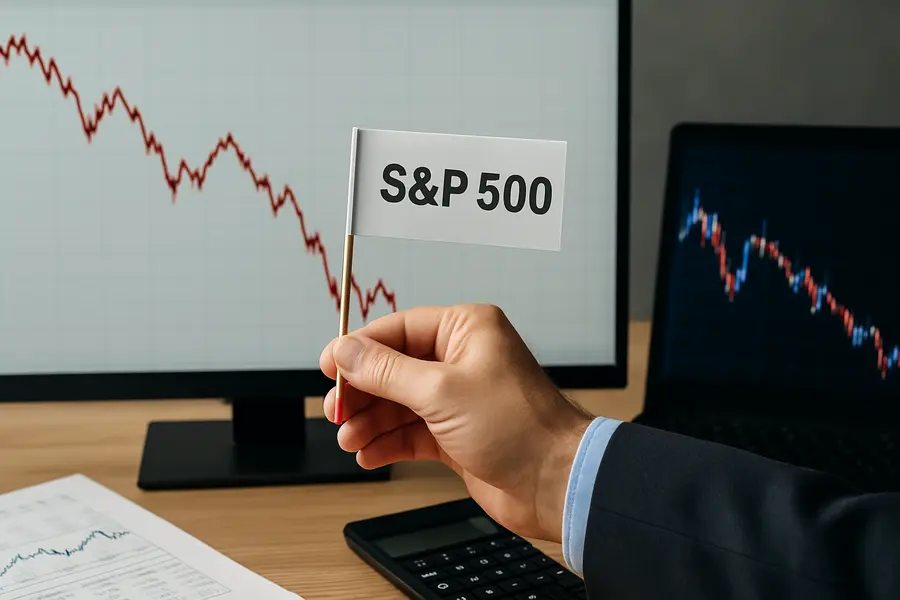
Polymarket S&P 500 prediction markets assigned two-to-one odds against a higher open today as chip-stock profit-taking clouds the S&P 500 H2 2026 outlook after a historic first half.
- Polymarket priced a 65% probability of a flat or lower S&P 500 close on July 1, the first trading day of H2 2026.
- The index enters the second half up 9.5% year-to-date after Q2's 14.9% gain, its strongest quarter since Q2 2020.
- Goldman Sachs projects an 8,000 year-end target; a minority of strategists warns of a 10–12% H2 pullback.
Lead
New York — Polymarket traders leaned bearish on the stock market open today. As Wall Street began the second half of 2026, the world's largest prediction market priced a 65% probability that the S&P 500 closes flat or lower on July 1 — placing two-to-one odds against a continuation of the first-half rally that pushed the index up 9.5% through June 30.What Happened
The opening session of S&P 500 H2 2026 confirmed the crowd's caution. The benchmark index slipped 0.4% in early trading, while the Dow Jones Industrial Average shed 184 points, or 0.3%. The Nasdaq Composite fell fractionally as semiconductor and AI-infrastructure stocks — the primary engines of the H1 advance — faced heavy profit-taking at the calendar turn.
The pullback followed an extraordinary six months for equities. The S&P 500's second-quarter gain of 14.9% was the index's strongest quarterly performance since Q2 2020, driven by a surge in memory chips, data-center hardware, and software tied to artificial intelligence buildouts. The VanEck Semiconductor ETF (SOXX) gained 82% in the first six months of 2026, its best first-half since inception in 2000. Individual winners were more dramatic: SanDisk rose 858% and Intel advanced 278%, with memory and storage manufacturers benefiting from a supply crunch tied to AI data-center expansion.
Prediction Markets Signal Caution
Prediction markets news heading into July centers on whether AI-driven momentum can extend into the second half. The Polymarket S&P 500 prediction contract for July 1 settled at 35% for an "up" close before the bell — roughly one-in-three odds — reflecting quarter-end repositioning, stretched semiconductor valuations, and unresolved Federal Reserve policy risk.
Polymarket, where users place real-money bets on real-world outcomes, has become a real-time sentiment barometer. Because capital is at risk, its prices function as probability-weighted forecasts rather than survey results, offering a skin-in-the-game consensus that institutional traders increasingly cite alongside traditional sentiment gauges. The platform's broader S&P 500 year-end market shows implied probabilities spread across a $6,500–$8,000 range, reflecting genuine disagreement over macro variables rather than directional conviction in either direction.Wall Street's H2 Outlook: Divided
Goldman Sachs raised its S&P 500 year-end 2026 target to 8,000 — up from 7,600 — projecting a 6% gain from current levels, underpinned by expectations of roughly 25% year-over-year earnings growth and a resilient consumer. Among 19 Wall Street banks and research firms, the median year-end target stands at 7,850, implying approximately 5% additional upside from H1 closing levels.The bull case centers on the upcoming earnings season, which begins July 14 when the largest U.S. banks report second-quarter results. FactSet consensus models project 22% average earnings growth across the S&P 500 — a figure that, if realized, would provide fundamental support for elevated valuations.
A minority view anticipates a more difficult second half. Some strategists project a 10–12% S&P 500 decline, arguing the AI and chip trade has peaked and that capital will rotate toward slower-growth, lower-multiple businesses. The bear case also leans on monetary policy: Kalshi prediction markets price a 53% probability of a rate increase before year-end 2026, a headwind absent for most of H1.
Macro Headwinds Coming Into Focus
The Federal Reserve's reluctance to ease stems from elevated core inflation and a labor market that has remained tighter than models projected. That combination puts the policy backdrop for S&P 500 H2 2026 in sharp contrast to the rate-cut expectations that helped underpin H1 gains. Rate cuts are not expected for the remainder of the year.
Energy markets add uncertainty. Sustained upward pressure on crude oil would introduce pass-through effects on margins across transportation, industrials, and consumer discretionary sectors. The dollar's trajectory matters as well — higher-for-longer U.S. rates tend to strengthen the currency, pressuring the roughly 40% of S&P 500 revenues generated outside the United States and compressing translation gains that multinational companies reported through June.
Sector Rotation in Focus
With technology and semiconductors absorbing profit-taking, attention is turning to whether defensive and value-oriented sectors can absorb capital flows. Financials stand to benefit from a steeper yield curve if rate expectations reprice higher. Energy and utilities may attract flows from investors seeking inflation protection. Healthcare has lagged the index year-to-date and carries relative-value appeal at current multiples.
Earnings season will be the near-term arbiter. Conservative guidance from large banks on net interest margin or credit quality would undercut the rotation thesis. Strong results, conversely, could validate a broadening of the market beyond technology-heavy H1 leaders.
Outlook
The S&P 500 enters H2 2026 with substantial year-to-date gains, a solid earnings-growth backdrop, and prediction markets tilted toward caution for the opening stretch. Wall Street's central scenario calls for further but slower appreciation, with year-end targets clustered near 7,850–8,000. The primary risks are a Federal Reserve stance firmer than currently priced, an energy-price shock, and a rotation away from the AI and semiconductor trade. The earnings season beginning July 14 will establish whether the fundamental case for the index's current valuation can hold against the headwinds accumulating at the start of the second half.
Mentioned tickers: SPX, SOXX, SPY, VOO