Pomegra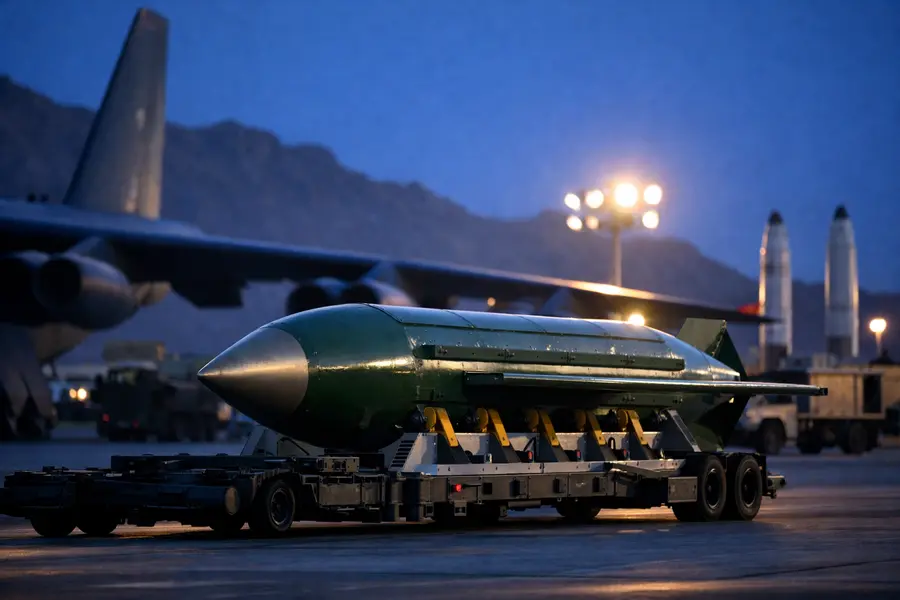
The Pentagon has drawn up options to use the 21,600-pound MOAB on Iranian nuclear and energy sites, lifting escalation risk and oil prices in the six-month war.
- US planners have prepared strike packages using the GBU-43/B MOAB if Trump orders combat to resume.
- Brent crude traded near $104 a barrel on October 15, after touching $105.20 a week earlier.
- Military specialists doubt the MOAB can penetrate Iran's deeply buried nuclear facilities.
Lead
US military planners have developed new strike options that include the GBU-43/B Massive Ordnance Air Blast, known as the "mother of all bombs," against Iranian energy infrastructure and nuclear sites. The plans would take effect if President Donald Trump orders major combat operations to resume. The 21,600-pound weapon is the largest non-nuclear munition in the US arsenal. Its inclusion signals a possible step up in a war that began in February 2026 and has no negotiated settlement. The White House declined to discuss classified planning and said Trump "keeps all options on the table to ensure Iran never acquires a nuclear weapon."
What Does the Pentagon Plan Involve?
The plan pairs the MOAB with broader strike packages that Trump asked the military to prepare, which include a large share of Iranian energy infrastructure. The reported targets include the Pickaxe Mountain complex, where Washington believes Tehran has stored nuclear program components. Trump has repeatedly threatened to strike the site.
The MOAB is built to destroy surface targets and shallow tunnels, and one detonation can devastate an area roughly equal to nine city blocks. The weapon is "definitely not designed as a deep penetration warhead," in the words of one assessment of the plan. Granite and layers of reinforced concrete protect Iran's most sensitive assets, and the MOAB likely lacks the capability to penetrate that deep. The 30,000-pound GBU-57 Massive Ordnance Penetrator, used against Iranian nuclear sites in June 2025, is the US weapon designed for that task.
The central point for military planners is that the MOAB would be more useful against exposed energy facilities and tunnel entrances than against deeply buried enrichment halls. That gap between the weapon and the stated objective is what has drawn skepticism.
Why Are Escalation Fears Rising Now?
Escalation fears are rising because the planning coincides with a run of attacks across the Gulf and a Pentagon order to prepare for renewed combat. US Central Command was told to complete preparations for a possible return to "major combat operations."
Recent events have added to the pressure:
- Houthi forces struck King Khalid International Airport in Riyadh on Saturday, killing 12 people and injuring more than 300.
- A container ship sank in the Strait of Hormuz on Wednesday after being hit by unidentified projectiles.
- Tanker operators are steering clear of their usual crude-loading areas as attacks on shipping disrupt export flows.
Trump paused full combat operations earlier in the year but has kept up threats of new strikes. He has also said publicly that he would not act before the midterm elections on November 3. Advisers have questioned whether that pledge is firm, and administration officials have discussed a strike as a possible "symbolic" show of strength before voters go to the polls. The war remains deeply unpopular at home.
How Are Oil Markets Reacting?
Oil markets are reacting with higher prices and wider risk premiums, as traders price in the chance of damage to Gulf supply. Brent crude jumped about 5% to $105.20 a barrel on October 8 on reports that Trump was weighing a return to major combat. West Texas Intermediate rose a similar 5.1% to $92.75. By October 15, Brent had eased 2.05% to $103.89 in what looked like profit-taking after the rally.
The move spilled into other markets on October 8. Germany's DAX fell 0.76% as inflation concerns resurfaced, and France's 10-year yield climbed to 4.89%. Global oil inventories are described as worryingly low, so there is little buffer if Gulf exports are interrupted.
What Comes Next for the Crude Oil Price?
The crude oil price is likely to track two variables over the next three to twelve months: whether Washington orders strikes on energy infrastructure, and whether Iran and its allies widen attacks on shipping in the Strait of Hormuz. About a fifth of global oil consumption normally moves through the strait, so even brief interruptions carry outsized price effects.
Three scenarios stand out:
- Planning without action. The MOAB option stays a contingency through the midterms. Oil remains elevated but range-bound near $100 to $105.
- Limited strikes. Targeted attacks on energy or nuclear sites lead to Iranian retaliation against shipping and Gulf producers. Brent would probably test new highs.
- Diplomatic reset. A negotiated pause would remove much of the risk premium, though no talks are under way.
Strategic Context
The war has lasted more than six months with no agreed endpoint. Attacks by Iran-backed Houthi forces on Saudi Arabia show that the conflict now reaches beyond direct US-Iran exchanges. The consensus view among defense specialists is that a MOAB strike would signal resolve more than it would change Iran's nuclear capacity. That puts the political and economic effects, rather than the military ones, at the center of the debate.
An Israeli official has described the probability of strikes before the midterms as "not high," while declining to rule them out.
Outlook
The Pentagon has prepared a menu of escalation options, including the largest non-nuclear bomb in its arsenal, but no order has been given. Oil prices near $104 a barrel reflect a market that treats renewed combat as a live risk. The next signals to watch are any White House decision on strikes before or after November 3, further shipping incidents in Hormuz, and the pace of Houthi attacks on Saudi Arabia.
Mentioned tickers: None