 Pomegra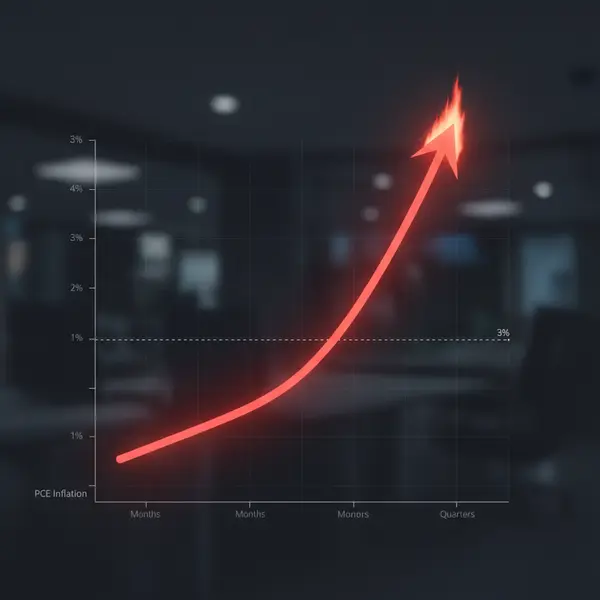
The Commerce Department's Bureau of Economic Analysis released the April Personal Consumption Expenditures (PCE) price index on Thursday, May 28, 2026, confirming that U.S. inflation accelerated to its fastest pace in three years. The headline PCE gauge registered 3.8% on a 12-month basis — matching economist forecasts polled by Reuters — while the monthly reading came in at 0.4%, a deceleration from March's sharp 0.7% surge. The data cements a deteriorating price stability picture as the U.S.-Iran conflict continues to reverberate through global energy markets and supply chains.
- The PCE price index rose 3.8% year-over-year in April 2026, up from 3.5% in March and 2.8% in February.
- Core PCE, which excludes food and energy, climbed to 3.3% annually, the highest since the post-pandemic inflation wave.
- Financial markets now price no Federal Reserve rate cuts through 2026, with futures pointing to rates remaining at 3.50%–3.75% well into 2027.
The Iran War's Energy Shock Powers the Surge
The primary driver behind April's inflation acceleration is the ongoing disruption to global energy flows triggered by the conflict with Iran, which began in late February 2026. Iran's partial closure of the Strait of Hormuz — a chokepoint through which roughly 20% of the world's oil transits — sent energy prices into a sustained upward spiral. The national average retail gasoline price jumped 12.3% in April alone, according to the U.S. Energy Information Administration, and has now surged more than 50% since hostilities began. West Texas Intermediate crude was trading above $90 a barrel on Thursday, with Brent crude rising to approximately $95.92 before pulling back on unconfirmed reports of a U.S.-Iran ceasefire extension.
The conflict has also strained the global movement of fertilizers, aluminum, and a broad range of consumer products, feeding imported inflation that layers onto price pressures already elevated by sweeping import tariffs imposed during the Trump administration's first term. The IMF has characterized the Hormuz disruption as the largest oil supply shock since the 1970s.
Core Inflation Broadens Beyond Energy
While energy dominates headlines, the core PCE index — stripping out volatile food and energy components and representing the Federal Reserve's most closely watched inflation metric — rose 3.3% year-over-year in April, ticking up from 3.2% in March. On a monthly basis, core PCE gained 0.2%, a modest deceleration from March's 0.3% advance. The three-month annualized pace of core PCE had already surged to 4.4% by March 2026, signaling that underlying price pressures are spreading well beyond the pump.
Elevated services inflation and persistently high shelter costs are compounding the energy shock, making the Fed's path back to its 2% target increasingly complex and prolonged. The gap between headline PCE and the pre-war February reading of 2.8% illustrates how swiftly the geopolitical shock transmitted into domestic consumer prices within just two months.
Consumer Spending Holds, But Cracks Emerge
Consumer spending, which accounts for more than two-thirds of U.S. economic activity, rose 0.5% in April after surging 1.0% in March — a slowdown that reflects the eroding purchasing power of American households. Inflation-adjusted real consumer spending inched up just 0.1%, indicating that nominal gains are being overwhelmed by higher prices rather than genuine demand expansion.A surge in tax refunds during the filing season provided a temporary cushion, particularly for lower-income households, while many consumers drew down savings to sustain spending levels. With the tax season now over and wage growth failing to keep pace with inflation, economists broadly anticipate a consumer pullback in the months ahead. The personal savings rate has been declining, raising concerns about household financial resilience amid sustained cost-of-living pressures.
Federal Reserve Frozen Between Inflation and Growth Risk
The April PCE report reinforces a dilemma that has gripped Federal Reserve policymakers throughout 2026. With inflation running nearly double the central bank's 2% target, the Fed faces mounting pressure to consider rate hikes — even as GDP growth was revised down to 1.6% for the first quarter of 2026 in a separate release Thursday. Fed officials John Williams and Alberto Musalem both reiterated this week that current monetary policy remains appropriately positioned given the outlook, though minutes from the April 28–29 FOMC meeting revealed a growing faction of policymakers open to resuming rate increases.
Financial markets have fully priced out rate cuts through 2026, with the federal funds rate expected to hold in the 3.50%–3.75% range into 2027. The three-month annualized core PCE print above 4% is hardening the view that the Fed's next move, if any, is more likely a hike than an ease — a dramatic reversal from the rate-cutting cycle that began in late 2024.
Wall Street Shrugs at Data, Eyes Iran Ceasefire
Equity markets largely absorbed the inflation data without sustained selling. After an initial dip at the opening bell — the S&P 500 slipped 0.02% and the Nasdaq fell 0.16% — both indexes reversed to new all-time highs by midday as rumors circulated that the U.S. and Iran had reached a conditional ceasefire extension agreement. The S&P 500 gained 0.49% and the Nasdaq Composite climbed 0.64% at midday, with the Iran peace speculation sending WTI crude back below $90 a barrel despite the broader inflationary backdrop. The Dow Jones Industrial Average, however, remained under pressure, losing 0.63%.
Individual movers on May 28 included Dollar Tree surging 16.8%, Agilent Technologies jumping 16.23%, and Best Buy climbing 15.76% on strong earnings. On the downside, Synopsys fell 8.17%, and railroad stocks Norfolk Southern and Union Pacific dropped over 4% each on merger skepticism. Gold futures fell 1.5% to $4,415.40 an ounce as the dollar firmed on the hawkish inflation implications.
Political Pressure Mounts as Prices Bite
The inflation surge is exacting a political cost on the Trump administration. A Reuters/Ipsos survey published the prior week showed presidential approval ratings near their lowest point since Trump returned to office, with Republican voter confidence softening. The president won the 2024 election in large part on pledges to bring prices down, and the persistence of elevated consumer prices above 3% poses a direct challenge to the Republican Party's Congressional majority heading into the November 2026 midterm elections. Trump has characterized Iran as "negotiating on fumes" and has left open the possibility of escalated military action, a posture that keeps energy market uncertainty elevated.
Outlook: Inflation Trajectory Hinges on Hormuz
The direction of U.S. inflation through the second half of 2026 remains tightly bound to the resolution — or escalation — of the Iran conflict. If the Strait of Hormuz reopens under a sustained ceasefire, energy prices are expected to retreat, providing relief to both headline PCE and broader supply chains. University of Michigan economists project PCE inflation to ease through 2026's second half if diplomatic progress materializes. However, with tariff-driven structural price pressures already embedded before the war, and core PCE running above 3%, the return to the Fed's 2% target is not expected before 2027 under any current scenario. The combination of a geopolitical shock, elevated tariffs, and a Fed that is constrained from easing creates the most challenging macroeconomic environment for U.S. consumers since the post-pandemic inflation surge of 2022.
Mentioned tickers: SPY, QQQ, DJI, DLTR, A, BBY, SNPS, NSC, UNP, SNOW, WIX, DELL, KSS