 Pomegra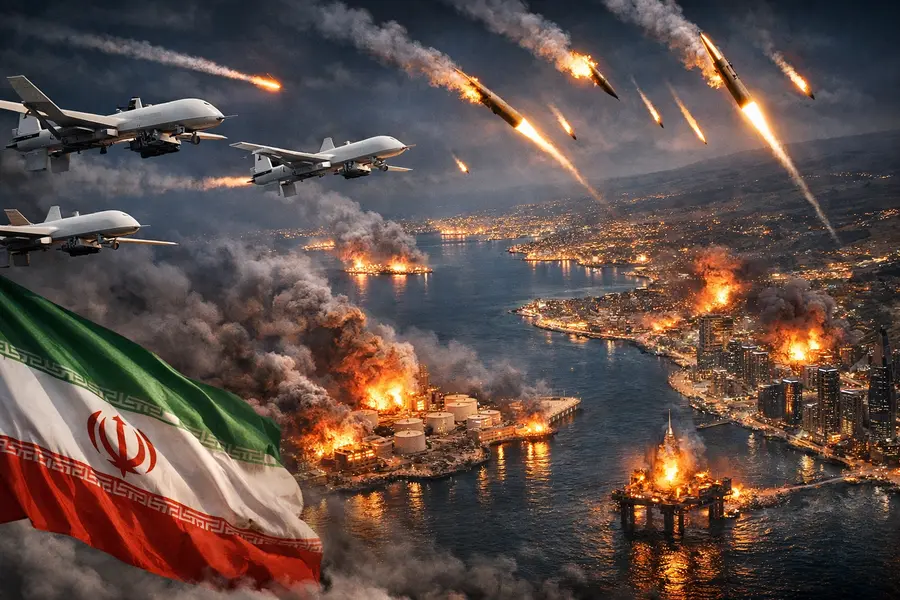
Iran launched its largest drone and missile barrage in months against Qatar, the UAE, Kuwait, Bahrain, and Oman, targeting US military bases as the fragile ceasefire with Washington collapsed.
- Iran's IRGC hit US installations at Al Udeid Air Base in Qatar and the 5th Fleet headquarters in Bahrain, hours after CENTCOM struck ~140 Iranian military targets
- One child was killed in Kuwait and three people wounded in Qatar as Iran launched Middle East drone strikes into civilian areas
- Brent crude held near $76 a barrel — up ~4.7% on the week — as the Strait of Hormuz dropped to 22 ship transits per day against a normal 70–80
Lead
Iran's Islamic Revolutionary Guard Corps unleashed coordinated missile and drone strikes across five Gulf Cooperation Council states on July 12, 2026, targeting US military installations in Qatar, the United Arab Emirates, Kuwait, Bahrain, and Oman in the largest Iranian barrage since the conflict escalated in the spring. The attacks — which killed at least one child in Kuwait and wounded three others, including a child, in Qatar — came hours after US Central Command announced it had struck approximately 140 Iranian military targets, including missile and drone launch sites, naval assets, and ammunition storage facilities.
What Happened
The IRGC directed ballistic missiles at Al Udeid Air Base in Qatar, striking the facility's command center and fighter aircraft maintenance infrastructure. The US Navy's 5th Fleet headquarters at Naval Support Activity Bahrain sustained a missile strike as air raid alerts sounded across the island kingdom. In Kuwait, the IRGC claimed destruction of a US radar site; debris from an intercepted drone fell on a residential area, killing a child. Powerful explosions in Kuwait were audible across parts of neighboring Iraq.
Qatar's military said its air defenses intercepted multiple incoming ballistic missiles, though falling shrapnel injured three people, including a child. The UAE issued missile alerts and directed residents to seek shelter. In Oman, drones targeted sites in the Musandam governorate — a strategic exclave projecting into the Strait of Hormuz. Jordan reported three Iranian missiles landing without causing casualties, while the IRGC claimed strikes on a US position there as well.
Qatar, the UAE, and Kuwait closed their airspace in response. The UAE foreign ministry formally condemned the attacks as "renewed hostile aggression."
The IRGC issued a statement declaring: "The Strait of Hormuz is closed until further notice and until the end of America's interventions in the region, and no vessel will be permitted to pass through."
Strategic Context
The July 12 barrage is the latest sequence in an escalation cycle dating to February 28, 2026, when the United States and Israel launched Operation Epic Fury — coordinated strikes targeting Iranian military infrastructure, nuclear facilities, and senior leadership, including Supreme Leader Ali Khamenei. Tehran formally declared the Strait of Hormuz closed to commercial traffic on March 4 and has repeatedly enforced that declaration through direct attacks on vessels and neighboring states.
By the end of March, Iran had fired 438 ballistic missiles, 2,012 drones, and 19 cruise missiles at targets in the UAE alone, per UAE Ministry of Defence tallies. The July strikes represent a renewed phase after a fragile ceasefire held briefly in late June and early July. President Donald Trump stated that Washington would continue negotiations but characterized the ceasefire as "effectively over" following the renewed hostilities.
The targeting pattern — US military installations at Al Udeid, the 5th Fleet anchorage, and logistics nodes in Kuwait and Oman — reflects Iran's strategic logic of raising the cost for GCC states hosting American forces. Tehran is simultaneously pressuring Arab governments to reassess their alliance posture while signaling to Washington that military strikes inside Iran carry consequences for Gulf stability.
Energy and Shipping Disruption
The Strait of Hormuz normally handles 70 to 80 commercial vessel crossings daily and carries approximately 20 percent of the world's oil and gas trade, along with roughly 30 percent of internationally traded fertilizers. Following the February escalation, commercial traffic dropped more than 90 percent. Daily transits recently stood at 22 vessels — well below normal and far from the single-digit levels recorded in early March. Approximately 6,000 seafarers remain stranded aboard hundreds of vessels near the strait.
The International Energy Agency has characterized the ongoing disruption as the largest supply interruption in the recorded history of the global oil market. Only Saudi Arabia and the UAE possess overland pipeline alternatives to the strait, and both have limited spare export capacity.
Market Reaction
Brent crude closed the week near $76 per barrel, approximately 5 percent above pre-war levels and up roughly 4.7 percent on a weekly basis, though far below the conflict's peak of nearly $120 a barrel. Oil prices had retreated toward pre-conflict levels during the ceasefire period in late June, only to reverse sharply as US strikes resumed July 8. Markets are now pricing a sustained risk premium reflecting the probability of recurring Hormuz disruption rather than a one-time spike. Emergency oil stockpile releases by IEA member countries have partially offset supply shortfalls but are expected to wind down in the coming months.Geopolitical Dimension
The US Iran conflict has delivered structural disruption to the GCC's economic model, which depends on hydrocarbon export revenue flowing through the Strait, dollar-pegged currency frameworks, and deep integration with US financial and security systems. The World Bank estimates global economic growth will slow to 2.8 percent in 2026 from 3.4 percent in 2025, with Gulf states and energy-importing emerging markets absorbing disproportionate impacts. Iran's closure of the Strait has been characterized by energy analysts as a deliberate attempt to cement leverage over the waterway as a negotiating instrument, regardless of ceasefire status.
Outlook
The July 12 Iran attacks on Gulf states confirm the conflict has not reached a decisive military or diplomatic endpoint. Brent crude is expected to remain elevated while Strait of Hormuz transit conditions stay hazardous and emergency reserve releases diminish. Ongoing Washington-Tehran negotiations have not produced the framework needed for a verifiable halt to hostilities. Until a durable settlement holds, the Gulf states hosting US forces — Qatar, Bahrain, Kuwait, the UAE, and Oman — face recurring disruption to air corridors, maritime trade, and civilian security, with Iran's demonstrated willingness to target residential areas adding a humanitarian dimension that previous conflict phases had largely avoided.
Mentioned tickers: BNO, USO, XOM, CVX, BP, TTE, SHEL