 Pomegra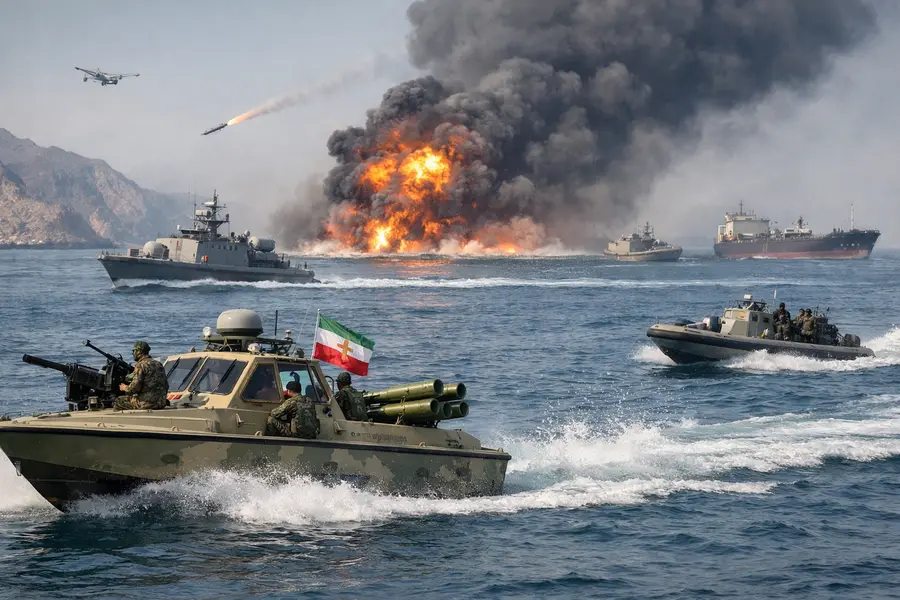
Iran's Revolutionary Guards closed the Strait of Hormuz on July 12 after U.S. strikes hit 140 Iranian targets in a week, threatening roughly a fifth of global daily oil flows.
- The IRGC Navy declared the Strait of Hormuz closed until further notice on July 12 after attacking the Cyprus-flagged container ship M/V GFS Galaxy.
- U.S. CENTCOM struck more than 80 Iranian targets on July 7 and approximately 140 more on July 12, hitting naval assets, coastal radar sites, and command networks.
- Brent crude climbed toward $90 per barrel as traceable tanker crossings fell to roughly one-third of pre-war levels.
Lead
The Islamic Revolutionary Guard Corps Navy declared the Strait of Hormuz closed to all vessel traffic on July 12, 2026, after IRGC forces attacked the M/V GFS Galaxy, a Cyprus-flagged container ship, for transiting what Tehran called an unauthorized route. The closure formalized a de facto blockade that had already cut the passage's tanker traffic to 15.6 vessels per day from a pre-war baseline of 55. U.S. Central Command responded within hours with its third strike package in five days, hitting approximately 140 Iranian military targets across the country's southern coast.
What Happened
The sequence began July 7, when U.S. forces struck more than 80 Iranian targets—including air defense systems, command and control networks, coastal radar installations, anti-ship missile batteries, and more than 60 IRGC fast-attack boats—after Iran struck three commercial vessels in the waterway. The Trump administration simultaneously revoked a 60-day waiver on Iranian oil sanctions agreed under a June memorandum of understanding, barring Iranian crude transactions after July 17.
Iran countered with missiles and drones against U.S. military infrastructure in Bahrain and Kuwait, targeting Salman Port, homeport of the U.S. Fifth Fleet, and Ali Al Salem Air Base. A second U.S. strike package followed July 9, hitting approximately 90 targets. On the night of July 11, the IRGC struck the M/V GFS Galaxy, triggering a third U.S. response and, hours later, the IRGC's formal closure declaration.
In its statement, the IRGC Navy said the waterway would remain shut "until the end of American interventions in this area, and no vessels will be allowed to pass through it."
Market Reaction
Brent crude surged toward $90 per barrel following the closure, extending a rally from near $70 in late June when a fragile ceasefire had appeared within reach. The strait's disruption has been described as the largest global oil supply shock in the modern history of energy markets. Flows through the passage fell from approximately 20 million barrels per day before hostilities began in late February to an average of 2.7 million barrels per day across March, April, and May. Energy equities rallied sharply, led by exploration and production companies and tanker operators. Major container shipping groups—including Maersk, CMA CGM, and Hapag-Lloyd—suspended strait transits, rerouting vessels around the Cape of Good Hope and adding weeks to delivery schedules. The disruption has spread beyond crude: aluminum, fertilizer, and helium markets face constrained supply, with up to 30 percent of internationally traded fertilizers normally moving through the passage.Geopolitical Dimension
The July 12 closure caps an escalation that began February 28, when the United States and Israel launched a sustained air campaign against Iran. The IRGC navy progressively tightened maritime restrictions, boarded and attacked merchant vessels, and deployed sea mines, reducing overall strait traffic to 33 percent of pre-war levels—32.1 total vessels per day against a pre-war baseline of 97.
Iran broadened its military footprint on July 12, launching simultaneous missile and drone strikes against Bahrain, Kuwait, Qatar, the UAE, Jordan, and Oman, hitting U.S. Patriot air defense systems, ammunition depots, radar installations, and drone hangars. IRGC ballistic missiles struck Prince Hassan Air Base in Jordan, where CENTCOM operates MQ-9 assets.
Diplomatic efforts have repeatedly collapsed. Talks hosted by Oman—centered on a framework to manage commercial traffic through the strait—resumed July 11 even as President Trump declared the ceasefire "over." Iranian Foreign Minister Abbas Araghchi led Tehran's delegation in Muscat. Both sides agreed to keep channels open, but the IRGC's formal closure declaration has hardened positions on both sides.
Strategic Context
The strait is the world's most critical oil supply chokepoint, linking Persian Gulf production zones in Saudi Arabia, Iraq, Kuwait, the UAE, and Iran to global markets. Sustained closure forces major Asian importers—China, India, Japan, and South Korea—to compete for alternative supplies from West Africa, the Americas, and the North Sea, compressing refinery margins and elevating freight rates. The U.S. Treasury's reimposition of Iranian oil sanctions removes an estimated 1.5 to 2 million barrels per day of supply that had helped soften global prices in the first half of the year.
The IRGC's formal declaration shifts the crisis from contested maritime enforcement to a stated interdiction of internationally recognized shipping lanes, raising the legal and strategic threshold for any third-party vessel attempting transit and for U.S. naval escort operations.
Outlook
The global oil supply disruption has no clear near-term resolution. Diplomatic contacts in Oman continue, but the IRGC's closure statement and Iran's strikes across five Gulf nations signal deliberate escalation rather than any move toward de-escalation. Brent crude is expected to remain elevated above $80 per barrel as long as the Strait of Hormuz stays closed, with upside risk if naval exchanges intensify or Gulf land-based infrastructure is struck. The July 17 Iranian sanctions deadline adds immediate pressure. A durable reopening requires either a negotiated framework or a decisive shift in military conditions on the water—neither of which is imminent.