Pomegra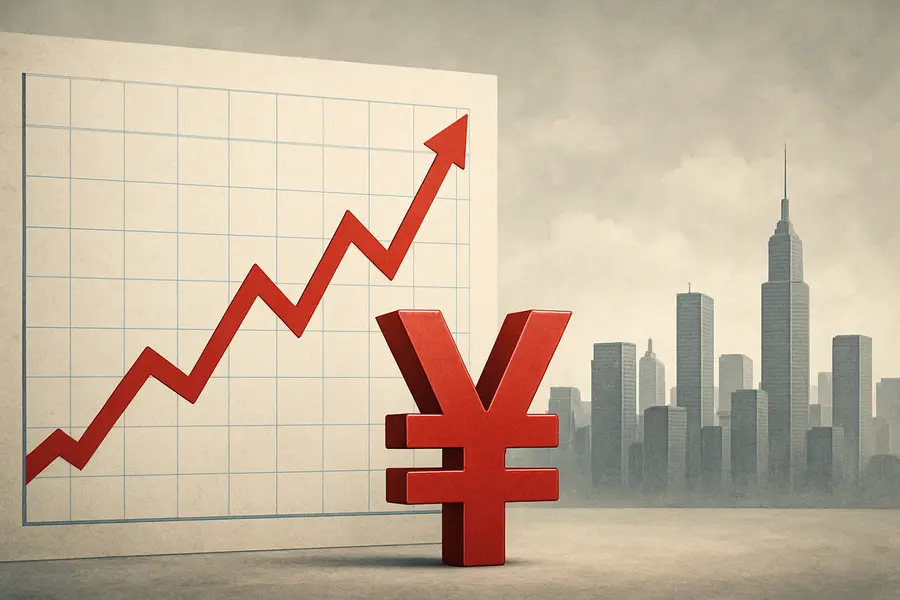
The People's Bank of China is reshaping its monetary-policy framework to stabilize the yuan and attract foreign capital, even as a two-speed domestic economy leaves policymakers with few easy levers to pull.
- PBOC will launch overnight reverse repo operations June 29–30, tightening rate-corridor control around the seven-day reverse repo benchmark.
- The yuan has gained 5.15% against the dollar over twelve months, reaching 6.7567 per dollar on June 17 before settling near 6.80 this week.
- China's Q1 2026 GDP expanded 5.0% year-on-year, but the growth is export-led; domestic demand and the property sector remain structurally weak.
Lead
Beijing — The People's Bank of China moved this month to overhaul the mechanics of its interest-rate policy, announcing an overnight funding corridor intended to reduce short-term volatility in the yuan and align its toolkit more closely with the U.S. Federal Reserve, as China's economic recovery enters its most asymmetric phase in years. The yuan exchange rate touched 6.7567 per dollar on June 17 — its strongest reading since 2023 — before pulling back to 6.8027 on June 26, reflecting the PBOC's willingness to tolerate measured appreciation while guarding against an overshoot that would further crimp exporters already under margin pressure.A New Policy Toolkit
PBOC Governor Pan Gongsheng on June 17 unveiled a restructured monetary-operations framework centered on the seven-day reverse repo rate as the primary policy signal, flanked by an overnight corridor. Temporary overnight reverse repo rates will be set 25 basis points below the seven-day rate, while outright repurchase agreement rates will sit 25 basis points above it. The central bank will execute initial overnight reverse repo operations on June 29 and June 30 between 3:00 p.m. and 3:30 p.m., a timing shift designed to smooth end-of-day liquidity.
The redesign targets a persistent problem in China market news: extreme intraday swings in the overnight interbank rate have made yuan-denominated bonds less predictable for institutional investors relative to equivalently rated U.S. Treasury and European sovereign paper. By compressing the corridor, Beijing is signaling that the cost of short-term yuan funding will remain anchored — a prerequisite for drawing foreign capital into the onshore bond market at scale.
In a parallel move, eligible foreign central bank–type institutions gained access to yuan funding against high-quality collateral, including top-tier Chinese government bonds, broadening the PBOC yuan policy 2026 agenda to include renminbi internationalization as a structural priority.
The Yuan's Upswing and Its Limits
The yuan's twelve-month gain of 5.15% against the dollar is the product of China's record $1.2 trillion trade surplus, capital inflows into the onshore bond market, and a deliberate shift in PBOC fixing guidance — the central bank set the daily reference rate stronger than the 7.00 threshold for the first time since 2023 in January. From that point, USD/CNY has trended steadily lower, with a brief acceleration through mid-June before consolidating.
The appreciation is a double-edged force. Factories that price goods in dollars and convert earnings back into yuan face structural margin compression; the impact is especially acute for mid-tier manufacturers in textiles, electronics assembly, and industrial components. On the other side of the ledger, a stronger currency lowers the renminbi cost of importing dollar-priced raw materials and capital equipment — providing partial relief to industries upgrading their production lines.
The PBOC's response to the appreciation has been calibrated rather than interventionist. When USD/CNY fell sharply toward 6.75, the central bank set its daily fixing meaningfully above consensus market forecasts, using the reference rate mechanism to slow the pace of gains without reversing the trend. That approach reflects a dual mandate: support the renminbi's international standing while protecting the export engine that has driven China economic recovery in the first half of 2026.
Two-Speed Recovery
China's real GDP grew 5.0% year-on-year in the first quarter of 2026, accelerating from 4.5% in the fourth quarter of 2025. The headline number obscures a pronounced divergence between sectors. Industrial output, advanced manufacturing — electric vehicles, batteries, robotics — and export volumes are outperforming, buoyed by China's dominant cost position in high-value goods. Domestic consumption, services, and the property sector are materially lagging.
The GDP deflator is projected at minus 0.7% for full-year 2026, an indication that demand is insufficient to generate sustained price pressure even as the supply side recovers. Producer prices contracted for a prolonged period before posting a tentative 0.5% year-on-year gain in March alongside a headline CPI reading of 1.0% — a potential inflection point that policymakers are monitoring closely but have not yet declared a trend.
Domestic Demand: The Missing Engine
The structural obstacles to a consumer-led recovery have accumulated over several years. The property sector remains in correction after a government-led deleveraging campaign that began in 2020 left a large inventory of unfinished and unsold housing. The associated wealth effect has depressed household spending intent; consumers facing uncertain asset values and an incomplete social safety net have consistently increased their savings rate rather than expenditures.
Youth unemployment remains near cycle highs, dampening the income outlook for the largest demographic cohort of new spenders. The government allocated CNY 250 billion in consumption subsidies for 2026 — below the CNY 300 billion deployed in 2025 — focused on household appliances, electric vehicles, and green-energy products. The IMF, in its February 2026 consultation, called for more forceful central government financing to complete unfinished housing projects and restore consumer confidence, recommending a sustained pivot toward expansionary fiscal policy until deflationary pressure subsides.
Geopolitical and Trade Dimension
The yuan's appreciation is not uncontested internationally. China's $1.2 trillion trade surplus has intensified calls from trading partners — particularly in North America and Europe — for a stronger renminbi. New trade barriers introduced since 2024 have already moderated Chinese export volume growth, and a further round of tariff escalation remains a live risk for the second half of the year. A materially stronger yuan would absorb some external political pressure but would simultaneously constrain the export growth that the recovery depends upon — a tension the PBOC must navigate with the rate corridor and reference-rate management tools it is actively refining.
Outlook
The PBOC's June policy moves position the central bank to exert tighter control over short-term funding costs while making the yuan more legible and attractive to foreign institutional investors — a step toward renminbi internationalization that complements the currency's recent appreciation. The structural challenge, however, lies not in the rate corridor but in domestic demand: until the property sector stabilizes and consumer confidence rebounds, GDP growth will remain export-dependent and vulnerable to external trade shocks. Policymakers have additional room for RRR reductions and benchmark rate cuts, which Governor Pan indicated remain available, but their transmission to household spending will be gradual. The divergence between a strengthening currency and a still-healing domestic economy defines PBOC yuan policy 2026 for the remainder of the year.