Pomegra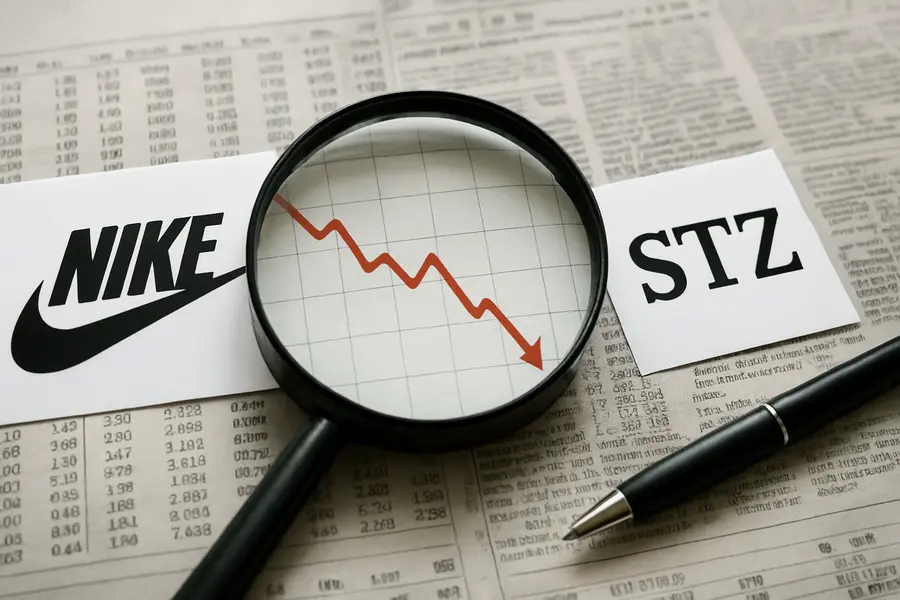
Nike (NKE) and Constellation Brands (STZ) both topped Wall Street forecasts on June 30, 2026, yet shares in each company declined as investors looked past headline beats to softer underlying demand and cautious guidance.
- Nike posted Q4 FY2026 revenue of $10.97 billion, beating estimates, but a $986M tariff refund masked a 17% decline in Greater China sales.
- Constellation Brands' Q1 FY2027 EPS of $3.43 beat the $3.21 consensus; net sales fell 3.3% year-over-year to $2.43 billion.
- Both stocks fell after hours on the same evening, with NKE down 3.6% and STZ shedding 4.5%.
Lead
Two of America's most-watched consumer brands posted fiscal quarterly results on June 30, 2026, joining a packed retail earnings slate that underscored how uneven the consumer-demand landscape remains entering the second half of the year. Nike and Constellation Brands each delivered earnings per share above analyst expectations, yet in both cases the relief was short-lived as markets absorbed ongoing headwinds — ranging from weak Chinese consumer spending to a slowing U.S. beer market — that dimmed forward visibility.
Nike: Tariff Windfall Clouds the Real Picture
Nike's fourth-quarter fiscal 2026 revenue of $10.97 billion exceeded the $10.86 billion consensus, and EPS of $0.72 dwarfed the $0.13 estimate. Investors quickly discounted the headline, however: $0.52 of that per-share figure reflected an anticipated recovery of roughly $986 million in IEEPA tariffs following a Supreme Court ruling that struck down broad presidential trade duties. Stripping out the benefit, adjusted EPS landed near $0.20.The underlying revenue picture confirmed that CEO Elliott Hill's "Win Now" restructuring — reorganizing Nike around individual sports such as Running, Basketball, and Football rather than consumer-segment lines — remains a work in progress. Q4 revenue fell 1% on a reported basis and 4% on a currency-neutral basis. Greater China, once a reliable growth engine, posted a 17% revenue decline in the quarter; EMEA was down 6%. North America provided the one clear positive: revenue rose 3%, with wholesale growing 10% as the company leaned harder into retail partnerships it had previously deprioritized.
Nike Direct continued its retreat, down 9% for the quarter, with Nike Digital off 12% and physical Nike stores declining 7%. For the full fiscal year, revenue came in at $46.4 billion — flat on a reported basis and down 2% in currency-neutral terms — while wholesale grew 4% led by double-digit gains in North America.The market reaction was swift. NKE fell as much as 8% in after-hours trading before trimming losses to close the extended session down roughly 3.6% at $39.58. The stock has now shed approximately 42% over the prior twelve months. Management guided for earnings to be "flattish" through the first two quarters of fiscal 2027, with Hill acknowledging that the full impact of the turnaround will not materialize until later in the fiscal year.
Constellation Brands: Beer Holds; Wine Drag Persists
Constellation Brands reported Q1 fiscal 2027 results on the same evening. Adjusted EPS of $3.43 beat the $3.21 analyst consensus by nearly 7%, while net sales of $2.43 billion fell 3.3% year-over-year. The revenue miss reflected a fundamental portfolio shift rather than a demand collapse: the wine and spirits segment dropped 47% to $149.2 million, almost entirely the result of brand divestitures completed in 2025. The underlying beer business — which generated $2.28 billion in Q1 sales, up 2% — held relatively firm, supported by pricing gains and modestly stronger shipment volumes.Comparable operating income rose 6% to $834.2 million, a signal that margin discipline is intact even as the top line contracts. CEO Nicholas Fink and CFO Garth Hankinson highlighted the beer segment's pricing power as a key buffer against softer volume trends.
STZ has nonetheless faced a difficult twelve months. The company's sharply reduced FY2026 guidance — which included significant downward revisions to beer volumes and EBIT — raised investor questions about demand visibility in the U.S. Hispanic consumer market, a cornerstone of the company's core Mexican beer brands. Slower growth in the broader U.S. beer category and some cannibalization within the company's own portfolio added further pressure. The stock fell 4.54% in after-hours trading, broadly in line with a sector-wide pullback that pushed peers including BUD and TAP down between 1.4% and 4.3%.
Retail Earnings Week in Context
The concurrent results from Nike and Constellation Brands underscored the central tension of the current retail earnings week: companies are generating headline beats through pricing power, cost discipline, or one-time items, while volume-level demand in key categories and geographies remains soft. Tariff-related distortions — in Nike's case, a nine-figure refund — complicate year-on-year comparisons for the remainder of the calendar year.
The broader consumer discretionary and staples sectors are navigating a combination of post-pandemic normalization, residual tariff uncertainty, and uneven international demand. Both NKE and STZ illustrate how even market-leading brands face a multi-quarter reset in expectations.