Pomegra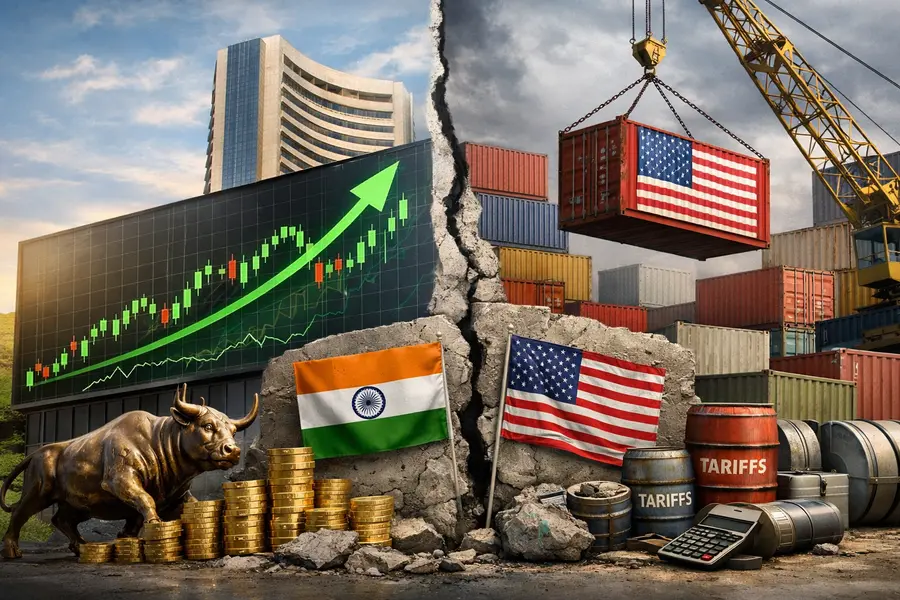
Indian equities advanced through early July as the Nifty 50 drew global investors, but a July 24 US tariff expiry threatens India's export-sector gains.
- The Nifty 50 extended a multi-session winning streak through July 3, with the BSE Sensex clearing 77,000 as US Federal Reserve rate fears eased.
- The US Section 122 tariff framework expires July 24; absent a signed deal, India risks reclassification to far steeper Section 301 duties on its US-bound goods.
- US Section 232 pharmaceutical tariffs take effect July 31 for named importers, threatening India's $10.515 billion US-bound pharma export sector.
Lead
Indian equity benchmarks opened the first trading week of July on a constructive footing, with the BSE Sensex jumping 160 points to 77,083 and the Nifty 50 gaining 56 points to 24,062 on July 2, extending a winning streak into July 3 as receding US Federal Reserve rate fears lifted broader risk appetite. The rally, however, is shadowed by a fresh escalation in US-India tariff tensions. A social-media post by US President Donald Trump signaling higher duties on Indian stocks' most exposed sectors rattled currency markets over the Independence Day holiday, driving the Indian rupee to 87.80 against the dollar. With a critical bilateral trade deadline less than three weeks away, India markets open higher but with investors watching Washington closely.What Happened
Indian stocks staged a sustained advance through the opening sessions of July, driven by receding Federal Reserve anxiety and a surge of institutional interest in the Nifty 50 as a comparative shelter. The index moved 1% or more on just one-third of trading days in the first half of 2026 — a rate below the MSCI Emerging Markets Index and barely above the S&P 500 — making it an increasingly attractive destination for investors seeking relative stability during the artificial-intelligence-driven volatility sweeping other Asian and US benchmarks.Sentiment turned sharply cautious heading into the weekend when President Trump renewed tariff threats against India via social media, signaling that Washington could escalate duties if talks fail to produce a signed agreement before the July 24 deadline. Oil and gas, pharma, construction, and consumer goods stocks bore the heaviest selling pressure in response, while information technology services — structurally insulated from goods tariffs — held up comparatively well.
Market Reaction
The Nifty 50 opened at 23,917 on July 1 and advanced to 24,062 on July 2, with the BSE Sensex posting its third consecutive session of gains through July 3. The Indian rupee told a more cautious story: it weakened to 87.80 against the dollar and briefly breached the 88.00 level on the tariff headline, before the Indian Ministry of External Affairs issued a statement defending the country's crude oil purchasing stance. The currency recovered partially but remains sensitive to further US trade signals.
Pharma stocks retreated across NSE benchmarks on Section 232 timeline concerns, even as India's generic drug exporters — formally carved out of the current US tariff measure — attempted to separate their exposure from patented-product peers. Sector rotation into IT services, domestic financials, and consumer staples reflected the market's effort to reduce exposure to export-side risk.Strategic Context
The current tariff uncertainty traces to an unresolved negotiating track that emerged from a February 2026 framework agreement, under which Washington cut its reciprocal tariff on Indian goods from 25% to 18%, subsequently reduced further to 10%, in exchange for India's commitment to curtail Russian crude purchases. Both governments described the framework as historic, but translating it into a binding, signed instrument has stalled repeatedly.
A two-day ministerial meeting in late June reviewed progress on market access, digital trade, and non-tariff barriers without closing the remaining gaps. The principal sticking points are US demands for reciprocity in automobiles and electronics — two sectors central to India's industrial ambitions under the Production Linked Incentive scheme — along with proposed US investigations into alleged excess capacity in solar modules and steel.
The July 24 Section 122 expiry is the structural hinge: the emergency tariff measures are time-limited under US trade law. Without a framework in place by that date, India risks reclassification under Section 301, which carries significantly broader coverage and higher duties across a wide range of goods, representing a structural escalation beyond anything seen in the current bilateral episode. US trade advisors have publicly described the end-of-July window as a "drop-dead date."
Geopolitical Dimension
Overlaying the bilateral negotiation is a second, sector-specific pressure point. President Trump signed an executive order in April imposing Section 232 national-security tariffs on imported pharmaceuticals under a tiered rate regime that takes effect July 31, 2026 for 17 named importing companies and September 29 for all remaining global pharmaceutical importers. The default rate on patented products is 100%, with a 20% alternative for companies committing to US-based manufacturing and a zero rate for those signing most-favoured-nation pricing and onshoring agreements.
Generic pharmaceuticals and biosimilars are explicitly excluded from the measure — a carve-out that provides material relief for India's generics-dominant export profile. India's pharmaceutical exports to the United States totalled $10.515 billion in 2024–25, making the US the country's largest single drug-export market. Patented-product exporters without a company-level agreement face the 100% ceiling from July 31; generic-sector firms are temporarily shielded but monitoring closely for any narrowing of the exclusion's scope.The global trade tensions driving these measures are not bilateral in isolation. The Trump administration has ordered parallel investigations into excess manufacturing capacity across China, the European Union, India, Japan, and Taiwan, with Section 232 levies on semiconductors and critical minerals also expected as early as July. India is navigating these pressures while simultaneously serving as a preferred alternative manufacturing destination in US supply-chain diversification strategy — a tension that gives New Delhi structural negotiating leverage but also exposes it to retaliatory risk if talks break down.
What Comes Next
Market participants are framing the July 24 tariff deadline as the dominant near-term binary. When India and the United States announced their February framework, the Nifty 50 surged 2.5% in a single session — establishing a market template for the upside in a deal scenario. Conversely, any breakdown triggering Section 301 reclassification would expose exporters in textiles, auto components, gems and jewellery, and agricultural products to sharply higher duties, weakening the rupee and widening India's current-account deficit in a manner that constrains the Reserve Bank of India's rate-easing path.
The pharmaceutical Section 232 timeline is independent of the bilateral deal track. Even if India and the US conclude a trade framework before July 24, patented-drug exporters must negotiate company-level production commitments to avoid the 100% ceiling by July 31 — a parallel deadline that sustains headline risk across the sector regardless of the diplomatic outcome.
Outlook
Indian stock markets maintain a constructive underlying trajectory, supported by domestic demand, moderating Fed concerns, and foreign institutional flows into the Nifty 50 as a lower-volatility anchor among major emerging-market indices. The July 24 Section 122 expiry and July 31 Section 232 pharmaceutical deadline now define the key event horizon. A signed framework on the former would likely consolidate early-July gains and extend the recovery across Indian stocks. Failure would reintroduce volatility across export-sensitive sectors, with the rupee and pharma indices serving as the market's live indicators of how the US-India trade negotiation is progressing.Mentioned tickers: ^NSEI, ^BSESN, SUNPHARMA.NS, DRREDDY.NS, INFY.NS, TCS.NS