Pomegra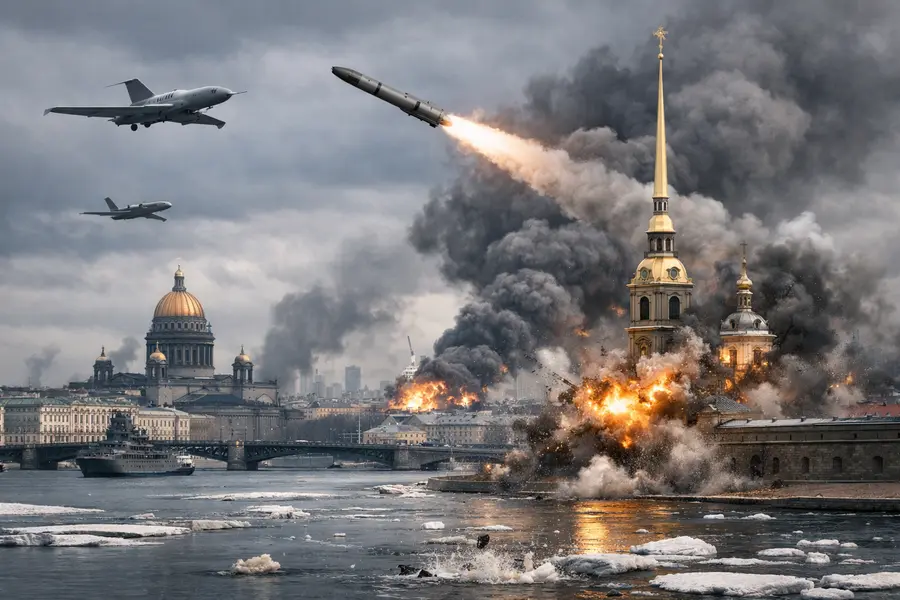
Ukrainian long-range drones hit oil infrastructure and Russia's Kronstadt naval base in a 500-UAV assault on Putin's home city, deepening the Eastern Europe security crisis.
- Ukraine deployed nearly 500 drones in its July 4 strike on St. Petersburg, targeting the Baltic port oil terminal and Kronstadt naval base.
- Russia's Leningrad region air defenses intercepted 72 UAVs; Pulkovo Airport briefly halted operations and mobile networks were throttled.
- Ukraine's General Staff claims 42.74% of Russia's oil refining capacity has been disabled since early June, with 60+ storage tanks destroyed or damaged.
Lead
Ukrainian forces launched one of the largest deep-strike drone operations of the Russia-Ukraine war overnight on July 4, 2026, sending close to 500 long-range unmanned aerial vehicles against St. Petersburg — Russia's second city and President Vladimir Putin's political home base. The assault struck the Baltic Sea port oil terminal and hit the Kronstadt naval base, which President Volodymyr Zelenskyy publicly confirmed as "an important military target," extending a relentless campaign to degrade Moscow's war-financing energy infrastructure.
What Happened
The overnight operation marked the second major Ukraine St. Petersburg strike in five weeks, following a June 3 attack timed — with deliberate symbolism — to coincide with the St. Petersburg International Economic Forum, when foreign business delegates witnessed smoke rising over the city's skyline. In that earlier raid, drones operated by Ukraine's 1st Separate Centre of Unmanned Systems Forces struck the corvette Boiky in the Veleshchynsky dry dock at Kronstadt — the first confirmed Ukrainian hit on a Baltic Fleet warship.
In the July 4 assault, Russia's Leningrad region Governor Alexander Drozdenko said air defense units shot down 72 UAVs over the region. Russian authorities briefly suspended flight operations at Pulkovo Airport and throttled municipal mobile internet networks in an effort to disrupt the cellular-backed navigation systems guiding the incoming drones. Despite those countermeasures, multiple projectiles reached designated targets.
The drones flew in excess of 1,000 kilometers — roughly 600 miles — to reach St. Petersburg, underscoring the operational reach Ukraine's drone warfare program has achieved since the war entered its fifth year.
Strategic Context
Zelenskyy framed the campaign in direct economic terms: strikes are directed at oil infrastructure funding Russia's military operations, not civilian populations. Ukraine's General Staff reported that attacks over the preceding month had disabled 42.74% of Russia's oil refining capacity, with eight refineries struck and more than 60 storage tanks either destroyed or significantly damaged. The cumulative effect has triggered fuel shortages in several Russian regions and compounded fiscal pressure on the Kremlin as global energy prices remain volatile.
The targeting of Kronstadt, which guards the seaward approach to St. Petersburg and houses a substantial portion of Russia's Baltic Fleet, represents a doctrinal evolution. Ukrainian planners appear to be integrating symbolic timing, naval denial, and energy disruption into a unified long-range strike posture rather than conducting isolated raids.
Geopolitical Dimension
The escalation lands against a backdrop of deteriorating Eastern Europe security. NATO fighter jets conducted more than 570 intercept missions along the alliance's eastern flank in 2025 — nearly triple the 2023 figure — as Russia increased airspace and maritime violations and staged large-scale Zapad-series exercises. The Kremlin has simultaneously expanded a hybrid warfare campaign across the continent, with GRU-linked operations targeting undersea cables, pipelines, defense production facilities, and logistics corridors supplying Ukraine.
Baltic states and other NATO frontline members have accelerated defense investment and force integration since 2022, but security analysts note persistent gaps in mobilization speed and sustainment infrastructure. Russia does not appear to be preparing a direct Article 5 confrontation, but the steady erosion of norms — Ukrainian drones over Russia's second city, Russian missiles deep into Ukrainian territory, naval assets struck in Baltic anchorages — has brought Eastern Europe tensions to their highest point since the full-scale invasion began in February 2022.For European energy markets, the ongoing degradation of Russian refining and export capacity through sustained drone warfare tightens supply and keeps a structural risk premium embedded in Brent and TTF natural gas prices. Shipping insurers have reassessed Baltic transit risk following confirmed attacks on naval infrastructure within St. Petersburg's maritime perimeter.
Geopolitical Dimension: Russia's Response
Moscow's defense ministry confirmed the scale of the drone wave but characterized the damage as limited, a claim that independent open-source analysts disputed based on satellite imagery and fire-tracking data. Russian officials did not announce retaliatory strikes in the immediate aftermath but have historically responded to deep-strike operations with large-scale missile and drone attacks on Kyiv and other Ukrainian cities — a pattern that last played out on June 2, 2026, the night before the first St. Petersburg oil terminal strike.
The Kremlin faces a strategic bind: escalating against Ukrainian cities risks accelerating Western weapons transfers, while absorbing strikes against prestige targets like St. Petersburg weakens domestic narratives about the war's conduct.
Outlook
The Ukraine St. Petersburg strike campaign has moved from audacious proof-of-concept to a repeatable operational tempo. With claimed refining disruptions now exceeding 40% and naval assets in Kronstadt no longer beyond the war's envelope, the strategic pressure on Moscow is compounding. How Russia calibrates its response — and whether Western governments adjust arms-supply thresholds in reaction to any counter-escalation — will define the Russia-Ukraine war's trajectory through the second half of 2026. The Eastern Europe security environment is unlikely to stabilize while long-range drone warfare operations continue to reach targets once considered geographically immune.
Mentioned tickers: OGZPY, LUKOY, BP, SHEL, TTE