Pomegra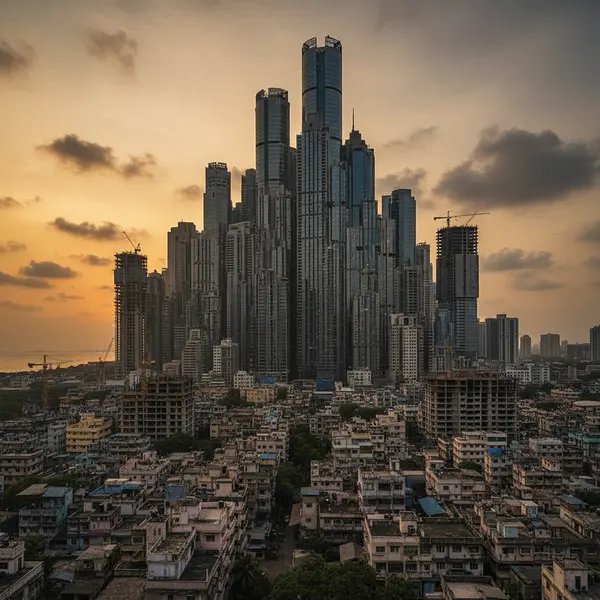
Mumbai real estate hit record launches in Q1 2026, yet a widening affordability gap is pushing India's financial capital beyond reach for most of its residents.
- Q1 2026: Mumbai logged 19,775 new residential unit launches — a 25% quarterly surge and 7% year-on-year gain across the Mumbai Metropolitan Region.
- Buying an average home now requires 15 years of household income in Mumbai, exceeding New York's 7.1 years and London's 8.5 years.
- Mumbai lost 60% of its affordable housing stock between 2022 and 2024 as developers pivoted heavily toward premium and luxury builds.
Lead
MUMBAI — India's most valuable urban real estate market set a new supply record in the first quarter of 2026, with developers launching 19,775 residential units across the Mumbai Metropolitan Region — a 25% sequential jump and a 7% annual gain. Glass towers are multiplying across Worli, Lower Parel, and Bandra, cementing Mumbai's status as the subcontinent's pre-eminent vertical city. Yet the same construction wave reshaping the skyline is widening an India housing affordability gap that now ranks among the world's most severe, pushing millions of residents deeper into an overburdened rental market with limited policy relief in sight.
What Happened
Mumbai real estate recorded an 8% rise in property registrations in early 2026 alongside a 14% annual increase in average home prices across the MMR. A cumulative 1,094 development agreements were signed between January 2020 and March 2026, unlocking nearly 432 acres — much of it from the conversion of aging low-rise buildings and former industrial plots into dense high-rise clusters. Redevelopment agreements alone grew 16% in 2025, a pace that has carried into 2026 as developers pursue densification under state government incentives.The vertical transformation is measurable: as of January 2026, Mumbai counted 278 completed or topped-out skyscrapers taller than 150 metres and 87 above 200 metres — no other Indian city comes close — with more than 4,000 high-rise buildings now defining its urban horizon. Among the most closely watched projects, Palais Royale in Worli, an 88-floor, 320-metre tower carrying 153 ultra-luxury apartments and what its developers bill as the world's largest penthouse at 125,000 square feet, is now targeted for completion in December 2026 after litigation-driven delays.
The Affordability Divide
Mumbai's housing affordability crisis has reached a scale that sets it apart from global peers. Purchasing an average home requires 15 years of household income, against 7.1 years in New York and 8.5 years in London. Monthly mortgage payments absorb more than 60% of average household income — well above the 50% threshold widely used to define affordability stress.
The entry-level supply pipeline has contracted sharply: the city lost 60% of its affordable housing inventory between 2022 and 2024 as developers concentrated capital on premium segments where margins are materially higher. Mid-market units now account for 48% of new supply; luxury and high-end residential makes up 27%; genuinely affordable homes represent just 25%, and that share is narrowing.
A policy mismatch deepens the structural problem. Central government norms classify homes priced up to ₹45 lakh as affordable. In Mumbai, no functional unit changes hands near that figure; participants place the realistic entry-level floor at ₹80–90 lakh. The annual tax deduction on home loan interest is capped at ₹2 lakh, while actual interest payments run ₹4–6 lakh per year — a gap that budget advocates have flagged as a structural distortion pushing more households permanently into renting.
New supply is concentrated geographically: Western Suburbs captured 25% of all launches, followed by Eastern Suburbs at 20%, Navi Mumbai at 17%, and Thane at 15%.
Infrastructure Reshaping Urban Development
Three completed mega-projects are redrawing Mumbai's urban development geography and concentrating residential demand in new corridors.
Metro Line 3, the 33.5-kilometre underground Aqua Line from Colaba to Aarey JVLR, is already compressing north-south travel time by 40–50%, lifting the residential appeal of Worli, Dadar, BKC, and Cuffe Parade. Proximity to a Metro station has become the most cited factor in purchase decisions across the MMR in 2026.The Mumbai Coastal Road — a 29.2-kilometre, eight-lane expressway constructed at a Phase 1 cost of ₹12,721 crore — connects Marine Drive to Kandivali along the western waterfront, cutting the South Mumbai-to-western-suburbs commute from two hours to roughly 40 minutes. Property values along the Worli-Prabhadevi corridor have responded with measurable premium appreciation.
Navi Mumbai International Airport launched commercial operations with its first scheduled flight on December 25, 2025, expanding the city's effective residential catchment and activating demand in Sewri, Parel, and Panvel — districts buyers had previously overlooked.Foreign capital continues to anchor confidence in the market: Mumbai commands 31% of total Indian real estate investment from overseas sources, the highest share of any Indian city.
Outlook
Mumbai's real estate market will remain a study in contrasts through the end of 2026. Supply-side momentum — driven by active redevelopment pipelines, infrastructure-led demand shifts, and sustained foreign capital inflows — points toward continued price appreciation and accelerating skyscraper completions in premium corridors. Against that backdrop, the structural affordability deficit is widening faster than policy is adjusting. Without a recalibration of subsidy thresholds and tax incentives to reflect Mumbai's market realities, the share of residents able to participate in homeownership will continue to contract, intensifying pressure on rental supply and deepening inequality across one of Asia's most consequential urban economies.
Mentioned tickers: NoneMarket Analysis