Pomegra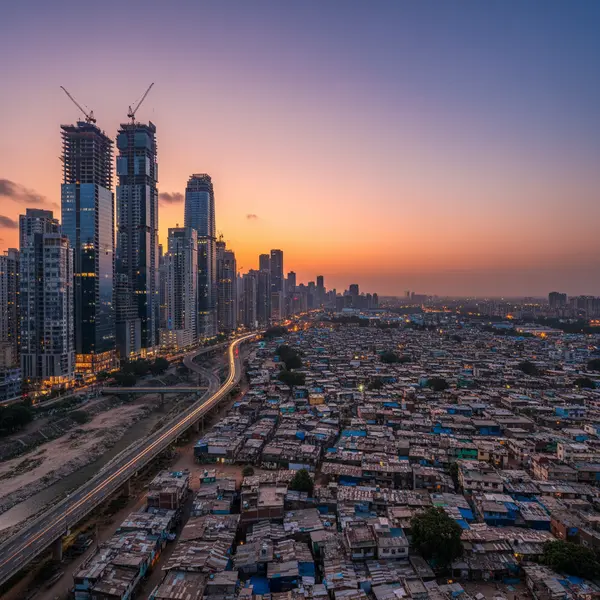
Mumbai leads the world in skyscraper construction in 2026, drawing over $1.2 billion in institutional capital, even as India's urban affordable housing deficit reaches 9.4 million units.
- Mumbai has 200+ skyscrapers under construction — more than Tokyo, Dubai, Shenzhen, and New York combined.
- Average residential asking prices reached ₹38,600 per sq ft in March 2026; prime south Mumbai commands ₹46,350.
- India's urban housing deficit is projected to nearly triple to 30 million units by 2030.
Lead
MUMBAI — India's financial capital is rising faster than any city on earth, with more than 200 skyscrapers currently under construction across a land-scarce island geography. The same vertical momentum that has drawn Barclays, BlackRock, KKR, Morgan Stanley, and UBS Group into gleaming towers along the Worli waterfront sits alongside a deepening contradiction: roughly one in four of Mumbai's 21 million residents still lives in informal settlements, and India's national urban affordable housing deficit has reached 9.4 million units — a figure analysts project will balloon to nearly 30 million by 2030.
What Is Driving the Boom
Mumbai now ranks as the world's fastest-growing high-rise city, surpassing Tokyo's 29 active skyscraper projects, Dubai's 38, Shenzhen's 73, and New York's 11 currently under way. The Mumbai Metropolitan Region is on track for a 34% increase in buildings taller than 40 floors by 2030, with 207 towers expected to be completed between 2024 and 2030, adding to an existing stock of 278 completed structures above 150 meters.
Office demand provided the initial catalyst. Prime Mumbai real estate rents climbed 23% last year, even as comparable Manhattan rents rose only 3%, according to CBRE Group data. Global financial institutions, expanding local operations to capture India's growth trajectory, have helped push the city into record institutional territory: Mumbai attracted more than $1.2 billion in institutional real estate inflows in 2025, reclaiming its position as India's strongest investment hub.
Residential construction has followed. Mumbai recorded 19,775 residential unit launches in the first quarter of 2026 — growth of 25% quarter-on-quarter and 7% year-on-year. The broader metropolitan region registered 1.4 lakh unit sales in fiscal year 2024-25, maintaining its position as India's largest housing market by volume.
Market Conditions
Despite the construction surge, supply remains historically tight. Unsold inventory has fallen to roughly 20 months of sales — well below prior-cycle averages — sustaining upward pressure across every price tier. The average residential asking price in Mumbai stood at ₹38,600 per square foot as of March 2026. Premium south Mumbai commanded ₹46,350 per sq ft, while the central and western suburbs averaged ₹33,000 and ₹34,900 respectively.
Home prices across India's major metro markets — Mumbai, Delhi NCR, Bengaluru, Chennai — are forecast to rise 5% to 7% annually over the next three years, consistently outpacing income growth. The widening gap between purchasing power and asking rates is pushing a growing share of residents into long-term rental dependency, further tightening an already constrained segment in a city that has almost no room to expand horizontally.
The Urban Development Squeeze
The geometry of Mumbai's urban development challenge is structural. Enclosed by water on three sides and anchored by some of the world's most expensive urban land, the city has historically absorbed population growth through densification of informal settlements. Today, flagship projects such as the Dharavi redevelopment — encompassing one of Asia's largest slums — represent a critical test of whether vertical density can resolve what horizontal sprawl could not.
Major developers have placed their bets accordingly. Hiranandani Group has committed ₹3,200 crore to redevelop five housing societies in Chembur and is in negotiations with seven additional societies across the city. The group's chairman, Niranjan Hiranandani, has described demand for Mumbai property as set to rise "exponentially beyond imagination," while acknowledging that as many as 5 million existing residents may require rehousing through the redevelopment process. The group has simultaneously built a dedicated rehabilitation vertical, including an active slum redevelopment project in Vikhroli.
A Rs 3-trillion redevelopment pipeline has drawn the full roster of India's largest builders. Lodha Group, Godrej Properties, Rustomjee, Prestige Estates, Wadhwa Group, and Runwal Realty are all active in the segment, spurred by revised development control regulations that have updated land pricing for older housing societies and created clearer frameworks for rehabilitation agreements.
Policy and Infrastructure Headwinds
Government ambition has expanded alongside private capital. Maharashtra announced plans in 2025 to support the construction of 30 lakh homes across the Mumbai Metropolitan Region through slum redevelopment and affordable housing initiatives. In 2026, however, the Slum Rehabilitation Authority scrapped 181 stalled joint-venture projects over implementation delays — a persistent signal that policy intent has consistently outrun execution capacity.
Infrastructure strain adds a second layer of pressure. High-rise density concentrates demand on water, sewage, and transport systems that were not designed for current loads, and cost allocation for municipal upgrades remains a contested variable in project negotiations. The mismatch between the luxury and premium stock being built and the genuinely affordable supply needed to close the widest part of the deficit is the central structural tension: developer economics systematically favor higher-margin segments where financial returns are clearer and regulatory friction, while still significant, is more predictable.
Outlook
Mumbai's skyline will continue to rise through the decade. The structural forces behind the construction cycle — institutional capital, expanding financial sector footprint, and the irreversible logic of vertical development on a land-constrained island — remain fully in place. Residential prices are expected to sustain their appreciation trajectory, supported by demand that routinely outpaces the constrained supply pipeline.
The more consequential question is distributional. Whether the current wave of India housing construction and urban development produces meaningful relief for the city's lower-income majority, or instead accelerates displacement to the periphery, will be determined by how effectively redevelopment frameworks bridge the gap between the economics of tower construction and the political imperative of inclusive growth. With the national urban shortfall on course to nearly triple by 2030, the resolution of that tension will shape Mumbai's social geography for a generation.
Mentioned tickers: CBRE, LODHA.NS, GODREJPROP.NS, PRESTIGE.NS