 Pomegra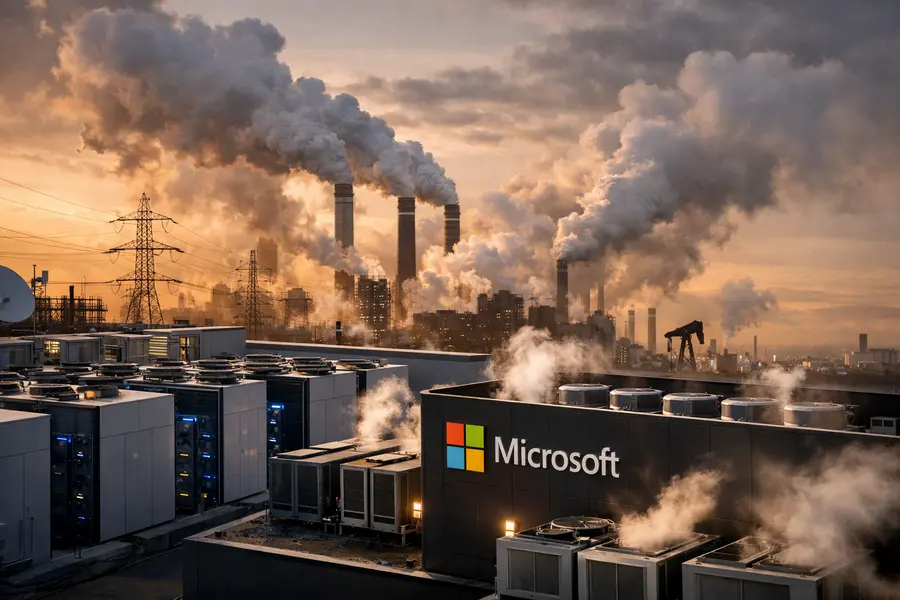
Microsoft's total greenhouse-gas output reached 20 million metric tons of CO₂ equivalent in 2025, a 25% rise driven by surging AI data center energy consumption that the company warns sustainability solutions cannot yet offset.
- Microsoft emitted 20 million metric tons of CO₂e in 2025, up from 16 million the prior year — the company's largest single-year emissions increase on record.
- Electricity-related emissions surged 945% year-over-year after Microsoft paused purchases of renewable energy credits while standing up approximately 2 gigawatts of new data center capacity.
- The carbon jump puts Microsoft's 2030 pledge to remove more carbon from the atmosphere than it emits under significant pressure with four years remaining.
Lead
Microsoft (MSFT) disclosed in its 2025 Environmental Sustainability Report that total greenhouse-gas emissions climbed to 20 million metric tons of carbon dioxide equivalent last year, a 25% increase from 16 million metric tons in 2024. The surge, published July 9, 2026, is tied directly to an unprecedented expansion of AI data center infrastructure across the company's global portfolio, and places its decade-old carbon-negative commitment on an increasingly difficult trajectory.What Happened
Microsoft's emissions footprint expanded sharply in 2025 as the company accelerated construction of facilities needed to power its growing AI data center energy consumption. Scope 2 emissions — those attributable to purchased electricity — climbed 945% year-over-year, reflecting both the scale of new capacity brought online and a previously announced pause in the acquisition of renewable energy credits that had historically offset grid power demand on a market-accounting basis. Underlying electricity consumption rose 24% across global operations.
The Boydton, Virginia campus emerged as the single largest power consumer in Microsoft's portfolio, drawing more than 3 million megawatt-hours annually. By the end of fiscal 2025, the company operated more than 400 data centers and had commissioned approximately 2 gigawatts of new capacity during the year alone.
Microsoft President Brad Smith and Chief Sustainability Officer Melanie Nakagawa stated in the report: "While AI infrastructure is driving demand for energy, water, land and materials, sustainability solutions are not scaling fast enough to meet demand."
Strategic Context
The disclosure arrives as Microsoft has committed more than $80 billion in capital expenditure for fiscal year 2026, with data center construction absorbing the largest share. The company leased $11.1 billion in data center capacity in the first quarter of fiscal 2026 alone, and total near-term infrastructure spending is projected to approach $190 billion. Management has guided for AI capacity to expand more than 80% in fiscal 2026, with the overall data center footprint expected to roughly double over two years.
Against that backdrop, MSFT sustainability targets set in 2020 are being stress-tested. Microsoft pledged six years ago to be carbon-negative — removing more carbon than it emits — by 2030. The latest 25% spike, layered atop prior-year increases, leaves a widening gap to close in four years.
The company holds contracts for up to 40 gigawatts of renewable energy, of which 19 gigawatts are operational. Forward commitments include a 1.2-gigawatt carbon-free energy agreement with We Energies in Wisconsin and a 20-year power purchase agreement with Constellation Energy for the 2027 restart of Three Mile Island Unit 1, adding 835 megawatts of nuclear-sourced generation. Microsoft also reported matching 100% of global electricity consumption with clean-energy procurement for the first time, and returning more water to watersheds than it withdrew globally — a first that management cited as evidence that some sustainability metrics are moving in the right direction.
AI and Technology Angle
Microsoft carbon emissions 2025 figures underscore a structural tension running across the AI industry: the computational demands of large language model training and inference workloads require energy infrastructure growing faster than the clean-power grid can supply. Each successive generation of AI accelerators runs hotter and consumes more power per rack, driving density and cooling requirements higher and compressing the timeline between capacity commitments and physical power delivery.The pattern is not unique to Microsoft. Tech industry carbon footprint disclosures across the hyperscaler group show a consistent upward trajectory. Google reported an 18% emissions increase in 2025, with electricity demand rising 37%, bringing its cumulative GHG output roughly 82% above 2019 levels. Amazon disclosed a 16% emissions increase to approximately 81 million metric tons — equivalent to the annual output of roughly 19 million gasoline-powered vehicles — with data center construction representing its fastest-growing emissions category, up more than 40% in a single year. Across the group, more than $300 billion in infrastructure capital expenditure is earmarked for fiscal 2026.
Regulatory and Policy Dimension
The scale of AI data center energy consumption is drawing increasing legislative scrutiny. U.S. utilities have outlined more than $1.4 trillion in planned capital investment to meet hyperscaler demand. Grid operators in Virginia, Texas, and the Pacific Northwest are managing unprecedented interconnection queues. Policy discussions in Washington and Brussels are focusing on whether large technology operators should bear a proportionate share of grid-upgrade costs and whether corporate carbon accounting rules adequately capture Scope 3 construction-phase emissions from new data center buildouts.
Market Reaction
Microsoft shares absorbed the sustainability disclosure without material movement. Investors remain focused on revenue and margin expansion tied to AI-related services, including the Azure cloud platform and the Copilot productivity suite. Emissions figures currently represent a reputational and regulatory risk rather than an immediate financial liability, though mandatory climate-disclosure rules advancing in the European Union and proposed frameworks in the United States could eventually translate environmental performance into balance-sheet consequences.
Outlook
Microsoft's 2025 AI data center expansion has placed measurable distance between the company's actual emissions trajectory and its 2030 carbon-negative commitment. Parallel tracks — large-scale renewable procurement, nuclear power agreements, and next-generation efficiency investments — are in motion, but management's own assessment confirms that sustainability solutions are not yet keeping pace with demand. With AI capacity guided to grow more than 80% in fiscal 2026, the emissions curve is unlikely to inflect downward in the near term. The critical variable is how quickly forward clean-power contracts convert to operational megawatts, and whether advanced reactor and long-duration storage technologies can reach commercial scale before the decade deadline arrives.
Mentioned tickers: MSFT, GOOGL, AMZN, CEG