 Pomegra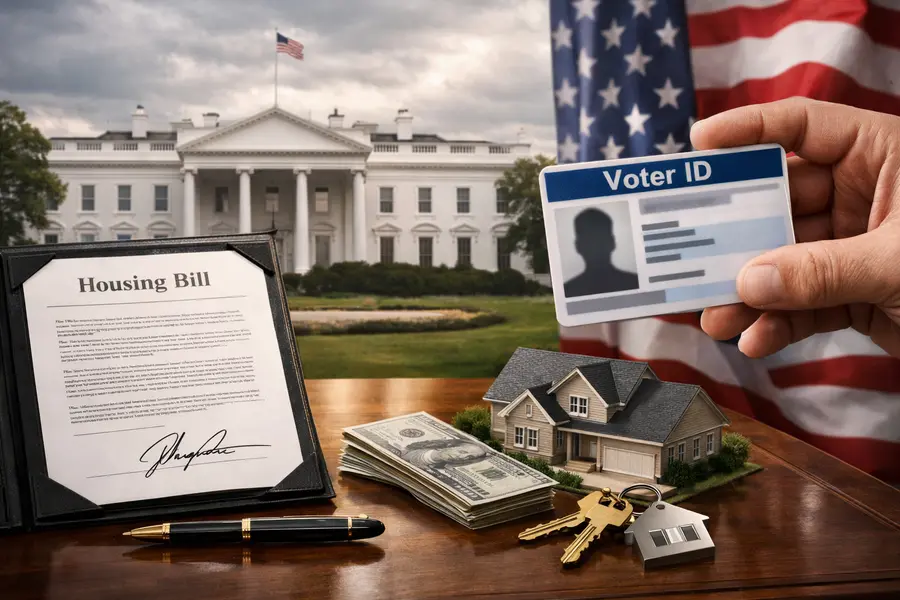
The 21st Century ROAD to Housing Act becomes law without Trump's signature after the Senate's failure to advance his voter ID priority stalls a rare bipartisan win.
- Trump refused to sign the housing bill, citing Senate failure to pass the SAVE America Act voter ID legislation.
- The 21st Century ROAD to Housing Act passed the Senate 85–5 and the House 358–32 before Trump's rebuke.
- The bill becomes law automatically at midnight without a presidential veto, despite Trump's public protest.
Lead
President Donald Trump announced on July 10, 2026, that he would not sign the 21st Century ROAD to Housing Act — the most sweeping bipartisan housing bill to pass Congress in decades — citing the Senate's inability to advance his signature voter ID legislation. The move, executed through a social media post rather than a veto, leaves the landmark measure to become law automatically at midnight under constitutional provisions that allow bills to take effect without presidential signature after ten days of inaction. The drama shadows what Republican leaders had staged as a historic legislative achievement ahead of November midterms.
What Happened
Trump surprised GOP allies on June 24, 2026, by canceling a planned bill-signing ceremony at the Capitol and announcing he would withhold his approval until Congress first delivered the SAVE America Act — the Safeguard American Voter Eligibility Act — which would require documentary proof of U.S. citizenship for federal voter registration and photo identification for in-person and mail-in ballots.
"I will not sign the Housing Bill, which has been fully approved by Congress and sent to the White House, in PROTEST over the fact that the United States Senate is not capable of passing THE SAVE AMERICA ACT," Trump wrote, in a post that set the tone for the standoff.
The president publicly dismissed the housing measure as "a yawn" and "so unimportant" relative to the elections legislation, a sharp rhetorical turn from the bipartisan framing that had propelled the housing package through both chambers with commanding margins.
The Housing Bill
The 21st Century ROAD to Housing Act passed the Senate 85–5 on June 22, 2026, followed by a 358–32 House vote the following day — margins that underscore the rare cross-party consensus behind the legislation. The bill contains 56 provisions spanning housing supply, manufactured housing, mortgage financing, rural housing, veteran housing, and community banking.
Among the headline measures: a competitive federal grant program to help state, local, and tribal governments streamline permitting and align housing development with transportation infrastructure; updated HUD guidelines enabling single-stairway residential buildings of up to six stories; and a 100,000-unit expansion of the Rental Assistance Demonstration program. A separate provision restricts institutional investors from purchasing single-family homes — one of the more contentious elements during negotiation, though an exemption for build-to-rent properties survived into the final text.
The Voter ID Dispute
At the center of Trump's protest is a GOP voter ID dispute that has exposed fractures within the Senate Republican conference. The SAVE America Act, sponsored in the Senate by Sen. Mike Lee of Utah, has cleared the House twice since 2024 — most recently in February 2026 — but lacks the votes to advance through the upper chamber. The Senate officially failed to pass the bill in June 2026.
Critics of the voter ID legislation, including voting-rights groups, note that more than 21 million Americans lack readily accessible documentary proof of citizenship — a burden that falls disproportionately on communities of color. Supporters counter that the measure closes a genuine vulnerability in federal election law.
Speaker Mike Johnson indicated he understood Trump's maneuver as a messaging exercise, framing it as a presidential signal that election integrity legislation ranks above US legislative wins on economic policy — even sweeping ones.
Strategic and Political Context
The decision carries clear political costs for Republican leaders who had intended to present the housing bill as a concrete economic deliverable heading into midterm election season. The legislation now advances without ceremony, deprived of a White House signing event that would have amplified its profile with voters worried about housing costs and mortgage rates.
The standoff also illustrates a recurring tension in Trump's second term: the president's willingness to subordinate even broadly popular legislation to leverage congressional action on his top political priorities. By declining to veto, Trump avoided killing a bill his own party helped write while still registering public dissatisfaction — a calculated use of constitutional mechanics to project pressure without direct obstruction.
Republican senators who back the housing package but oppose or are ambivalent about the SAVE America Act's proof-of-citizenship threshold now face intensified pressure as midterm campaigns accelerate.
Outlook
The 21st Century ROAD to Housing Act will take effect as scheduled, giving its 56 provisions the force of law regardless of the White House's silence. Whether the episode galvanizes fresh Senate negotiations over the SAVE America Act or simply becomes a footnote to a larger mid-cycle standoff remains the central US legislative question of the moment. Trump's tactic raises the political cost of ignoring his voter ID push — but with Senate arithmetic unchanged, a path to 60 votes on the elections measure remains elusive.