 Pomegra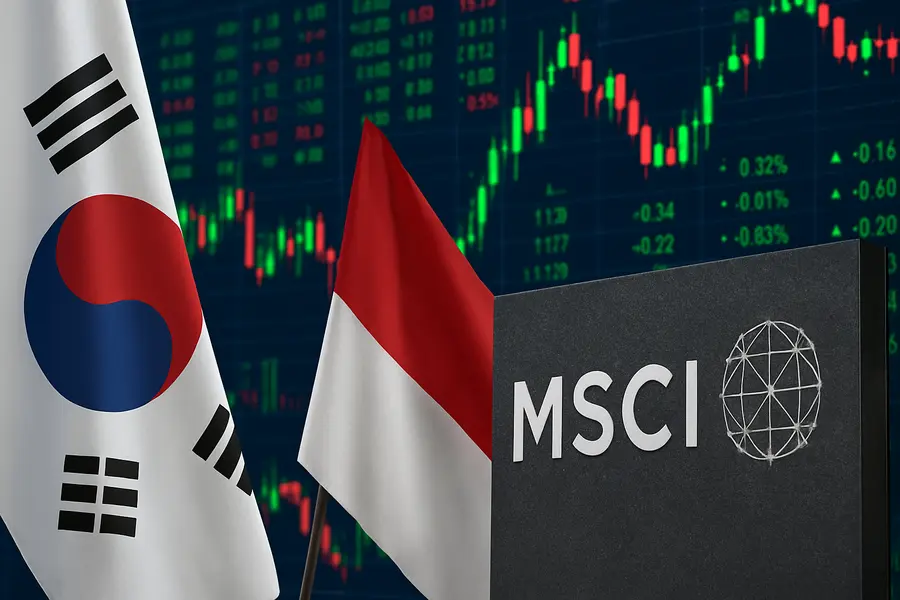
MSCI's 2026 classification review maintains South Korea's emerging-market status while extending Indonesia's downgrade risk assessment to a November deadline, splitting two of Asia's largest equity markets.
- South Korea stays in MSCI Emerging Markets as foreign exchange reform work continues; 24-hour won trading launches July 6, 2026.
- Indonesia avoids immediate downgrade but faces a hard November deadline; the IDX Composite has lost roughly 30% year-to-date and up to $13 billion in outflows are at stake.
- KOSPI crossed 9,000 for the first time on AI-chip demand before falling 5.7% on the review announcement, then rebounding more than 3% the following session.
Lead
MSCI confirmed on June 23–24, 2026, that South Korea retains its emerging-market classification for another year, while Indonesia received a reprieve from immediate downgrade but faces a fresh reassessment at the November 2026 index review. The dual announcement crystallized diverging trajectories for two of Asia's largest equity markets: Seoul racing to meet a 2027 developed-market target and Jakarta fighting to stay off the frontier-market list.What Happened
MSCI's annual market accessibility review evaluates dozens of operational criteria — foreign exchange liquidity, settlement mechanisms, investor identification systems, and information flow — against developed-market standards. South Korea cleared several of those bars in recent months but fell short on the most critical one: offshore convertibility of the Korean won.
MSCI stated that the won remains non-deliverable offshore and that extended trading hours have yet to demonstrate sufficient liquidity for execution standards comparable to developed markets. Investor registration and settlement constraints also persist. The index provider acknowledged Seoul's reform roadmap but said market participants need more time to "thoroughly evaluate the sustained effectiveness of the changes."
South Korea is not on a formal watchlist, meaning no upgrade consultation was opened. A watchlist addition — the step before any actual reclassification — remains a 2027 aspiration contingent on further reform delivery.
Indonesia fared more precariously. MSCI kept the country in the emerging-market index but maintained an existing freeze on adding new Indonesian securities to its indices. MSCI flagged a deterioration in one of 18 accessibility criteria this cycle — information flow — downgrading it from no major issues to improvements needed, citing opacity in shareholding structures and suspected coordinated trading that distorts price formation.Market Reaction
The KOSPI had already crossed 9,000 points for the first time on June 18, 2026, driven by a near-doubling year-to-date on AI-chip demand centered on Samsung Electronics and SK Hynix. On the day of the MSCI announcement, June 23, the index dropped 5.7% as traders priced out upgrade optionality, then recovered more than 3% on June 24 as the result had been broadly anticipated. The iShares MSCI South Korea ETF (EWY) fell to $197.45 on June 23 from a prior close of $219.02, reflecting similar intraday pressure before stabilizing.
Indonesia's market told a grimmer story before the announcement was made. The IDX Composite entered the review window down roughly 30% year-to-date — among the worst performances of any major index globally in 2026. The Indonesian rupiah has depreciated approximately 7% this year, adding import costs and household financial pressure. The iShares MSCI Indonesia ETF (EIDO) posted a net-asset-value total return of -33.42% year-to-date as of June 22. Foreign investors have withdrawn a net $3.65–3.89 billion from Indonesian equities so far in 2026.
Strategic Context
South Korea's Ministry of Finance and Economy has mapped 39 specific tasks required for MSCI Developed Market status. As of late June, 28 of those tasks were targeted for completion. The most consequential near-term step is the launch of 24-hour dollar-won spot trading on July 6, 2026, followed by an offshore won settlement system planned for September. Seoul's aim is to have the won included in globally recognized foreign exchange benchmarks used by institutional investors.
Officials described the MSCI decision as a temporary setback. The KOSPI's extraordinary 2026 performance — roughly 109% year-to-date, making it the best-performing major market globally — has provided political and fiscal breathing room to sustain the reform program.
Indonesia's situation is structurally more complex. President Prabowo Subianto's administration has expanded fiscal commitments, including a multibillion-dollar food program, pushing the budget deficit toward the statutory 3% of GDP ceiling. Credit rating agencies have already revised Indonesia's sovereign outlook to negative. The country's sovereign wealth fund, Danantara, has introduced governance uncertainty that MSCI's evaluation has absorbed.
In response to MSCI's transparency critique, Indonesian authorities introduced a package of market reforms: doubling the minimum free-float requirement from 7.5% to 15%, phased over one to three years; lowering shareholder disclosure thresholds from 5% to 1%; and creating a public list of stocks with high shareholder concentrations. Plans to convert the Indonesia Stock Exchange (IDX) from a member-controlled to a publicly owned structure are also under discussion. MSCI characterized the steps as "a step in the right direction" but underscored the need for consistent and sustained implementation.
What Comes Next
The mechanics of a potential frontier-market downgrade for Indonesia are straightforward and severe. Passive funds tracking the MSCI Emerging Markets index would be required to liquidate Indonesian positions; estimates from Goldman Sachs place forced outflows at up to $13 billion. Active managers would likely follow, amplifying the signal. A November 2026 confirmation of adequate reform progress would remove that overhang; a downgrade would crystallize it.
For South Korea, the July FX market expansion and September offshore settlement launch are the observable milestones MSCI will evaluate before any formal upgrade consultation can begin. Missing those timelines, or failing to generate sufficient liquidity evidence in practice, would push developed-market inclusion beyond 2027.
Outlook
South Korea enters the second half of 2026 with reform momentum and an AI-driven equity rally that gives policymakers unusual leverage — but the FX convertibility gap remains a hard structural threshold MSCI will not waive. Indonesia faces a defined five-month window to demonstrate market governance improvements sufficient to preserve its emerging-market designation and defend against what would be one of the largest single index-driven capital outflow events in its history. Both decisions now rest not with index methodology but with on-the-ground market evidence that neither government can fully control on its own timeline.
Mentioned tickers: EWY, EIDO