 Pomegra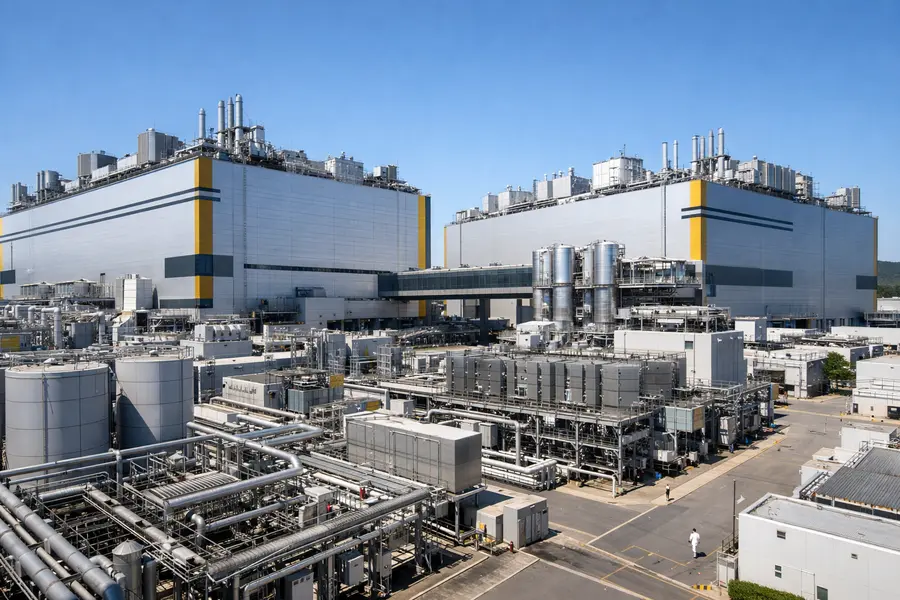
SK Hynix's board approved ₩54 trillion ($38.3 billion) for new DRAM and NAND fabs in Yongin and Cheongju, locking in South Korea as the world's dominant AI memory hub through the early 2030s.
- SK Hynix will spend ₩35.2 trillion on the Yongin Y2 DRAM fab and ₩19.1 trillion on the Cheongju M17 NAND fab, with first cleanrooms opening 2028–2029.
- The company holds roughly 70% of the HBM4 supply earmarked for Nvidia's next-generation Rubin GPU platform, cementing its AI memory lead.
- DRAM industry revenue is forecast to surge 51% in 2026 while NAND climbs 45%, marking the steepest memory supercycle in more than two decades.
Lead
SK Hynix announced on August 7, 2026, that its board of directors had approved ₩54 trillion — approximately $38.3 billion — in capital expenditure for two new semiconductor fabrication facilities in South Korea. The Yongin Y2 plant will manufacture DRAM, including high-bandwidth memory (HBM), while the Cheongju M17 plant will produce NAND flash, together representing the largest single capex commitment in the company's history and a decisive bet on structural, AI-driven memory demand through the decade.What Happened
The board allocated ₩35.2 trillion ($24.8 billion) to the Yongin Y2 fab, a 1.13 million-square-meter DRAM facility slated to break ground in July 2027, with its first cleanroom targeting production readiness in June 2029. The site is the second of four planned fabs within the broader Yongin Semiconductor Cluster, a master program for which SK Hynix has earmarked a total of 600 trillion won over the long term.
The remaining ₩19.1 trillion ($13.5 billion) goes toward Cheongju M17, a 680,000-square-meter NAND flash facility set to break ground in February 2027, with its first cleanroom scheduled for December 2028. Investment in M17 continues through April 2031, giving the fab a multi-phase construction runway aligned with projected demand curves.
Strategic Context
The twin approvals reflect SK Hynix's conviction that memory has crossed a threshold from commodity component to core AI infrastructure. Market research firm Omdia projects compound annual growth rates of 19% for both DRAM and NAND demand from 2025 through 2030, underpinned by the compute requirements of large language models, AI accelerators, and cloud data centers.
SK Hynix currently commands an estimated 70% share of the HBM4 market allocated to Nvidia's forthcoming Rubin GPU platform, giving it outsized exposure to the fastest-growing segment of the memory stack. HBM bandwidth directly constrains AI accelerator throughput, making SK Hynix a bottleneck supplier for the world's leading AI infrastructure builders.The capex commitment also fits within an intensifying Korea-anchored semiconductor investment wave. SK Hynix's existing Yongin Y1 fab is under active construction, and the company is simultaneously expanding its Cheongju production base under a separate 100-trillion-won expansion plan. The combination positions Korea to retain chipmaking concentration in advanced memory even as geopolitical pressure pushes other semiconductor categories toward diversified supply chains.
Memory Supercycle
Bank of America has characterized 2026 as a memory supercycle comparable in magnitude to the AI-led semiconductor boom of the late 1990s. Industry-wide DRAM revenue is projected to grow 51% year-over-year and NAND revenue 45%, driven almost entirely by AI infrastructure build-out rather than the consumer-device cycles that historically governed memory markets.
SK Hynix's annual capex run rate — over 90% of which is directed at HBM production lines, advanced packaging, and new Korean fab construction — has risen to the 48–50 trillion won range. The newly approved $38.3 billion commitment layers an additional tranche of long-dated capital spending on top of that baseline, signaling confidence that demand will not only persist but accelerate through the new facilities' expected production windows in the late 2020s and early 2030s.
Geopolitical Dimension
The dual-fab approval carries strategic weight beyond corporate finance. With the United States currently operating zero HBM wafer fabrication facilities, South Korea — through SK Hynix and Samsung — holds a near-monopoly on the memory technology most critical to AI model training and inference. The Yongin and Cheongju expansions deepen that geographic concentration at a moment when Washington and its allies are actively debating how to diversify advanced semiconductor supply chains. Near-term export control dynamics could affect both the sale of HBM to certain markets and the procurement of equipment needed to build out the new fabs.
Outlook
SK Hynix's $38.3 billion commitment anchors the company's production roadmap through the early 2030s and reinforces Korea's structural role as the primary supplier of AI memory. With first cleanrooms at Cheongju M17 and Yongin Y2 opening in late 2028 and mid-2029, respectively, the company is building capacity to meet a demand wave that analysts project will sustain double-digit annual growth for at least five years. The scale of the capex program also raises the barriers to entry for would-be competitors seeking to challenge SK Hynix's dominance in HBM and advanced NAND at the height of the AI infrastructure buildout.
Mentioned tickers: SKHY, 000660.KS, NVDA, SSNLF