Pomegra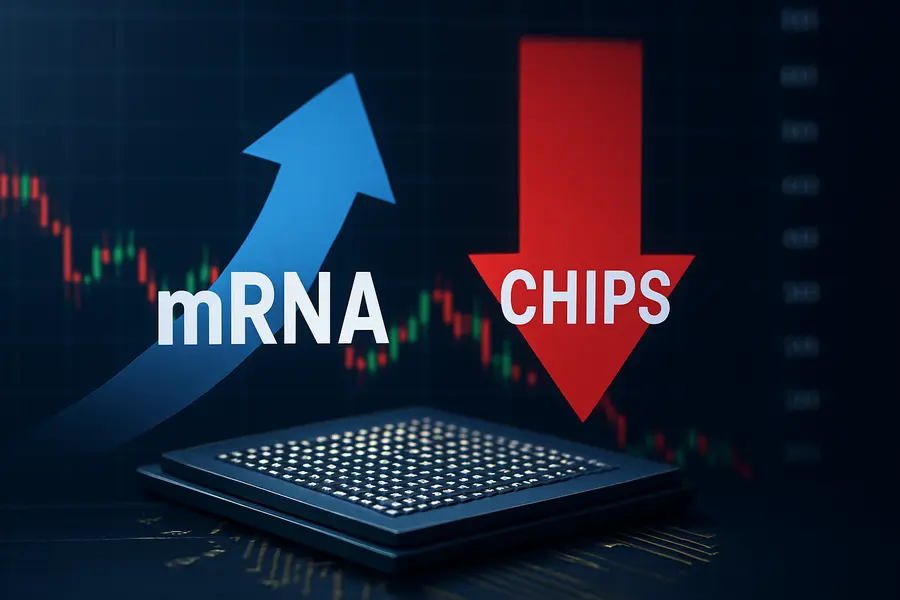
Moderna shares surged 48% in June as an FDA flu vaccine endorsement and sector rotation away from semiconductors lifted healthcare and biotech stocks broadly.
- MRNA stock climbed from roughly $46 to $68.04 between June 1 and June 26, 2026, a ~48% gain driven by FDA backing and pipeline momentum.
- Semiconductor stocks shed over $1.3 trillion in market value in a single June session, accelerating defensive rotation into healthcare.
- The SPDR S&P Biotech ETF (XBI) gained 2.45% and the Vanguard Health Care ETF (VHT) rose 2.82% on days tech fell as much as 3.66%.
Lead
Moderna, Inc. (Nasdaq: MRNA) emerged as one of the standout performers of June 2026, with its MRNA stock price advancing approximately 48% over the month — from around $46 on June 1 to $68.04 on June 26 — as a landmark FDA advisory committee vote on its influenza vaccine collided with a sweeping rotation out of semiconductor and AI-infrastructure names. The broader healthcare vs. tech stocks dynamic crystallized mid-month when chip stocks suffered their worst single-session rout since April 2025, erasing more than $1.3 trillion in combined market value and redirecting capital into defensive and late-cycle sectors, with healthcare leading the inflows.What Happened
On June 18, the U.S. Food and Drug Administration's Vaccines and Related Biological Products Advisory Committee voted 9–0 to endorse Moderna's mFLUSIVA (mRNA-1010) seasonal influenza vaccine for adults aged 50–64, and supported accelerated approval for the 65-and-older cohort by the same unanimous margin. MRNA shares gained roughly 4%, reaching $64.28 that afternoon. The PDUFA action date is set for August 5, 2026, giving Moderna a clear near-term regulatory catalyst.
The vaccine committee vote was only one strand of the Moderna stock rally. In the weeks prior, the Cambridge, Massachusetts-based biotechnology company outlined a sweeping pipeline reset, consolidating its commercial ambitions around three franchises — respiratory, latent viral, and rare disease — with a cluster of product launches targeted for 2027 and 2028. Separately, Moderna disclosed plans to deepen European manufacturing capacity through investments in German production sites and a potential acquisition of a BioNTech plant, sending shares up more than 8% on those disclosures alone.
By June 26, with additional pipeline data circulating ahead of an investor science day, MRNA was trading up more than 12% for the session, closing near $68.
Market Reaction and the Chip Selloff
The Moderna stock rally did not occur in isolation. On June 4–5, semiconductor and artificial-intelligence infrastructure stocks suffered a severe reversal after Broadcom issued a cautious near-term AI chip revenue outlook, calling into question assumptions about the pace of hyperscaler spending. Nvidia shed roughly $740 billion in market capitalization. Broadcom fell more than 14%. Intel dropped 11.28% to $99.17, AMD declined 10.86% to $466.38, and Micron Technology slid approximately 7% to $1,004. The Nasdaq Composite posted its worst single-day loss since April 2025, falling 4%.
The speed and scale of the chip-stock correction accelerated portfolio rebalancing into sectors less exposed to AI capital-expenditure cycles. Healthcare vs. tech stocks became the defining trade. Healthcare and real estate ranked as the second- and third-best S&P 500 sector performers on the day of peak tech weakness, rising 1.37% and 1.35%, respectively. Technology sat at the bottom of the sector scorecard, down 3.66%.
Strategic Context
The biotech market news backdrop for Moderna's rally is more nuanced than a single regulatory event. The company has spent more than two years navigating a post-COVID revenue trough as its mRNA-1273 COVID vaccine franchise normalized from pandemic-era peaks. The restructuring announced in late 2025 and early 2026 — targeting a smaller, more focused pipeline and a cleaner path to profitability — had stabilized investor sentiment before the FDA flu vote amplified it.
The mFLUSIVA vaccine is strategically significant because it would give Moderna its first commercially available non-COVID mRNA product, validating the platform's broader applicability. The 50–64 and 65+ age-group indications also target the highest-volume, highest-margin segment of the seasonal influenza market, where GSK, Sanofi, and Pfizer currently dominate.
The European manufacturing push adds a supply-chain dimension. Intra-EU production capacity reduces exposure to U.S. tariff and trade policy uncertainty, an increasingly relevant consideration for pharmaceutical companies with globally distributed commercial operations.
What Comes Next
The August 5 PDUFA date for mFLUSIVA is the next hard catalyst for MRNA stock. A full approval for the 50–64 cohort and accelerated approval for 65+ would open the commercial influenza market ahead of the 2026–27 Northern Hemisphere flu season, though peak revenue contribution from the franchise is broadly expected in fiscal 2027. Several pipeline readouts from Moderna's latent-virus and rare-disease programs are also anticipated in the second half of 2026, sustaining event-driven interest in the stock.
On the macro side, the sector rotation dynamic will depend partly on whether semiconductor stocks stabilize. A soft recovery was already visible by June 8, when the Nasdaq reclaimed nearly 0.9% as AI chip names rebounded. If AI infrastructure investment resumes at the pace markets initially priced in, some of the capital that flowed into healthcare may reverse. Conversely, if AI earnings visibility remains murky into the third quarter, healthcare vs. tech stocks positioning could extend.
Outlook
Moderna's roughly 48% MRNA stock advance through June 2026 reflects a convergence of company-specific catalysts — a unanimous FDA advisory vote, a credible pipeline restructuring, and expanded manufacturing ambitions — and a broader market rotation that punished semiconductor exposure and rewarded defensive healthcare positioning. The August FDA decision and second-half pipeline disclosures are the near-term signposts. Sector-wide, biotech market news continues to benefit from demographic tailwinds, mRNA platform maturation, and portfolio-level demand for names with limited AI-capex correlation.
Mentioned tickers: MRNA, XBI, IBB, VHT, NVDA, AVGO, AMD, INTC, MU, UNH, JNJ, PFE, GSK