Pomegra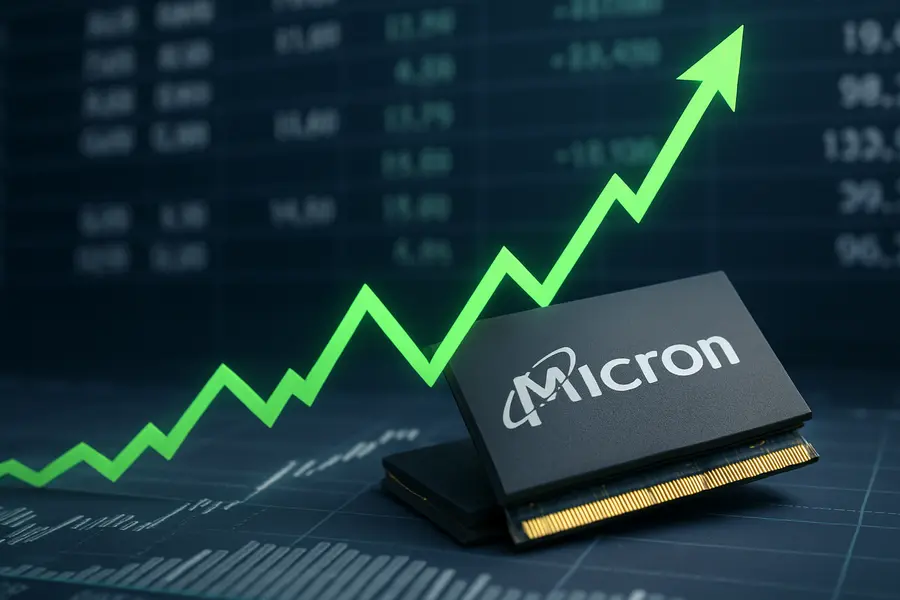
Micron Technology shares recover from a brief June pullback as high-bandwidth memory sold out through 2026 reinforces the AI-driven memory chip market trade.
- Micron shares pulled back from a record $1,035.68 on June 1 before rebounding, still up more than 300% year-to-date in 2026.
- High-bandwidth memory is sold out through 2026, with AI data centers projected to absorb 70% of global memory chip supply this year.
- Fiscal Q3 earnings on June 24 loom as a pivotal test, with Wall Street expecting $34.8 billion in revenue and $19.82 in adjusted EPS.
Lead
Micron Technology (MU) shares bounced back toward the $970 range on June 8, 2026, after sliding from a record intraday high of $1,035.68 reached on June 1 — a pullback that briefly stoked doubts before buyers returned in force. The recovery underscores that the so-called memory trade, one of the defining investment themes of the current AI infrastructure buildout, remains structurally intact: high-bandwidth memory is sold out through year-end, a global supply squeeze shows no sign of easing, and a make-or-break earnings report on June 24 is rapidly approaching.What Happened
After Micron's stock crossed the $1 trillion market-capitalization threshold for the first time in late May and printed a fresh record above $1,000 on June 1, the shares gave back ground, trading between $850.17 and $969.82 on June 7. The pullback followed a near-parabolic run — the stock surged roughly 38% in a single week in early May — and came as broader semiconductor stocks digested the scale of recent gains. The rebound that followed was swift, with buyers interpreting the dip as a consolidation rather than a reversal, a view reinforced by the company's unchanged supply-demand fundamentals.
The Memory Trade Thesis
The investment case rests on a structural imbalance between supply and demand for memory chips, particularly high-bandwidth memory required by the AI accelerators powering large-language model training and inference. AI data centers are on course to absorb an estimated 70% of global memory chip supply this year, and key customers are reportedly receiving only 50% to two-thirds of their order requirements due to the shortage. Micron's HBM capacity is sold out through the end of 2026, with order books extending into 2027.
The company's most recent quarterly results illustrated the financial impact: revenue of approximately $23.9 billion and net income of $13.8 billion produced a profit margin north of 38%, with EBIT margins above 45% — elite-level profitability for any chip name at scale. Wall Street is now pricing in continued acceleration. Consensus estimates for the June 24 fiscal third-quarter report stand at $34.8 billion in revenue and $19.82 in adjusted earnings per share.
Wider Semiconductor Stocks and the Memory Complex
The Micron stock rally has lifted the entire memory sector. South Korea's SK Hynix, Micron's principal rival in high-bandwidth memory, crossed the trillion-dollar market capitalization mark alongside Micron in recent weeks, as institutional investors repositioned toward a trade that was largely overlooked two years ago. SanDisk has also seen renewed interest, with multiple analysts citing a potential memory chip supercycle that could extend well past 2027 as chipmakers negotiate long-term supply agreements with hyperscalers.
The broader semiconductor stocks complex — including Nvidia, whose Blackwell and forthcoming Rubin AI accelerators are the primary demand engine for HBM — has tracked the Micron move closely. The thesis connecting AI compute to memory consumption has become the central narrative in the sector: more AI training runs require more HBM; more HBM requires more Micron.
Analyst Targets and Strategic Context
Wall Street's price target revisions have been unusually aggressive. UBS tripled its target to $1,625, citing long-term supply agreements with partially fixed pricing and projecting DRAM market tightness persisting through the second quarter of 2028 and NAND tightness through the fourth quarter of 2027. Morgan Stanley doubled its target to $1,050, pointing to a global memory chip market shortage it expects to last another two to three years. Raymond James and Barclays have both more than doubled their targets, identifying memory and storage as among the best-positioned corners of the semiconductor landscape through at least 2027.
The broader conversation has shifted from whether a supercycle exists to how long it can last. Gross margins above 75% are being projected by both Micron and Broadcom for 2026, a threshold that historically signals pricing power sufficient to sustain multi-year earnings expansion cycles.
What Comes Next
The June 24 earnings report functions as the near-term test of the entire memory trade thesis. A revenue beat above $34.8 billion or an upward revision to full-year guidance would likely reignite momentum in MU shares and ripple through related semiconductor names. Conversely, any indication that HBM demand is softening — even slightly — would expose the magnitude of the premium investors have already baked in.
Beyond the single report, the structural case depends on the pace of AI infrastructure investment. As long as hyperscalers continue expanding data-center capacity at current rates and NVIDIA's accelerator roadmap advances on schedule, the supply-demand equation for high-bandwidth memory is unlikely to rebalance before the end of the decade.
Outlook
The Micron stock rally, while volatile at the margins, reflects a durable shift in the memory chip market from commodity cyclicality toward something closer to structural scarcity. With HBM sold out, margins at multi-decade highs, and the AI infrastructure buildout still in early innings, the June 7 pullback looks, in hindsight, like an entry point rather than an exit signal. The June 24 earnings report will set the tone for the second half of the year.
Mentioned tickers: MU, NVDA, AVGOMarkets