Pomegra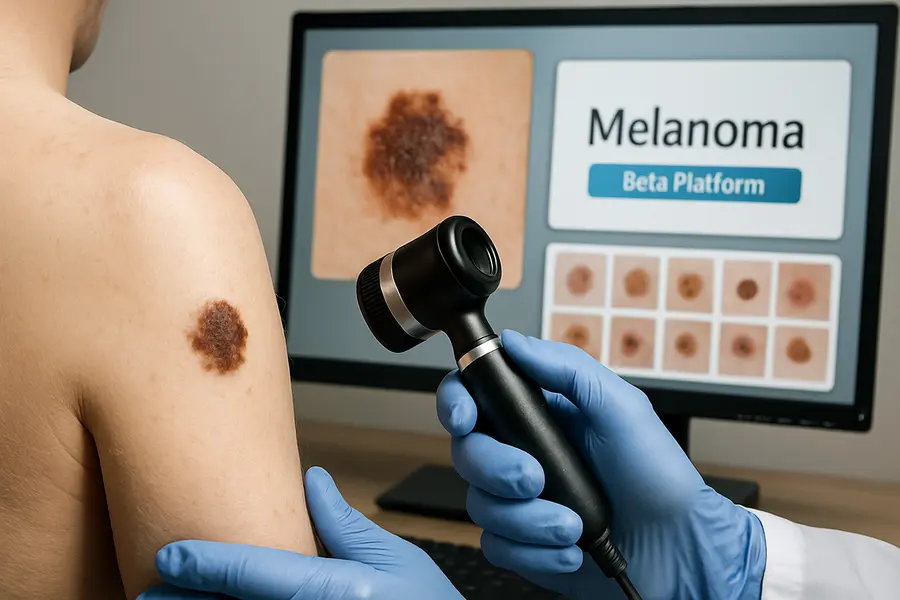
Medical Care Technologies launches its MDCE Melanoma Scan beta, combining Google-backed AI and 70,000 expert-verified dermoscopic images to target a $2.9 billion market by 2030.
- MDCE opened beta access to its AI melanoma scan on May 22, 2026, using deep learning to analyze asymmetry, border irregularities, color variegation, and diameter change.
- The platform integrates Google's Derm Foundation model and the ISIC Archive's 70,000+ verified images, targeting early detection when five-year survival rates exceed 95%.
- Medical Care Technologies posted 63% revenue growth in 2025 as the global AI dermatology imaging market accelerates toward a projected $2.9 billion by 2030.
Lead
Medical Care Technologies Inc. (OTC Pink: MDCE) launched the beta preview of its MDCE Melanoma Scan platform on May 22, 2026, positioning the Mesa, Arizona-based company at the intersection of consumer health tech and clinical-grade AI skin cancer detection. The launch follows a months-long integration of Google's Derm Foundation model and a 70,000-image dermoscopic database secured from the International Skin Imaging Collaboration, marking the most significant product milestone in the company's history.What Happened
The MDCE Melanoma Scan platform uses deep learning algorithms trained across millions of dermoscopic and clinical images to evaluate four established risk indicators: lesion asymmetry, border irregularities, color variegation — including pigment shifts invisible to the naked eye — and diameter change tracked against a patient's personal baseline. Full-body 3D mapping indexes lesions longitudinally, enabling temporal comparison across repeated imaging sessions.
Chief Executive Marshall Perkins III, who survived advanced bone cancer in early 2025, has anchored the company's mission around early detection. "Our AI technology brings an AI-powered diagnostic tool into the home, empowering patients and clinicians with earlier, more precise insights that can save lives," Perkins said at the time of the platform's specification release on May 28, 2026.
The company stressed that the platform is a pre-screening tool, not a diagnostic device, and has not yet been reviewed or cleared by the U.S. Food and Drug Administration. A medical-grade beta application and structured clinical testing are targeted for later in 2026.
Technology and Data Infrastructure
Two foundational partnerships underpin the platform's AI skin cancer detection capability.
In October 2025, MDCE secured access to the ISIC Archive — a repository of over 70,000 expert-verified dermoscopic images spanning diverse skin tones, cancer subtypes, and benign conditions. That dataset feeds the machine learning pipeline directly. In December 2025, the company integrated Derm Foundation, a Google-backed pretrained dermatology imaging model that adds melanoma risk classification, chronic wound tracking, and automated image quality checks via HTTPS API endpoints, enabling scalable mobile deployment.
The resulting platform organizes images through an interactive body-map interface, allowing clinicians and patients to catalog, compare, and monitor skin changes over successive imaging sessions.
Market Context
Melanoma accounts for roughly 1% of all skin cancers yet drives the majority of skin cancer deaths globally, with approximately 1.5 million new diagnoses recorded annually worldwide. When identified at the earliest stage, survival rates exceed 95%; late-stage detection reverses that calculus sharply.
The commercial backdrop reflects the urgency. The AI dermatology imaging market was valued at $256 million in 2025 and is projected to compound at 21% annually through 2030, reaching $2.9 billion. The broader global skin cancer diagnostics market stands at approximately $9.4 billion in 2026.
The FDA established a regulatory precedent for AI-enabled skin imaging in January 2024, when it authorized DermaSensor's spectroscopy-based device — the first such clearance in primary care — after a 1,000-patient study showed a roughly 50% reduction in missed diagnoses. MDCE's path toward eventual FDA review follows the same structured framework but remains at an earlier stage of development.
Financial Position
MDCE reported full-year 2025 revenue of $1.07 million, a 63% increase from $656,402 in 2024, with gross profit rising 79% to $576,121 and net income reaching $230,768. The company carries $75,080 in cash against $68,308 in total debt. Its market capitalization stands at approximately $1 million, reflecting its early-stage OTC status.
Beyond dermatology, MDCE is developing an AI wound-monitoring system, an AI nutrition app called Snapshot Recipes, and a broader AI lifestyle application, with commercial launches targeted for late 2026 and early 2027.
Outlook
MDCE's beta launch of its MDCE melanoma detection platform marks a concrete step from research-stage AI infrastructure toward a deployable consumer product. The integration of Google's Derm Foundation model and the ISIC Archive positions the company with credible training data and computational architecture. The next critical phase — structured clinical beta testing and progress toward FDA review — will determine whether the platform can translate its technical foundation into regulatory standing and commercial adoption within the rapidly expanding AI skin cancer health tech sector.Technology